
Building a project around a single-board computer is easier when the board, power supply, storage, cooling, and case arrive together. These budget single-board computer kits cover affordable Raspberry Pi alternatives, capable Pi 5 bundles, and specialized development boards for beginners and experienced makers.
We selected options for different workloads and budgets, from basic Linux experimentation and retro projects to AI vision, Python learning, IoT, and robotics. The right kit depends as much on included accessories and software support as it does on processor speed or RAM.
Best 10 Budget Single-Board Computer Kits Picks for 2026
Best Ready-to-Use Pick
Raspberry Pi 5 4GB Starter Kit

- Includes board, active cooler, ABS case, and screwdriver
- 4GB RAM with quad-core Arm Cortex-A76 processor
- Suitable for IoT, robotics, retro gaming, and media servers
Best For: Beginners and hobbyists wanting a current Raspberry Pi 5 foundation
Best Essentials Bundle
Raspberry Pi 4B 2GB Budget Kit

- Includes Pi 4B, case, USB-C power supply, heatsinks, and guide
- Lets experienced users choose their own storage and OS
- Provides four USB ports and HDMI connectivity
Best For: Makers who already own a microSD card and HDMI cable
Best Hybrid AI Platform

- Pairs a Qualcomm quad-core MPU with an STM32 microcontroller
- Runs Debian Linux with 16GB built-in eMMC storage
- Supports AI, robotics, IoT, Arduino shields, and Qwiic hardware
Best For: Developers building lightweight AI and hybrid Arduino-Linux prototypes
Best Complete High-Memory Kit
Raspberry Pi 5 8GB Starter Kit Pro
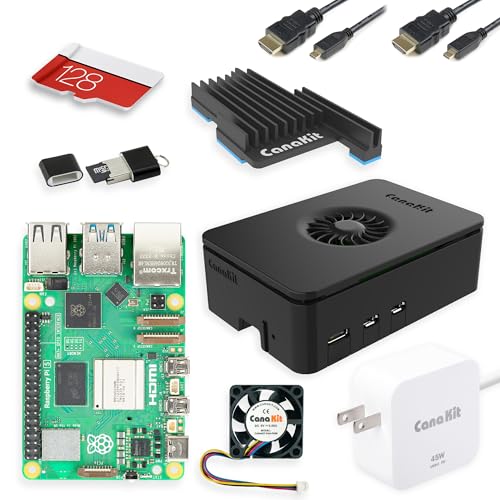
- Includes 8GB Pi 5, 128GB preloaded microSD card, and reader
- Adds case, fan, heatsink, 45W power supply, and display cables
- Supports up to 4K 60p displays
Best For: Users wanting a ready-to-run Pi 5 system with maximum included memory and storage
Compact Linux Pick

- Quad-core H618 board with 1GB LPDDR4
- Wi-Fi 5, Bluetooth 5.0, and Gigabit Ethernet
- Runs Debian, Ubuntu, and Android 12 TV
Best For: Compact Linux, media, server, and GPIO projects
Performance Kit Pick
RasTech Raspberry Pi 5 8GB Kit

- 8GB Raspberry Pi 5 with active cooler and case
- Quad-core 2.4GHz Cortex-A76 processor
- Dual 4Kp60 display and PCIe support
Best For: Desktop computing, automation, robotics, and Home Assistant
Beginner STEM Pick

- Pre-installed Debian and Python environment
- 2.8-inch touchscreen with built-in sensors
- 16GB flash, Wi-Fi, Bluetooth, and expansion interfaces
Best For: STEM education, beginner coding, and interactive IoT projects
Low-Power Alternative
Libre Computer Le Potato Starter Kit

- 2GB RAM with a 1.5GHz quad-core CPU
- 4K hardware video decoding support
- Raspberry Pi-compatible 40-pin header
Best For: Linux makers wanting efficient performance and expansion
High-Performance Pick
Vilros Raspberry Pi 5 8GB Starter Kit

- Official Pi 5 with 8GB RAM
- 128GB microSD card preloaded with Raspberry Pi OS
- Includes cooling, case, power supply, and cables
Best For: Users wanting a ready-to-run Pi 5 for demanding projects
Best Ready-to-Use Pick – Raspberry Pi 5 4GB Starter Kit
For shoppers comparing budget single-board computer kits, this Raspberry Pi 5 bundle is a convenient starting point. It includes the 4GB board, active cooler, ABS case, and screwdriver, so beginners can get started without sourcing basic hardware separately.
Best For: Beginners, students, and hobbyists building IoT projects, robotics systems, retro gaming devices, or home media servers.
Pros:
- Includes the Raspberry Pi 5 board, cooler, protective case, and screwdriver.
- 4GB RAM, quad-core Arm Cortex-A76 processing, Wi-Fi 5, Bluetooth 5.0, Ethernet, HDMI, and USB connectivity.
- Active cooling helps reduce heat and performance throttling during sustained workloads.
Cons:
- The included case cannot accommodate an M.2 HAT add-on board and solid-state drive.
- No storage card is listed, so you may need to provide storage and install an operating system.
This is a well-rounded Pi 5 kit for buyers who want modern performance and the essential physical accessories in one package. Its 4GB memory and active cooling make it particularly practical for demanding DIY projects.
Best Essentials Bundle – Raspberry Pi 4B 2GB Budget Kit
This PiShop package keeps the focus on core hardware, making it one of the more practical budget single-board computer kits for experienced makers. It includes a Raspberry Pi 4 Model B with 2GB RAM, case, USB-C power supply, heatsinks, and a quick-start guide, while leaving storage and software choices to you.
Best For: Experienced hobbyists and DIYers who already have a microSD card, HDMI cable, and preferred operating system.
Pros:
- Includes the Raspberry Pi 4B board, protective case, power supply, three aluminum heatsinks, and guide.
- No preloaded SD card means you can install Raspberry Pi OS, Ubuntu Server, LibreELEC, Home Assistant, RetroPie, or another supported setup.
- Four USB ports and HDMI connectivity support a range of maker and computing projects.
Cons:
- Only 2GB of RAM is included.
- A microSD card and HDMI cable are not included.
- Its stripped-back accessory selection is less convenient for first-time buyers.
The main appeal is flexibility and avoiding accessories you may already own. It is a sensible value choice for makers who want a Pi 4 foundation and prefer to configure the software and storage themselves.
Best Hybrid AI Platform – Arduino UNO Q 2GB
The Arduino UNO Q takes a different approach to budget single-board computer kits by combining a Linux-capable Qualcomm processor with a real-time STM32 microcontroller. With 2GB RAM, 16GB built-in eMMC storage, Wi-Fi 5, and Bluetooth 5.1, it targets compact AI, robotics, and IoT prototypes rather than a traditional starter bundle.
Best For: Developers prototyping AI vision, voice, robotics, IoT, and TinyML applications while combining Arduino sketches with Python and Debian Linux.
Pros:
- Combines a quad-core Qualcomm processor with a low-power STM32U585 microcontroller.
- Runs Linux Debian and includes 16GB eMMC storage, reducing dependence on removable storage.
- Supports Arduino shields, Modulino nodes, Qwiic sensors, Wi-Fi 5, Bluetooth 5.1, and USB-C.
Cons:
- The 2GB RAM configuration is intended for lightweight AI and memory-optimized workloads rather than heavy multitasking.
- It is a board-only purchase with no case, power supply, or peripheral kit listed.
- The single USB port may limit connected accessories without additional expansion.
Choose the UNO Q when its hybrid architecture and Arduino ecosystem matter more than a conventional Raspberry Pi-style kit. Built-in storage and Linux support make it a capable platform for focused development projects.
Best Complete High-Memory Kit – Raspberry Pi 5 8GB Starter Kit Pro
CanaKit Raspberry Pi 5 Starter Kit PRO - Turbine Black (128GB Edition) (8GB RAM)
Check Price On AmazonFor buyers who want a fuller package, this CanaKit bundle is a premium option among budget single-board computer kits. It combines an 8GB Raspberry Pi 5 with a 128GB microSD card preloaded with 64-bit Raspberry Pi OS, cooling hardware, a case, power supply, card reader, and two display cables.
Best For: Users who want high memory, included storage, 4K display support, and most of the setup accessories in one Raspberry Pi 5 package.
Pros:
- Includes the 8GB Raspberry Pi 5 board and 128GB microSD card with Raspberry Pi OS preloaded.
- Comes with a turbine case, low-noise fan, mega heatsink, and 45W USB-C PD power supply.
- Two six-foot display cables support resolutions up to 4K at 60p.
Cons:
- The larger accessory bundle may cost more than a basic board-and-case setup.
- The included operating system and storage are centered on Raspberry Pi OS rather than a blank card.
- The kit is more substantial than necessary for simple, low-memory projects.
This is the strongest choice here for buyers prioritizing memory, included storage, cooling, and convenience. It reduces setup friction while providing enough hardware for demanding desktop, media, and development projects.
Compact Linux Pick – Orange Pi Zero 3
For shoppers comparing budget single-board computer kits, the Orange Pi Zero 3 is a compact, low-cost development board with a quad-core processor, wireless connectivity, and several operating-system options. This 1GB version is suited to lightweight Linux, media, server, and GPIO projects, though accessories and expansion hardware may be needed separately.
Best For: Compact Linux projects, wireless servers, media applications, and GPIO experimentation.
Pros:
- Quad-core Allwinner H618 processor with LPDDR4 memory.
- Supports Debian, Ubuntu, and Android 12 TV.
- Includes Wi-Fi 5, Bluetooth 5.0, Gigabit Ethernet, and micro HDMI.
- Offers 16MB SPI flash plus 13-pin and 26-pin expansion headers.
Cons:
- The listed configuration has only 1GB of RAM.
- Expansion-board functions and accessories may require additional purchases.
- Only one USB 2.0 port is listed on the board itself.
The Orange Pi Zero 3 stands out when small dimensions, wireless networking, and broad OS support matter more than a ready-to-use bundle. Verify the required power, storage, and expansion accessories before ordering.
Performance Kit Pick – RasTech Raspberry Pi 5 8GB Kit
Among budget single-board computer kits, this RasTech Raspberry Pi 5 bundle is aimed at buyers who want a powerful board with basic cooling and case protection included. Its 8GB RAM, quad-core Cortex-A76 processor, dual 4K display support, and broad connectivity suit demanding desktop, automation, and maker projects.
Best For: Desktop use, Home Assistant, robotics, AI projects, web development, and multi-display setups.
Pros:
- Includes the Raspberry Pi 5 8GB board, case, active cooler, screwdriver, and instructions.
- 2.4GHz quad-core Cortex-A76 processor and 8GB LPDDR4X memory.
- Supports two 4K displays at 60Hz with HDR.
- Provides USB 3.0, USB 2.0, Gigabit Ethernet, Wi-Fi, Bluetooth 5.0, and PCIe connectivity.
Cons:
- The USB-C power connector requires a 27W, 5.1V/5A power supply.
- An M.2 HAT is required to attach an SSD through PCIe.
- The listed kit does not specify included storage.
This is the strongest performance-oriented option in the group, especially for users who want substantial memory and included cooling. Budget separately for the required power supply, storage, and any PCIe accessories.
Beginner STEM Pick – UNIHIKER M10 Python Dev Kit
The UNIHIKER M10 takes a different approach to budget single-board computer kits by combining a Debian-based Python environment with a touchscreen and built-in sensors. Because it arrives with Debian and coding tools pre-installed, it is particularly approachable for beginners, classrooms, and interactive IoT prototypes.
Best For: STEM education, beginner Python learning, interactive IoT prototypes, and sensor-based projects.
Pros:
- Pre-installed Debian Linux, Python environment, Jupyter Notebook, and VS Code support.
- Built-in 2.8-inch color touchscreen, microphone, buzzer, and motion and light sensors.
- Includes 16GB flash storage, Wi-Fi, Bluetooth, and a USB-C cable.
- Supports micro:bit accessories and Gravity-interface expansion.
Cons:
- The board has 512MB of RAM and a 1.2GHz ARMv7 processor.
- Its specialized design is less suited to high-performance desktop computing.
- The listed warranty period is 90 days from delivery.
Choose the UNIHIKER M10 if ease of setup and hands-on learning are more important than raw performance. Its integrated display and sensors reduce the need for extra modules when building introductory Python and IoT projects.
Best Value Pi Kit – Raspberry Pi 3 B Starter Kit
This Raspberry Pi 3 B bundle is a practical entry point for shoppers comparing budget single-board computer kits. It includes the board, power supply, case, 64GB memory card, USB card reader, HDMI cable, and heat sink, so most of the basic setup work is covered in one purchase.
Best For: Beginners who want an all-in-one Raspberry Pi kit for Linux projects, learning, and everyday experimentation.
Pros:
- Includes the main accessories needed to get started.
- Quad-core 1.4GHz processor and 1GB of RAM support a range of beginner projects.
- 64GB storage provides room for the operating system and files.
- Case and heat sink add protection and cooling support.
Cons:
- The older Raspberry Pi 3 B platform has less memory and processing capacity than newer boards.
- The included kit is centered on the Pi 3 B and may be less suitable for demanding applications.
Choose this kit when convenience and a complete starter bundle matter more than maximum performance. Its included storage and accessories make it a straightforward way to begin with Raspberry Pi projects.
Low-Power Alternative – Libre Computer Le Potato Starter Kit
Libre Computer Le Potato AML-S905X-CC SBC Complete Starter Kit (None, WiFi 5 BT)
Check Price On AmazonThe Libre Computer Le Potato is a strong option for shoppers comparing budget single-board computer kits beyond the Raspberry Pi range. This starter kit combines a quad-core 1.5GHz ARM processor, 2GB of memory, Wi-Fi 5, Bluetooth, and a Raspberry Pi-compatible 40-pin header in a platform designed for efficient Linux computing.
Best For: Makers who want a low-power Linux board with extra memory, 4K video decoding, and Raspberry Pi-style hardware expansion.
Pros:
- 2GB of memory and a 1.5GHz quad-core processor offer more headroom than a Pi 3 B-class board.
- Supports hardware-accelerated 4K video decoding and OpenGL ES 2.0 graphics.
- 40-pin header supports GPIO, SPI, I2C, PWM, and UART projects.
- Designed for lower power use and supports Ubuntu, Debian, and other standard Linux distributions.
Cons:
- Raspberry Pi software is not compatible out of the box and may require portability tools or converted images.
- Hardware-specific libraries may need updating when moving from Raspberry Pi designs.
Le Potato is appealing when performance per watt and open Linux support are priorities. It is a capable alternative, but buyers migrating from Raspberry Pi should plan for some software compatibility work.
High-Performance Pick – Vilros Raspberry Pi 5 8GB Starter Kit
This Vilros bundle is the performance-focused choice among these budget single-board computer kits. It includes an official Raspberry Pi 5 with 8GB of RAM, a 128GB preloaded microSD card, case, power supply, cooling, cables, reader, and quickstart materials for a plug-and-play setup.
Best For: Beginners and advanced users who need a well-equipped Raspberry Pi 5 for coding, retro gaming, smart-home projects, or robotics.
Pros:
- Official Raspberry Pi 5 board with 8GB of RAM and a 2.4GHz processor.
- 128GB microSD card arrives preloaded with Raspberry Pi OS.
- Includes a case, power supply, fan, heat sinks, cables, reader, and quickstart guide.
- Supports Bluetooth, Ethernet, GPIO, HDMI, and I2C connectivity.
Cons:
- The larger 8GB configuration may be more capability than basic projects require.
- Its feature-rich bundle may not be the lowest-cost choice for simple beginner tasks.
This is the most complete and capable option in the group, especially for users who want current Raspberry Pi performance without sourcing accessories separately. The preloaded storage and cooling setup make it particularly convenient for demanding projects.
How We Picked These Budget Single-Board Computer Kits
We compared the selected kits by total value rather than board price alone. Our evaluation focused on processor performance, RAM, storage, cooling, power delivery, enclosure quality, operating-system support, connectivity, and how complete each bundle is out of the box. We also considered whether a kit suits a clear use case, such as beginner programming, robotics, media playback, computer vision, or lightweight server work.
Accessory quality matters because an underpowered supply, poor cooling, or missing storage can make an inexpensive board frustrating to use. Kits with current components and practical extras generally offer a better starting point than bare boards, even when their initial price is slightly higher.
Quick Comparison
- Best overall performance: Raspberry Pi 5 kits with 8GB RAM and active cooling.
- Best lower-cost Raspberry Pi option: Raspberry Pi 4B or Raspberry Pi 3 starter bundles.
- Best for compact, low-power projects: Orange Pi Zero 3.
- Best for Python and STEM learning: UNIHIKER M10.
- Best for AI and hybrid hardware experimentation: Arduino UNO Q.
- Best Raspberry Pi alternative: Libre Computer Le Potato.
Key Buying Factors for Budget Single-Board Computer Kits
Performance and Memory
Choose RAM based on the workload. A 1GB or 2GB board can handle basic Linux, coding, sensors, and simple servers, while 4GB or 8GB is more suitable for multitasking, containers, desktop use, and heavier development. Newer processors also improve application responsiveness and video capabilities.
Cooling and Power
Faster boards can throttle without adequate cooling. Look for an active cooler, heatsink, or ventilated case, especially with Raspberry Pi 5-class hardware. Confirm that the included power supply meets the board’s recommended voltage and current requirements; generic adapters may cause instability.
Storage and Connectivity
Preloaded microSD storage makes setup faster, but check its capacity and whether the kit includes a card reader. Wi-Fi, Bluetooth, USB, Ethernet, display outputs, and GPIO headers should match your planned peripherals. For long-running projects, consider storage reliability and backup options.
Software and Community Support
Large communities and mature Linux images make troubleshooting easier. Raspberry Pi boards typically offer the broadest documentation and accessory ecosystem, while specialist boards may provide useful built-in features but require more platform-specific research.
Who Should Buy Which Budget Single-Board Computer Kits?
Beginners should favor a complete kit with a case, reliable power supply, cooling, and storage. A Raspberry Pi 4 bundle is a sensible value choice for learning Linux and coding, while a Pi 5 kit is better for users who want more speed and room to grow. Choose an 8GB Pi 5 bundle for demanding multitasking, development environments, or home-lab services.
Pick the Orange Pi Zero 3 or Le Potato for compact, affordable projects where community support and exact software compatibility are acceptable trade-offs. The UNIHIKER M10 is a strong fit for classroom STEM work and hands-on Python projects because its touchscreen and preinstalled environment reduce setup friction. Choose the Arduino UNO Q when AI vision and combined microcontroller/microprocessor experimentation are priorities.
