
Indoor air can change quickly as people, pets, cooking, cleaning products, and combustion add pollutants to the space. The best air quality monitoring systems make those changes visible, helping you decide when to ventilate, filter, or investigate a problem.
This roundup compares 10 options ranging from connected brand-name monitors to multi-sensor displays designed for home, office, and portable use. Focus on the measurements you actually need, sensor quality, alert features, and long-term usability rather than the raw parameter count.
Best 10 Air Quality Monitoring Systems Picks for 2026
Best Overall

- Measures radon, PM2.5, CO2, VOCs, and more
- Battery-powered for flexible placement
- App includes alerts and trend tracking
Best For: Comprehensive home monitoring with radon detection
Best Simple PM Monitor

- Tracks PM2.5, temperature, and humidity
- Refreshes readings every two seconds
- Works with select GoveeLife appliances
Best For: Fast everyday PM2.5 tracking in connected homes
Best for Sidewalk Homes

- Tracks CO, PM2.5, temperature, and humidity
- Offers actionable indoor-air suggestions
- Connects through Amazon Sidewalk without a base station
Best For: Ring users wanting simple connected home monitoring
Best for Detailed Analysis

- Monitors CO2, particles, TVOC, and formaldehyde
- Stores 90 days of app history with CSV export
- Offers up to six hours of portable battery use
Best For: Detailed pollutant tracking and long-term data analysis
Best All-in-One Value
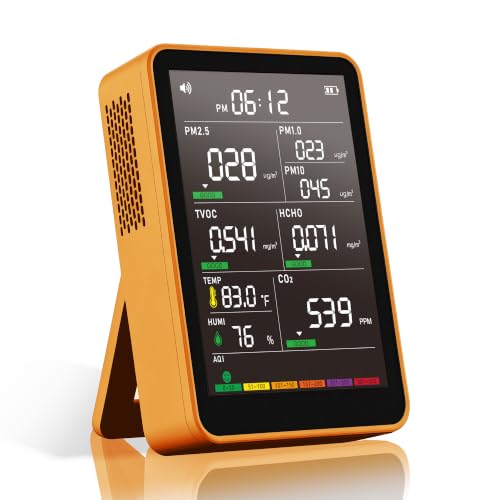
- Tracks particles, gases, temperature, and humidity
- HD color display with readings every 1.5 seconds
- Portable design with Type-C charging
Best For: Detailed home, office, vehicle, and plant-area monitoring
Best Smart Monitoring

- Works with Smart Life and Tuya Smart apps
- Stores historical readings and supports remote checks
- 3000mAh battery offers about 7–15 hours
Best For: Connected households tracking indoor air remotely
Best Long-Run Portable Pick

- Tracks particles, gases, AQI, temperature, and humidity
- Up to 96 hours of continuous monitoring
- No WiFi, Bluetooth, or app setup required
Best For: Extended portable monitoring and power-outage coverage
Best Large-Screen Monitor

- Measures gases, particles, temperature, humidity, and AQI
- 7-inch display with adjustable brightness
- Real-time buzzer alerts with mute function
Best For: Home or office users who prioritize broad readings and easy viewing
Best Rechargeable Monitor
16-in-1 Rechargeable Air Quality Monitor

- 7-inch display with three brightness settings
- Up to 8 hours of battery runtime
- USB-C charging, alerts, and 12-month warranty
Best For: Large-screen monitoring when flexible, short-term portable use is useful
Best Overall – Airthings View Plus
For shoppers comparing air quality monitoring systems, the Airthings View Plus is a comprehensive indoor option. It continuously measures radon, PM2.5, CO2, VOCs, humidity, temperature, and air pressure, while its battery-powered design supports flexible placement.
Best For: Homeowners who want broad pollutant coverage, including radon, plus app-based trend tracking.
Pros:
- Measures radon, PM2.5, CO2, VOCs, humidity, temperature, and pressure.
- Battery-powered operation with an average battery life of up to two years.
- App provides live readings, notifications, trends, and pollen information.
- Customizable eInk screen and optional five-year extended warranty.
Cons:
- Requires the Airthings app, an account, and internet access to function.
- Uses six AA batteries, which must eventually be replaced.
The View Plus stands out when radon detection and a wide range of measurements matter more than a simple plug-in display. Its cloud-connected app is useful for long-term monitoring, but buyers should be comfortable with account and internet requirements.
Best Simple PM Monitor – GoveeLife H5106
The GoveeLife H5106 is a straightforward choice among air quality monitoring systems for tracking PM2.5, temperature, and humidity. Its two-second refresh rate, LED display, and GoveeHome integration make it practical for everyday indoor use.
Best For: Homes and offices that primarily need fast PM2.5, temperature, and humidity updates.
Pros:
- Refreshes PM2.5, temperature, and humidity data every two seconds.
- Displays readings and uses four LED air-quality indicator levels.
- Supports remote monitoring, 13-day graphs, and up to two years of exported data.
- Can link with compatible GoveeLife purifiers, humidifiers, and fans.
Cons:
- Measures only PM2.5, temperature, and humidity; it does not monitor CO2 or VOCs.
- Requires continuous USB-C power and has no built-in battery.
- 2.4 GHz Wi-Fi is required for time display and connected features.
This monitor is a good fit if you want quick particulate readings and smart-appliance automation without a long list of sensors. Its wired design limits portability, but the data export and Govee ecosystem add useful convenience.
Best for Sidewalk Homes – Ring Air Quality Monitor
The Ring Air Quality Monitor offers a compact way to add indoor readings to a Ring-connected home. As air quality monitoring systems go, it focuses on temperature, humidity, PM2.5, and carbon monoxide levels, then provides actionable suggestions through Amazon Sidewalk connectivity.
Best For: Ring and Amazon Sidewalk users who want simple connected monitoring and practical prompts.
Pros:
- Tracks temperature, humidity, PM2.5, and CO levels.
- Provides suggestions such as opening a window or running a purifier.
- Connects through Amazon Sidewalk without requiring a base station.
Cons:
- Requires Amazon Sidewalk, and coverage may vary.
- It is not a certified carbon monoxide alarm or detector.
- Does not measure CO2 or radon and has no microphone or speaker for an alarm.
The Ring monitor makes the most sense for users already invested in Amazon’s connected-home ecosystem. It can help identify changing indoor conditions, but it should complement—not replace—a certified CO alarm.
Best for Detailed Analysis – BREATHE Airmonitor Plus Gen 2
The BREATHE Airmonitor Plus Gen 2 is designed for shoppers who want detailed air quality monitoring systems data rather than a basic single-sensor reading. It tracks CO2, PM1, PM2.5, PM10, TVOC, formaldehyde, temperature, and humidity, with app alerts, 90-day history, and data export.
Best For: Home, office, classroom, and bedroom users who want to study pollutant patterns and export readings.
Pros:
- Eight-in-one monitoring covers CO2, three particle sizes, TVOC, formaldehyde, temperature, and humidity.
- Uses NDIR CO2 measurement, laser particle sensing, and dedicated TVOC and HCHO detection.
- Offers configurable alerts, 90-day history, and CSV data export through the app.
- Rechargeable design provides up to six hours of portable use and can run on USB-C power.
Cons:
- App connectivity requires 2.4 GHz Wi-Fi.
- Portable battery life is limited to up to six hours.
- Its broader sensor set may be more than needed for shoppers seeking basic readings.
Choose the BREATHE Gen 2 when comparing changes caused by cooking, cleaning, occupancy, or ventilation is a priority. Its extensive measurements and exportable history support deeper analysis, while USB-C operation allows continuous monitoring when portability is unnecessary.
Best All-in-One Value – 16-in-1 Air Quality Monitor
For shoppers comparing air quality monitoring systems, this 16-in-1 monitor offers broad coverage in a compact, portable design. It tracks particles, gases, temperature, and humidity while updating readings every 1.5 seconds on a high-definition color screen.
Best For: Households, offices, vehicles, and plant owners wanting detailed readings without multiple single-function meters.
Pros:
- Measures PM1.0, PM2.5, PM10, TVOC, HCHO, temperature, and humidity.
- Color-coded HD display provides quick visual feedback.
- Simple single-button operation with optional audio prompts.
- Portable Type-C charging and a 12-month full-unit warranty.
Cons:
- Continuous battery runtime is approximately 4–5 hours.
- The supplied notes do not mention app connectivity or remote monitoring.
This is a practical choice when measurement range and straightforward operation matter most. Its shorter battery life makes it better suited to spot checks and nearby monitoring than extended untethered use.
Best Smart Monitoring – WiFi Air Quality Monitor
Among air quality monitoring systems, this model stands out for connected monitoring. It measures AQI, CO2, particulate matter, HCHO, TVOC, temperature, and humidity, then lets you view readings and stored history through compatible Smart Life or Tuya Smart apps over 2.4GHz WiFi.
Best For: Users who want remote access, historical data, alerts, and configurable monitoring from a phone.
Pros:
- Supports WiFi, app-based data storage, remote viewing, and settings.
- Monitors AQI, CO2, PM1.0, PM2.5, PM10, TVOC, HCHO, temperature, and humidity.
- Dual-chip architecture is designed for responsive, stable operation.
- 3000mAh battery provides approximately 7–15 hours of use.
Cons:
- Requires 2.4GHz WiFi and compatibility mode on WiFi 6+ routers.
- Only one phone can be connected at a time according to the usage notes.
- Long-term data recording is recommended while plugged in.
This is the strongest fit for buyers who value phone access and historical trends over completely offline simplicity. Setup involves more networking steps than a basic standalone monitor.
Best Long-Run Portable Pick – 10-in-1 Air Quality Monitor
This 10-in-1 unit is a convenient option among air quality monitoring systems for users who want broad measurements without WiFi or Bluetooth setup. It monitors particles, CO2, CO, HCHO, TVOC, AQI, temperature, and humidity, with readings processed every 1.2 seconds.
Best For: Portable monitoring in bedrooms, kitchens, offices, vehicles, and rooms where long battery life or outage coverage is important.
Pros:
- Measures PM0.3, PM2.5, PM10, CO2, CO, HCHO, TVOC, AQI, temperature, and humidity.
- Color-coded levels make changes easy to recognize at a glance.
- Audible alerts can signal preset air-quality conditions.
- 2000mAh battery supports up to 96 hours of continuous monitoring.
Cons:
- The supplied notes do not mention app connectivity or historical data storage.
- Includes a charging cable but no AC adapter is listed.
Choose this model when wireless portability and extended runtime are higher priorities than app-based control. Its one-button, offline operation also makes it approachable for quick checks throughout the home or on the go.
Best Large-Screen Monitor – 16-in-1 Air Quality Monitor
For shoppers comparing air quality monitoring systems for a home, office, or bedroom, this model emphasizes broad coverage and easy at-a-glance viewing. Its 7-inch display shows readings for CO2, particulate matter, HCHO, TVOC, temperature, humidity, and AQI, while built-in alerts help flag changing conditions.
Best For: Home or office users who want many readings on a large, adjustable-brightness screen.
Pros:
- Tracks CO2, PM1.0, PM2.5, PM10, HCHO, TVOC, temperature, humidity, and AQI.
- Large 7-inch display presents data in one view.
- Real-time alerts include a buzzer and mute function.
- Supports calibration and adjustable Fahrenheit/Celsius and 12/24-hour settings.
Cons:
- The larger display may be less convenient for portable use.
- The manufacturer advises avoiding sensor contact and strong odors to help maintain accuracy.
This is a practical choice when visibility and a wide set of indoor measurements matter more than a compact form factor. Calibration support adds flexibility for ongoing household monitoring.
Best Portable Option – 10-in-1 Smart Air Quality Monitor
This compact monitor is a flexible option among air quality monitoring systems, with readings for CO2, HCHO, TVOC, particulate matter, temperature, humidity, and AQI. Its color-screen visualization and portable design make it useful for checking conditions in multiple rooms, vehicles, and other spaces.
Best For: Users who want a compact monitor for moving between bedrooms, offices, cars, and other environments.
Pros:
- Measures CO2, HCHO, TVOC, PM1.0, PM2.5, PM10, temperature, humidity, and AQI.
- Three-color screen visualization makes changing air conditions easier to notice.
- Portable design supports use in homes, cars, offices, schools, hotels, and more.
- Offers Bluetooth time calibration and dedicated calibration mode.
Cons:
- Several functions rely on button-press sequences that may take time to learn.
- The notes do not specify a runtime or battery capacity.
Choose this model if portability and quick visual status cues are priorities. It provides broad pollutant coverage in a compact format, though buyers should be comfortable learning its controls.
Best Rechargeable Monitor – 16-in-1 Rechargeable Air Quality Monitor
For buyers seeking air quality monitoring systems with flexible placement, this rechargeable model combines a 7-inch display with external sensors and coverage of major indoor pollutants. It can run for up to 8 hours on a charge and includes USB-C charging, making it suitable for rooms, vehicles, and other indoor settings.
Best For: Users who want a large-screen monitor that can operate away from a wall outlet for limited periods.
Pros:
- Monitors CO2, PM1.0, PM2.5, PM10, HCHO, TVOC, temperature, humidity, and AQI.
- 7-inch display offers three brightness settings.
- Up to 8 hours of runtime with USB-C charging and an included AC adapter.
- Includes real-time AQI alert buzzers, a mute button, and a 12-month warranty.
Cons:
- Its stated “16-in-1” count combines nine detectable parameters with seven alert types.
- Battery runtime is limited to up to 8 hours per full charge.
- External sensors should be protected from touching, perfumes, and strong odors.
This model stands out for combining a large display with rechargeable operation and flexible USB-C power. It is a strong fit for occasional portable checks, while continuous monitoring may call for keeping it connected.
How We Picked These Air Quality Monitoring Systems
We selected models that cover important indoor-air measurements and represent different buying priorities, including radon detection, particulate monitoring, CO2 tracking, VOC sensing, smart alerts, portability, and large-screen readability. We also considered whether each monitor appears suited to continuous home use, quick spot checks, or integration with a connected household.
Because specifications can vary by seller and model revision, verify the current listing for sensor types, app compatibility, power requirements, calibration guidance, and whether readings are intended for screening or formal testing.
Quick Comparison
| Best For | Look For | Useful Measurements |
|---|---|---|
| Whole-home awareness | App access, alerts, and continuous operation | CO2, PM2.5, VOCs, humidity, temperature |
| Radon screening | A dedicated radon sensor and trend history | Radon, pressure, temperature, humidity |
| Large-room visibility | Bright, readable display and clear status indicators | CO2, PM2.5, PM10, TVOC |
| Portable checks | Compact design, battery operation, and fast updates | CO2, particles, VOCs, formaldehyde |
| Smart-home users | Reliable app notifications and ecosystem support | PM2.5, CO, trends, actionable alerts |
Key Buying Factors for Air Quality Monitoring Systems
Choose Sensors Based on Your Concern
CO2 is mainly a ventilation indicator, while PM2.5 helps reveal smoke, cooking particles, and other fine pollutants. TVOC and formaldehyde readings can provide useful warnings around products and materials, but low-cost VOC sensors often report broad estimates rather than identifying a specific chemical. Radon requires a dedicated sensor and should not be confused with general air-quality readings. Carbon monoxide is a life-safety concern: an air monitor should supplement, never replace, certified CO alarms.
Check Accuracy, Calibration, and Trends
A precise-looking display does not guarantee laboratory accuracy. Prefer monitors that explain sensor technology, calibration requirements, update intervals, and expected operating conditions. Trend graphs and alerts are often more useful than a single number because they show whether ventilation or filtration is improving the room.
Consider Power and Placement
Battery-powered units are easier to move but may require charging or offer fewer always-on features. Wired monitors work well in a fixed location. Place a monitor away from windows, vents, kitchens, bathrooms, and direct sunlight unless you are specifically testing those areas, and allow it to acclimate before judging readings.
Evaluate Connectivity and Usability
Choose a clear display for quick checks and app connectivity when you need remote alerts or historical data. Confirm Wi-Fi, Bluetooth, Amazon Sidewalk, phone, and smart-home compatibility before buying. A monitor that is easy to understand and maintain is more valuable than one with unused measurements.
Who Should Buy Which Air Quality Monitoring Systems?
Choose a radon-capable model if radon is your primary concern. Pick a connected monitor if you want notifications and long-term trends while away from home. Large-display multi-sensor units suit living rooms, classrooms, and offices where readings need to be visible at a glance. Portable 10-in-1 or 16-in-1 designs are practical for comparing rooms, but treat broad VOC or formaldehyde readings as screening information. For homes focused on smoke, cooking, or ventilation, prioritize PM2.5 and CO2 performance over an inflated sensor count.
