
Indoor air can change quickly as you cook, clean, heat your home, or open and close windows. The right monitor helps turn invisible pollutants into useful information you can act on.
We compared 10 air quality monitoring systems for home use, from focused radon and carbon monoxide detectors to multi-sensor monitors that track CO2, particulates, VOCs, temperature, and humidity.
Best 10 Air Quality Monitoring Systems for Home Use Picks for 2026
Simple Connected Monitoring

- Tracks CO levels, PM2.5, humidity, and temperature
- Provides actionable indoor air suggestions
- No base station required; uses Amazon Sidewalk
Best For: Ring users wanting supplemental indoor air tracking
Radon-Focused Protection
Airthings Corentium Home 2 Radon Detector

- Continuously monitors radon with short- and long-term averages
- Bluetooth app shows graphs and personalized guidance
- Portable, battery-powered, and includes temperature and humidity readings
Best For: Continuous radon monitoring in bedrooms, living areas, or basements
Comprehensive Air Analysis

- Measures CO2, particles, TVOC, formaldehyde, temperature, and humidity
- Offers alerts, 90-day history, and CSV export
- Rechargeable and usable while connected to USB-C power
Best For: Detailed trend tracking and multi-pollutant home monitoring
Certified CO Safety
Kidde Smart CO Detector + Indoor Air Quality

- Provides an 85-dB CO alarm and app notifications
- Tracks IAQ, humidity, and TVOC with weekly trends
- Plug-in power includes AA battery backup and a 10-year warranty
Best For: Connected homes prioritizing certified carbon monoxide protection
Best Open-Source Pick
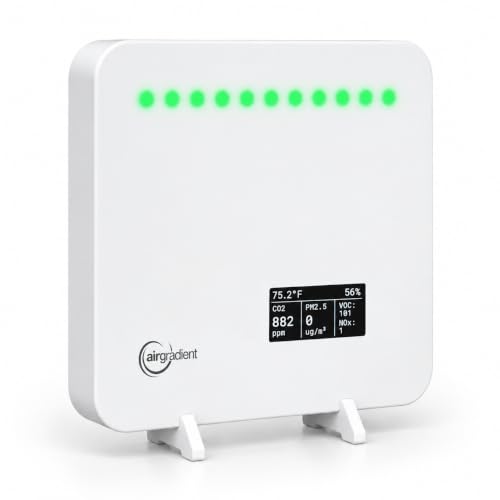
- Measures PM2.5, CO2, TVOC, NOx, temperature, and humidity
- Open-source with Home Assistant support and free API access
- Calibrated PM2.5 sensor with included digital test report
Best For: Connected-home users wanting detailed, subscription-free monitoring
Best Feature-Packed Portable Option

- Monitors particles, CO2, CO, HCHO, TVOC, AQI, temperature, and humidity
- Color display and audible alerts simplify quick checks
- Rechargeable battery offers up to 96 hours of monitoring
Best For: Portable, app-free monitoring across rooms, cars, and offices
Best Compact Travel Monitor
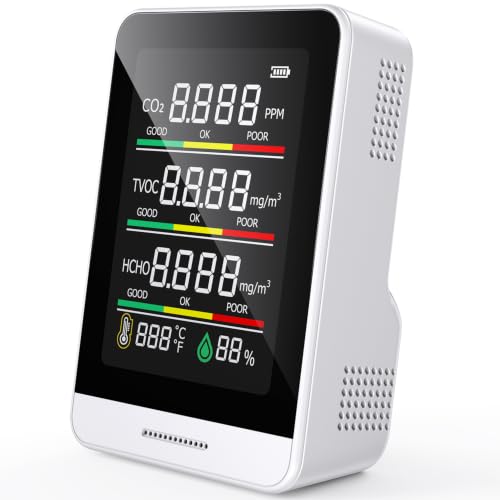
- Tracks CO2, HCHO, TVOC, AQI, temperature, and humidity
- Lightweight 4.8-ounce rechargeable design
- Audible alert with a silent mode for bedrooms and offices
Best For: Portable everyday checks at home, work, in cars, or while traveling
Best Portable Coverage
16-in-1 Indoor Air Quality Monitor
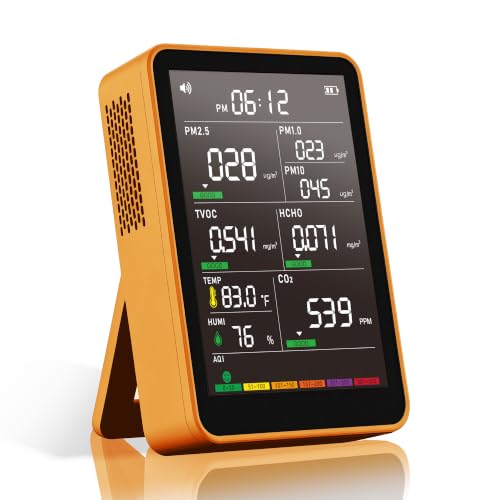
- Measures particles, gases, temperature, and humidity
- Refreshes readings every 1.5 seconds
- Compact design with simple controls and Type-C charging
Best For: Portable spot checks around the home, office, or vehicle
Best Connected Monitoring
Smart Wi-Fi Air Quality Monitor

- Tracks AQI, CO2, particles, gases, temperature, and humidity
- Works with Smart Life and Tuya Smart apps
- Stores historical data and supports remote monitoring
Best For: App-based tracking and checking indoor air while away
Best for Wall Placement
16-in-1 Smart Air Quality Tester

- Displays particles, gases, AQI, temperature, and humidity
- Includes a rear hanging hole for wall installation
- Offers about seven hours of battery use with USB-C charging
Best For: Visible local monitoring in kitchens, offices, and other rooms
Simple Connected Monitoring – Ring Air Quality Monitor
For homeowners seeking air quality monitoring systems for home use, the Ring Air Quality Monitor provides an easy way to track temperature, humidity, carbon monoxide levels, and PM2.5. It can also offer suggestions such as opening a window or running a purifier.
Best For: Ring users who want straightforward indoor condition tracking and connected alerts without installing a base station.
Pros:
- Tracks temperature, humidity, CO levels, and PM2.5.
- Offers actionable suggestions for ventilation, purification, or appliance service.
- Uses Amazon Sidewalk connectivity without a separate base station.
Cons:
- Requires Amazon Sidewalk, and coverage may vary.
- It is not a certified carbon monoxide alarm or detector.
- Does not measure CO2 or radon and has no audible alarm.
This is a practical supplemental monitor for everyday indoor awareness, but it should not replace a certified CO alarm. Its strongest appeal is simple, connected monitoring of common indoor air indicators.
Radon-Focused Protection – Airthings Corentium Home 2 Radon Detector
Among air quality monitoring systems for home use, the Airthings Corentium Home 2 is designed specifically for continuous radon measurement. Its portable, battery-powered design, on-device averages, and Bluetooth app make it useful for tracking changing radon levels over time.
Best For: Homeowners who want ongoing radon monitoring, especially in areas such as basements, without lab fees or waiting for test results.
Pros:
- Continuously monitors radon and displays short- and long-term averages.
- Bluetooth app graphs help visualize changes and provides personalized tips.
- Portable battery-powered design needs no installation and includes temperature and humidity sensors.
- Can support remote monitoring when paired with an Airthings Hub or View series monitor.
Cons:
- Its primary focus is radon rather than broad-spectrum indoor pollutant monitoring.
- Remote monitoring requires an additional compatible Airthings device.
- Uses visual indications rather than a listed audible alarm.
If radon is the main concern, this dedicated detector offers more focused information than a general-purpose monitor. The display and app make long-term trends easier to understand and act on.
Comprehensive Air Analysis – BREATHE Airmonitor Plus Gen 2
The BREATHE Airmonitor Plus Gen 2 is one of the more comprehensive air quality monitoring systems for home use, measuring CO2, multiple particle sizes, TVOC, formaldehyde, temperature, and humidity. Its display, Wi-Fi app, alerts, history, and data export support both quick checks and longer-term analysis.
Best For: Users who want detailed readings and trend data to understand how cooking, cleaning, occupancy, or ventilation affect indoor air.
Pros:
- Monitors eight categories, including CO2, PM1, PM2.5, PM10, TVOC, HCHO, temperature, and humidity.
- Combines NDIR CO2 measurement with laser particle sensing and dedicated VOC and formaldehyde detection.
- App provides alerts, up to 90 days of history, and CSV data export.
- Rechargeable design offers up to six hours of portable use and can run from USB-C power.
Cons:
- Portable battery use is limited to up to six hours.
- Remote readings and app features require 2.4 GHz Wi-Fi and app pairing.
- The broad feature set may be more than needed for users seeking only basic readings.
This is a strong choice for data-minded households, classrooms, or offices that want pollutant readings alongside historical context. It provides a fuller picture than a single-purpose monitor, particularly when identifying patterns over time.
Certified CO Safety – Kidde Smart CO Detector + Indoor Air Quality
For shoppers comparing air quality monitoring systems for home use with safety alarms, the Kidde Smart CO Detector combines carbon monoxide protection with indoor air quality, humidity, and TVOC tracking. It plugs into an outlet, includes AA battery backup, and sends app notifications over 2.4 GHz Wi-Fi.
Best For: Connected households that prioritize certified CO alarm protection along with basic indoor air quality insights.
Pros:
- Sounds an 85-dB alarm when dangerous CO is detected and provides real-time app notifications.
- Uses low-level CO technology with distinct alerts beginning at 30–70 ppm.
- Monitors indoor air quality, humidity, and TVOC, with weekly IAQ trends.
- Plug-in design includes two AA backup batteries and a rotating plug for outlet flexibility.
Cons:
- Some advanced home-health insights require an optional $1.99-per-month subscription.
- Requires 2.4 GHz Wi-Fi for app notifications and connected features.
- Its air-quality measurements are less extensive than dedicated multi-sensor monitors.
This model stands out when CO safety is the priority. Its UL 2034, 5th Edition testing and ETL listing add reassurance, while the connected IAQ features provide useful supplemental context.
Best Open-Source Pick – AirGradient ONE
The AirGradient ONE is a strong choice among air quality monitoring systems for home use when you want broad pollutant coverage, documented sensor quality, and flexible integrations. It measures PM2.5, CO2, TVOC, NOx, temperature, and humidity, while its subscription-free dashboard and Home Assistant support make it suitable for connected homes.
Best For: Homeowners who want detailed readings, open-source flexibility, and smart-home integration.
Pros:
- Tracks PM2.5, CO2, TVOC, NOx, temperature, and humidity.
- Uses named SenseAir, Plantower, Sensirion, and Sensirion sensor modules.
- Includes a display, subscription-free dashboard, free API access, and Home Assistant compatibility.
- Individually calibrated for PM2.5 and supplied with a digital test report.
Cons:
- Its open-source and integration-focused feature set may be more than casual users need.
- The included power adapter is a US model.
Choose the AirGradient ONE if accuracy credentials, local control, and long-term data access matter more than basic plug-and-view simplicity.
Best Feature-Packed Portable Option – 10-in-1 Air Quality Monitor
This 10-in-1 monitor suits shoppers comparing air quality monitoring systems for home use that can also move between rooms or vehicles. It combines particulate, gas, and environmental readings on a color display, with audible alerts, one-button operation, and a rechargeable battery for flexible placement.
Best For: Families who want many readings and a portable monitor without Wi-Fi, Bluetooth, or app setup.
Pros:
- Measures PM0.3, PM2.5, PM10, CO2, CO, HCHO, TVOC, AQI, temperature, and humidity.
- Color-coded display makes changing air-quality levels easier to interpret.
- Samples and processes readings every 1.2 seconds according to the supplied notes.
- Rechargeable 2000mAh battery provides up to 96 hours of continuous monitoring.
Cons:
- Does not include Wi-Fi, Bluetooth, or app connectivity.
- The supplied notes do not identify the individual sensor brands or calibration process.
Its broad 10-parameter coverage and long battery life make it practical for checking bedrooms, kitchens, cars, offices, and other spaces without installing a connected system.
Best Compact Travel Monitor – Lecoolife AK3
The Lecoolife AK3 is a compact option for air quality monitoring systems for home use when portability and quiet operation are priorities. It tracks CO2, formaldehyde, TVOC, AQI, temperature, and humidity, and its rechargeable design makes it easy to carry between a bedroom, office, car, hotel room, or other enclosed space.
Best For: Travelers, bedroom users, and anyone wanting a lightweight monitor with silent mode.
Pros:
- Lightweight at 4.8 ounces and designed for portable use.
- Monitors CO2, HCHO, TVOC, AQI, temperature, and humidity in real time.
- Performs a 30-second automatic self-test at startup.
- Includes rechargeable operation, audible alerts, and a silent mode.
Cons:
- Provides fewer monitored parameters than the 10-in-1 alternative.
- The supplied notes do not specify battery runtime.
- It does not list app, Wi-Fi, or smart-home integration.
The AK3 is a sensible everyday companion for checking ventilation and general conditions in multiple spaces, especially where a quiet, portable device is more useful than a permanently installed monitor.
Best Portable Coverage – 16-in-1 Indoor Air Quality Monitor
For shoppers comparing air quality monitoring systems for home use, this compact 16-in-1 monitor provides a broad snapshot of indoor conditions. It tracks particulate matter, gases, temperature, and humidity, while the color screen and frequent updates make readings easy to check.
Best For: Portable, straightforward monitoring in bedrooms, offices, vehicles, and other indoor spaces.
Pros:
- Tracks PM1.0, PM2.5, PM10, TVOC, HCHO, temperature, and humidity.
- Refreshes air data every 1.5 seconds on an HD color display.
- Simple single-button operation with an option to turn off audio prompts.
- Includes Type-C charging, an AC adapter, and a 12-month full-unit warranty.
Cons:
- Continuous battery operation is rated at approximately 4–5 hours.
- The notes do not mention Wi-Fi, app support, or remote monitoring.
This is a practical choice when you want many measurements in a small, easy-to-carry device. Its shorter battery runtime makes it better for spot checks or nearby charging than for extended off-grid monitoring.
Best Connected Monitoring – Smart Wi-Fi Air Quality Monitor
Among air quality monitoring systems for home use, this model stands out for connected tracking. It measures AQI, CO2, particulate matter, gases, temperature, and humidity, then links to compatible Smart Life or Tuya Smart apps for remote viewing and historical data.
Best For: Home users who want app access, saved readings, and remote indoor air checks.
Pros:
- Monitors AQI, CO2, PM1.0, PM2.5, PM10, TVOC, HCHO, temperature, and humidity.
- Supports 2.4GHz Wi-Fi, Smart Life, and Tuya Smart app connectivity.
- App features include historical data storage, alerts, and remote parameter adjustments.
- Its 3000mAh battery supports approximately 7–15 hours of continuous work.
Cons:
- Requires 2.4GHz Wi-Fi; compatibility mode may be needed on Wi-Fi 6 or newer routers.
- Only one phone can be connected at a time according to the usage instructions.
- Long-term data recording is recommended while the unit is plugged in.
This is the strongest fit for users who value remote access and trend tracking over purely local operation. Setup involves Wi-Fi and app pairing, but those features add useful visibility when you are away from home.
Best for Wall Placement – 16-in-1 Smart Air Quality Tester
This battery-powered tester is a useful option for shoppers evaluating air quality monitoring systems for home use in rooms where a visible display matters. Its color screen shows key air measurements, while a rear hanging hole allows wall placement in offices, kitchens, grow rooms, or other indoor areas.
Best For: Wall-mounted or portable monitoring with a readable display and rechargeable battery.
Pros:
- Displays PM2.5, PM10, CO2, HCHO, TVOC, AQI, temperature, and humidity.
- Ultra-high-definition color screen is designed for easy reading.
- Rear hanging hole supports convenient wall installation.
- Built-in 2000mAh battery provides approximately seven hours of use and charges via USB Type-C.
Cons:
- The notes describe a broad set of readings but refer to both 13-in-1 and 16-in-1 functionality.
- It enters energy-saving mode after 30 minutes of operation.
- The supplied details do not mention app connectivity or remote access.
Choose this model if you want a clearly visible local display that can sit on a surface or hang on a wall. Its energy-saving behavior and moderate battery capacity make it well suited to routine home checks rather than advanced connected monitoring.
How We Picked the Best Air Quality Monitoring Systems for Home Use
We focused on the measurements that matter most in everyday homes: carbon monoxide, radon, PM2.5, CO2, VOCs, temperature, and humidity. We also considered display clarity, portability, connectivity, alert options, power requirements, and whether a device is designed for continuous monitoring or occasional spot checks.
Because no single monitor measures everything equally well, the list includes both specialized detectors and broader indoor air quality systems. Safety-critical sensors, particularly carbon monoxide and radon detectors, should be evaluated for certification, placement guidance, and maintenance requirements rather than judged only by the number of advertised readings.
Quick Comparison
| Best For | What to Look For |
|---|---|
| Whole-home awareness | CO2, PM2.5, VOC, temperature, and humidity readings |
| Radon concerns | A dedicated radon detector with clear trend data |
| Carbon monoxide safety | A certified alarm with loud alerts and battery backup |
| Smart-home integration | Wi-Fi, Bluetooth, Home Assistant, or compatible app support |
| Portable testing | Rechargeable battery, readable display, and lightweight design |
Key Buying Factors
Choose the Right Sensors
PM2.5 is useful for tracking smoke, cooking particles, and outdoor pollution. CO2 can indicate inadequate ventilation, while VOC and formaldehyde readings may help identify emissions from cleaning products, furnishings, or finishes. Radon and carbon monoxide require more specialized attention and should not be treated as interchangeable with general air-quality scores.
Check Alert and Data Features
Look for adjustable thresholds, audible alarms, app notifications, historical charts, and easy-to-read screens. A monitor that shows trends can be more useful than one that displays a constantly changing number without context. If you want automation, confirm compatibility with your preferred smart-home platform before buying.
Consider Placement and Upkeep
Place monitors where people spend time, away from windows, vents, kitchens, bathrooms, and direct sunlight unless the manufacturer says otherwise. Battery-powered models are convenient but need regular charging or battery replacement. Sensors may also require calibration, periodic testing, or replacement as they age.
Who Should Buy Which Air Quality Monitoring Systems for Home Use?
Choose a dedicated radon monitor if your main concern is long-term radon exposure, especially in a basement or lower level. A certified carbon monoxide detector is the priority for combustion-related safety near sleeping areas and fuel-burning appliances. For ventilation and daily comfort, select a multi-sensor model with CO2, PM2.5, temperature, and humidity readings.
Smart-home users should favor connected monitors with dependable app support or Home Assistant compatibility. Renters, travelers, and anyone who wants occasional checks may prefer a compact rechargeable unit. If you are managing allergies, wildfire smoke, or frequent cooking pollutants, prioritize PM2.5 tracking and clear alerts over an inflated sensor count.
