
If you need an ai workstation desktop for researchers, the right system should handle large datasets, model development, and long compute sessions without slowing your workflow.
In this roundup, we focused on desktops that balance processing power, memory support, storage, and practical expandability so you can choose with confidence.
Best 6 AI Workstation Desktop for Researchers Picks for 2026
Best for Local Large-Model Workloads
Acer Veriton AI Mini Workstation GN100

- 1 PFLOPS FP4 performance for local AI workloads
- 128GB unified memory helps run large models on-device
- Dual 200Gbps ports support scaling into clustered setups
Best For: Research labs and AI teams that need compact, local large-model compute.
Best Refurbished Multi-Display Workhorse
Lenovo ThinkStation P920 Workstation

- 16 total cores for CPU-heavy research tasks
- 512GB NVMe SSD for faster loading and boot times
- Quadro M2000 supports 4 monitors for productivity
Best For: Researchers and analysts who want a refurbished workstation for multitasking, data work, and multiple displays.
Best Enterprise AI Workstation
Dell Pro Tower i7-14700T, 64GB, 1TB SSD

- 20-core Intel i7 and 64GB DDR5 for heavy multitasking
- Dual 4K display support for research and analytics
- Windows 11 Pro with vPro for secure business deployment
Best For: Researchers and business users who need a secure, high-memory tower for productivity and data work.
Best for Enterprise AI Workflows
Dell Pro Tower i7 Business Desktop
- 20-core i7-14700T for demanding multitasking
- vPro, BitLocker, and Remote Desktop for IT-managed use
- Dual 4K display support for research and productivity
Best For: Research teams and business users who need a secure, manageable desktop for data work and AI-adjacent tasks.
Best for Business IT
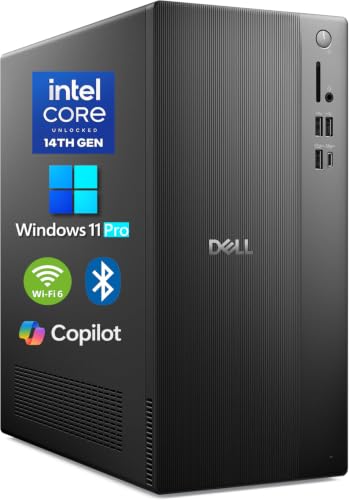
- 20-core Intel i7-14700T with vPro management
- 32GB DDR5 and 1TB SSD for fast multitasking
- Dual 4K display support for research and analytics
Best For: Corporate users, SMBs, and researchers who need a secure, manageable desktop for productivity and data work.
Best for Secure Business AI Workflows
- 20-core i7-14700T for strong multitasking
- vPro, Windows 11 Pro, and enterprise security
- Dual-4K display support for research setups
Best For: Researchers and business teams needing a secure, expandable desktop for data work and productivity.
Best for Local Large-Model Workloads – Acer Veriton AI Mini Workstation GN100
If you need an ai workstation desktop for researchers that can keep large models on the desk instead of in the cloud, the Acer Veriton AI Mini Workstation GN100 is built for exactly that job. Its GB10 Grace Blackwell Superchip, 128GB of unified memory, and DGX software stack make it a serious option for local prototyping, inference, and small-scale distributed work.
Best For: Research teams, university labs, and AI developers who want local access to large models, fast iteration, and a compact system that fits into a serious research workflow.
Pros:
- 1 PFLOPS FP4 performance and support for 200B+ parameter models locally
- 128GB coherent unified memory reduces CPU-GPU bottlenecks for AI workloads
- Dual 200Gbps ConnectX-7 ports support scaling to multi-node clusters
- DGX OS with CUDA, PyTorch, NIM, and NeMo streamlines AI development
Cons:
- Expensive and clearly aimed at specialized AI buyers
- 4TB SSD and fixed memory may limit some upgrade paths
- More workstation than general-purpose desktop for everyday office use
For researchers who want an ai workstation desktop for researchers that can prototype, fine-tune, and run sensitive workloads locally, this GN100 stands out for its server-class AI architecture and compact footprint. It is less about general productivity and more about delivering high-end local inference and cluster-ready scalability without leaving the lab.
Best Refurbished Multi-Display Workhorse – Lenovo ThinkStation P920 Workstation
If you need an ai workstation desktop for researchers that favors CPU-heavy workflows, lots of RAM headroom, and reliable multi-monitor output, this refurbished Lenovo ThinkStation P920 is worth a look. Its dual Xeon-class Silver processors and workstation graphics make it better suited to sustained analysis, simulation, and data prep than to flashy gaming-style specs.
Best For: Researchers, analysts, and lab users who want a refurbished tower for parallel workloads, large datasets, and multiple displays.
Pros:
- Dual Intel Silver processors provide 16 total cores for demanding multitasking
- 512GB NVMe SSD helps shorten boot and project load times
- Quadro M2000 with 4 display outputs is useful for multi-monitor research setups
- 1400W Platinum power supply leaves room for future expansion
Cons:
- Older workstation platform may not match newer AI-optimized CPUs or GPUs
- Quadro M2000 is modest for heavier CUDA training or modern visualization
- Renewed unit means condition can vary more than with a new machine
Overall, this is a practical ai workstation desktop for researchers who value cores, storage speed, and expandability over cutting-edge GPU power. It makes the most sense for compute-supported academic or lab work where stability and multi-display productivity matter.
Best Enterprise AI Workstation – Dell Pro Tower i7-14700T, 64GB, 1TB SSD
This Dell Pro Tower is a practical pick if you want an ai workstation desktop for researchers who need strong multitasking, fast storage, and business-grade manageability. With a 20-core Intel Core i7-14700T, 64GB of DDR5 RAM, and a 1TB NVMe SSD, it has the headroom for data analysis, coding, literature review workflows, and running several apps at once.
Best For: Researchers, analysts, and corporate teams who want a secure Windows 11 Pro tower for heavy multitasking and multi-display productivity.
Pros:
- 20-core i7-14700T and 64GB DDR5 handle demanding research and office workloads smoothly
- Supports up to two 4K displays for easier comparison work and data monitoring
- Windows 11 Pro and Intel vPro add security, remote management, and IT-friendly deployment
- 1TB PCIe NVMe SSD gives fast boot times and responsive file access
Cons:
- No built-in Wi-Fi, so wireless users need the included USB adapter or Ethernet
- Integrated graphics are fine for productivity, but not ideal for GPU-heavy AI training
- Tower form factor takes up more desk space than a compact desktop
Overall, this is a dependable choice for an ai workstation desktop for researchers who prioritize memory, security, and expandability over flashy extras. It fits best in office or lab settings where reliability and multi-display productivity matter most.
Best for Enterprise AI Workflows – Dell Pro Tower i7 Business Desktop
If you need an ai workstation desktop for researchers that also fits standard office IT policies, this Dell Pro Tower is a strong fit. It pairs a 20-core Intel Core i7-14700T with Windows 11 Pro, remote management, and business-grade security, making it practical for data-heavy research, analytics, and multi-app workflows.
Best For: Research teams, corporate analysts, and SMB users who want a secure, manageable desktop for AI-adjacent workloads, data processing, and multi-monitor productivity.
Pros:
- 20-core Intel Core i7-14700T offers solid headroom for multitasking and analytics.
- Business features like vPro, BitLocker, and Remote Desktop support IT-managed deployments.
- Can drive up to two 4K displays for research dashboards and productivity setups.
- Fast DDR5 memory and NVMe SSD help keep apps and datasets responsive.
Cons:
- Integrated graphics are fine for displays, but not ideal for serious GPU-based AI training.
- No built-in Wi-Fi, so some users will need wired Ethernet or an adapter.
- 16GB RAM and 512GB SSD may feel modest for larger research projects.
As an ai workstation desktop for researchers, this Dell makes the most sense for teams that value reliability, security, and easy fleet management over raw graphics horsepower. It is better suited to data analysis, simulation support, and office-based AI development than to heavy local model training.
Best for Business IT – Dell Pro Tower i7 Desktop
If you want an ai workstation desktop for researchers that can handle data-heavy workflows without jumping to a true workstation GPU, this Dell Pro Tower is a practical business-first choice. The 20-core Intel Core i7-14700T, 32GB of DDR5 memory, and 1TB NVMe SSD give it strong everyday speed for analysis, multitasking, and large project files, while Windows 11 Pro and vPro features add the manageability IT teams appreciate.
Best For: Corporate teams, SMBs, and researchers who need a secure, multi-monitor desktop for analytics, productivity, and light content creation.
Pros:
- 20-core i7-14700T with vPro for strong business-class performance and remote management
- 32GB DDR5 RAM and 1TB PCIe SSD support fast multitasking and quick file access
- Dual 4K display support is useful for dashboards, coding, and research workflows
- Windows 11 Pro adds BitLocker, Remote Desktop, and domain join support
Cons:
- No built-in Wi-Fi, so wireless networking requires the included USB adapter
- Intel UHD 770 graphics are fine for productivity, but not ideal for heavy AI training or 3D work
- Designed more for office deployment than compact home desks
This is a solid fit if your ai workstation desktop for researchers needs security, expandability, and dependable multitasking more than raw GPU acceleration. It is especially appealing for teams standardizing on manageable business desktops rather than specialized creator rigs.
Best for Secure Business AI Workflows – Dell Pro Tower i7 Desktop
If you need an ai workstation desktop for researchers that can handle data prep, multitasking, and long work sessions without feeling underpowered, this Dell Pro Tower is a practical business-first option. It pairs a 20-core Intel Core i7-14700T with fast DDR5 memory, a 1TB NVMe SSD, and Windows 11 Pro, making it a solid fit for professional labs, offices, and SMB environments.
Best For: Researchers, analysts, and business teams who want a secure, expandable desktop for AI-adjacent workflows, data analysis, and multi-monitor productivity.
Pros:
- 20-core Intel Core i7-14700T delivers strong multitasking for analytics and productivity workloads
- Windows 11 Pro plus Intel vPro adds business-grade security and remote management features
- Supports up to two 4K displays for research dashboards, coding, and reference-heavy workflows
- 16GB DDR5 RAM and 1TB SSD provide fast startup and responsive everyday performance
Cons:
- No built-in Wi-Fi, so wireless networking depends on the included USB adapter
- Integrated graphics are fine for productivity, but not ideal for heavy GPU-based AI training
- 16GB RAM is enough for many tasks, but demanding research workloads may benefit from an upgrade
For teams that value security, manageability, and reliable desktop performance over flashy gaming specs, this is a sensible ai workstation desktop for researchers. It is especially appealing if your work centers on data analysis, coding, and multi-display productivity rather than large-scale local model training.
How We Picked the Best AI Workstation Desktop for Researchers
We prioritized systems that make sense for research environments: strong CPU performance, enough RAM for data-heavy work, fast SSD storage, and workstation-friendly connectivity. We also considered form factor, reliability, and how well each machine fits common tasks like preprocessing, experimentation, visualization, and running local inference.
Quick Comparison
For a quick read, the Acer mini workstation stands out for compact AI-focused hardware, the Lenovo ThinkStation offers the most traditional workstation-style expansion, and the Dell tower options are the most straightforward choice for general research productivity and multi-display office setups.
Key Buying Factors for an AI Workstation Desktop for Researchers
CPU and Parallel Performance
Research workloads often involve data loading, feature engineering, simulation, and multitasking. More cores help, but sustained performance and thermal design matter just as much as peak clock speed.
Memory Capacity
RAM is one of the biggest differentiators in an AI Workstation Desktop for Researchers. If you work with large datasets, notebooks, containers, or multiple tools at once, prioritize higher memory headroom over minimal configurations.
Storage Speed and Capacity
A fast NVMe SSD reduces wait times when opening datasets, checkpoints, and project environments. Larger drives are better if you keep local copies of data, models, and versioned results.
Graphics and AI Acceleration
Some research users need GPU acceleration for model training, inference, or visualization. Others mainly need a strong CPU platform for preprocessing and lighter experimentation. Match the graphics hardware to your actual workflow rather than paying for unused capability.
Connectivity and Display Support
Multiple display outputs, USB options, and modern networking can improve day-to-day productivity. If your lab or office setup includes external drives, monitors, or shared storage, these details matter.
Who Should Buy Which AI Workstation Desktop for Researchers?
Choose the Acer mini workstation if you want a compact, AI-oriented system for tight desks or focused local development. Choose the Lenovo ThinkStation if you value a classic workstation with stronger expansion potential and a more traditional research-lab profile. Choose one of the Dell Pro Towers if you want a practical desktop for general research productivity, multi-monitor work, and a balanced mix of performance and simplicity.
If you are building a dependable AI Workstation Desktop for Researchers, the best choice is the one that matches your memory needs, storage demands, and whether your work is CPU-heavy, GPU-heavy, or a mix of both.
