
As technology progresses, your need for high-performance computing likely grows stronger. If you’re weighing a 4U GPU server for 2026, you’ll want to explore the latest options that deliver impressive power and efficiency. From the HHCJ6 Dell NVIDIA Tesla K80 to various budget-friendly alternatives, there’s much to reflect on. Understanding the key features of these servers can considerably impact your decision. What will you prioritize when choosing the best fit for your requirements?
HHCJ6 Dell NVIDIA Tesla K80 24GB GDDR5 PCI-E Server GPU Accelerator

If you’re in the market for a powerful GPU server that can handle demanding computational tasks, the HHCJ6 Dell NVIDIA Tesla K80 is an excellent choice. With 24GB of GDDR5 memory and 4,992 CUDA cores, it delivers a remarkable 5-10x performance boost for various applications. You’ll find it supports a wide range of software like CAFFE, NAMD, and GROMACS, making it versatile for scientific and engineering projects. This renewed server GPU accelerator enhances efficiency and is designed for high-performance computing, ensuring you get the most out of your workloads. Don’t miss the chance to elevate your computational power with this exceptional GPU.
Best For: Researchers and engineers looking for a high-performance computing solution to accelerate complex simulations and data processing tasks.
Pros:
- Exceptional performance: Offers a 5-10x boost in application performance, making it ideal for demanding workloads.
- Large memory capacity: With 24GB of GDDR5 memory, it can handle large datasets and complex computations.
- Wide software compatibility: Supports various scientific and engineering applications, providing versatility for different projects.
Cons:
- Renewed product: As a renewed item, it may not come with the same warranty or reliability as a new product.
- Power consumption: High-performance GPUs like the K80 may consume significant power, leading to increased operational costs.
- Older architecture: Being an older model, it may not support the latest advancements in GPU technology compared to newer alternatives.
ASUS Dual NVIDIA GeForce RTX 3050 Gaming Graphics Card
The ASUS Dual NVIDIA GeForce RTX 3050 Gaming Graphics Card is an excellent choice for gamers and creative professionals seeking a balance of performance and efficiency. With its NVIDIA Ampere architecture, it enhances power efficiency while delivering impressive FP32 throughput. The 6GB GDDR6 memory guarantees smooth gameplay, while the 2nd generation RT and 3rd generation Tensor Cores double the ray-tracing and AI performance. Its compact 2-slot design and axial-tech fan provide effective cooling and compatibility for smaller chassis. Plus, with a solid 4.7-star rating and a three-year warranty, you can trust its reliability for your next project.
Best For: Gamers and creative professionals looking for a powerful yet efficient graphics card for high-performance tasks.
Pros:
- NVIDIA Ampere Architecture enhances performance and power efficiency.
- Compact 2-slot design and axial-tech fan allow for effective cooling in smaller cases.
- High customer satisfaction with a rating of 4.7 out of 5 stars from over 1,000 reviews.
Cons:
- 6GB memory may be limiting for very high-resolution gaming or heavy creative workloads.
- Price point may be higher compared to entry-level GPUs.
- Potential compatibility issues in extremely small chassis despite the compact design.
Lian Li ATX PC Case Vertical GPU Kit (VG4v4)
For those looking to enhance their high-performance computing setups, the Lian Li ATX PC Case Vertical GPU Kit (VG4v4) stands out with its innovative dual-angle tilt feature. You can adjust the GPU’s angle for improved airflow or a sleek display. It offers three height adjustments to guarantee ideal clearance for HDMI and DisplayPort cables. The anti-sag support arm stabilizes your GPU, preventing sag during operation. With a 200mm PCIe 5.0 riser cable, it supports fast data rates. Plus, integrated RGB lighting adds a visual flair, making your setup not just powerful but also visually stunning.
Best For: Gamers and PC enthusiasts seeking to showcase their GPU with enhanced airflow and visual appeal.
Pros:
- Adjustable Heights: Offers three height settings for optimal cable clearance and GPU positioning.
- Dual-Angle Tilt: Provides flexibility to tilt the GPU either for better airflow or a more aesthetic look.
- Sturdy Support: Anti-sag support arm ensures stability, preventing GPU droop during use.
Cons:
- Installation Complexity: May require careful installation to avoid damage during setup.
- Space Requirements: Needs at least 6 PCIe slots for vertical mounting, limiting compatibility with some cases.
- RGB Lighting: Integrated lighting may not appeal to all users, especially those preferring a minimalist design.
upHere 5V Addressable RGB Graphics Card GPU Brace Support

GPU sag can be a major concern for gamers and professionals alike, especially when using high-performance graphics cards. The upHere 5V Addressable RGB GPU Brace Support (Model: GH03ARGB) is designed to tackle this issue effectively. It supports your GPU’s weight, eliminates drooping, and features adjustable height for various card types thanks to its segmented sliding design. Plus, you’ll love the stunning 5V ARGB lighting, synchronized with your motherboard, offering dynamic and static modes. Made from high-quality anodized aluminum and transparent acrylic, this brace guarantees durability and an eye-catching look. Installation is tool-free, using a hidden magnet for stable placement.
Best For: Gamers and professionals using high-performance graphics cards who want to prevent GPU sag and enhance their system’s aesthetics with RGB lighting.
Pros:
- Supports GPU weight, effectively eliminating drooping pressure.
- Features adjustable height with a segmented sliding design for compatibility with various graphics cards.
- Easy tool-free installation with a hidden magnet for stable placement and a visually appealing design.
Cons:
- May not be compatible with all case designs or layouts.
- ARGB lighting effects require a compatible motherboard for full functionality.
- Limited to a specific aesthetic that may not suit all users’ preferences.
upHere Graphics Card GPU Brace Support Video Card Sag Holder

Elevate your gaming or computing rig with the upHere Graphics Card GPU Brace Support, designed specifically for anyone struggling with video card sag. Crafted from anodized aerospace aluminum, this durable support holds single or dual-slot cards securely in place. Its segmented and slide design fits various cases, and the concealed magnet base guarantees easy installation. With tool-less screws and a cushioning scratch-proof pad, you’ll enjoy a hassle-free setup. Weighing just 0.15 kg, its sleek black finish adds a stylish touch while offering reliable support. Rated 4.7 out of 5 stars, it’s a must-have for serious gamers and professionals alike.
Best For: Serious gamers and professionals who need reliable support to prevent video card sag in their setups.
Pros:
- Durable Material: Made from anodized aerospace aluminum, ensuring long-lasting support without fragility.
- Easy Installation: Features a concealed magnet base and tool-less screws for a hassle-free setup.
- Versatile Compatibility: Supports various cases and configurations, accommodating single or dual-slot cards.
Cons:
- Weight Limitations: May not support extremely heavy graphics cards beyond specified limits.
- Aesthetic Choices: Available only in black, which may not match all custom builds.
- Requires Case Compatibility: Must be used in compatible MATX, ITX, or specific PSU bracket cases for optimal performance.
Height Adjustable RGB GPU Stand for PC Graphics Cards
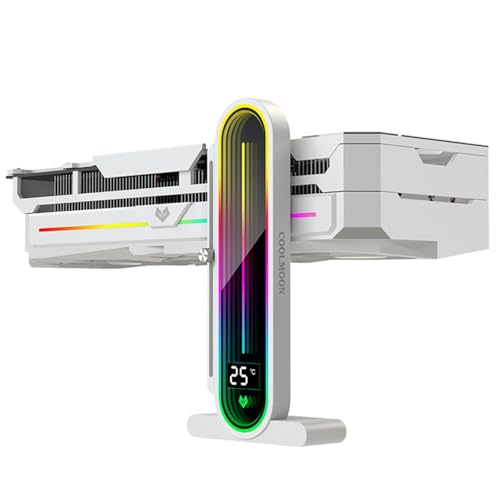
A height adjustable RGB GPU stand is essential for gamers and content creators who demand peak performance from their graphics cards. With real-time GPU temperature monitoring, you’ll stay informed about your card’s health, preventing overheating during intense sessions. The customizable ARGB Infinity lighting adds flair, syncing with your existing components for a stunning visual effect. Plus, the stand’s adjustable height (35 to 157mm) guarantees compatibility with various GPU sizes. Its anti-sag bracket prevents damage while maintaining a clean look. The magnetic base assures secure installation, making it easy to reposition without tools, so you can focus on your gameplay or projects.
Best For: Gamers and content creators seeking to enhance the performance and aesthetics of their graphics cards while ensuring optimal support and temperature monitoring.
Pros:
- Real-time GPU temperature monitoring helps prevent overheating and ensures optimal performance during intense gaming sessions.
- Customizable ARGB lighting syncs with existing components, adding a vibrant visual appeal to your PC setup.
- Adjustable height accommodates a wide range of GPU sizes, providing secure support and preventing sagging.
Cons:
- May require additional setup time to find the perfect height adjustment for larger GPUs.
- The magnetic base may not be compatible with all PC case materials, potentially affecting stability.
- Some users may find the ARGB lighting effects distracting during gameplay or work sessions.
GT 740 4GB GDDR5 Low Profile GPU Graphics Card
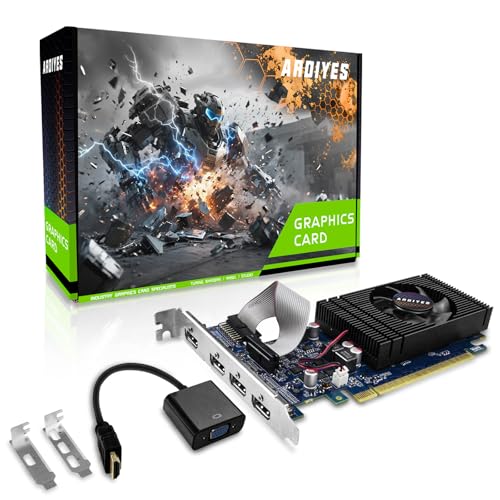
With 4GB of GDDR5 memory and support for a quad-monitor setup, the GT 740 Low Profile GPU is perfect for professionals who need efficient graphics performance in a compact design. It smoothly handles daily graphics tasks, making it ideal for office work, home theaters, and multimedia applications. Thanks to its PCI Express 3.0 x16 interface, it easily installs in most desktop PCs. The silent fan guarantees near-silent operation, while the low-profile design fits snugly into smaller cases. You’ll appreciate the included accessories and reliable support, simplifying your setup experience considerably. Enjoy seamless 1080P playback with this versatile GPU.
Best For: Professionals and home users seeking an efficient, low-profile graphics solution for office tasks, multimedia applications, and home theater setups.
Pros:
- Supports quad-monitor setups with four HDMI ports for enhanced multitasking capabilities.
- Silent fan and efficient cooling system ensure near-silent operation, perfect for noise-sensitive environments.
- Easy installation with PCI Express 3.0 x16 interface and included accessories for a hassle-free setup.
Cons:
- Limited performance for high-end gaming or resource-intensive applications due to its entry-level GPU status.
- May require additional power connectors depending on the specific desktop configuration.
- Low-profile design might restrict compatibility with larger cooling solutions or advanced graphics setups.
MSI Gaming GeForce GT 1030 Graphics Card (4GB DDR4)
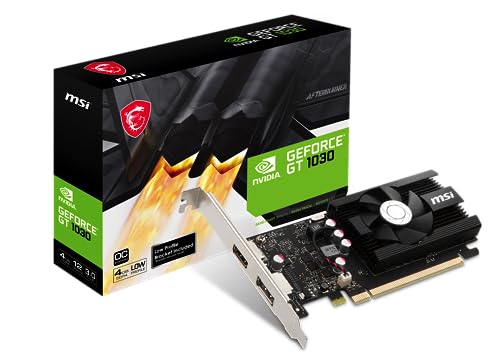
The MSI Gaming GeForce GT 1030 Graphics Card is an excellent choice for gamers and casual content creators seeking a budget-friendly option without sacrificing performance. With its NVIDIA Pascal architecture and 4GB DDR4 memory, you can enjoy smooth HD gaming and efficient picture editing. The card supports 4K UHD resolution, ensuring stunning visuals. Featuring a PCI-Express x16 interface, it’s easy to install in most desktops. Plus, it comes with a 3-year warranty, giving you peace of mind. With an impressive average rating of 4.5 out of 5 stars from users, it’s a reliable addition to your setup.
Best For: Gamers and casual content creators looking for a budget-friendly graphics card that delivers solid performance.
Pros:
- Affordable price point for entry-level gaming and content creation.
- Supports 4K UHD resolution, providing stunning visuals for high-definition displays.
- Easy installation with a PCI-Express x16 interface, compatible with most desktop systems.
Cons:
- Limited memory interface at 64-bit, which may restrict performance in more demanding applications.
- Single fan design may lead to higher temperatures under heavy load compared to cards with multiple fans.
- Not suitable for high-end gaming, as it is designed for budget and casual use only.
GeForce GT 610 2G DDR3 Low Profile Graphics Card

Designed for entry-level users, the GeForce GT 610 2G DDR3 Low Profile Graphics Card is an excellent choice for those looking to enhance their basic PC, small form factor (SFF) systems, or home theater PCs (HTPC). Powered by a 40nm NVIDIA chipset, it features a 523MHz core frequency and 2048MB of DDR3 memory. With HDMI and VGA outputs, you can achieve resolutions up to 2560×1600 and 2048×1536, respectively. It also supports DirectX 11, ensuring smooth performance in everyday tasks. Plus, it includes low-profile brackets, making it compatible with most setups, except micro form factor towers.
Best For: Entry-level users seeking an affordable graphics card to enhance their basic PC, small form factor systems, or home theater setups.
Pros:
- Supports high resolutions up to 2560×1600 via HDMI, ideal for multimedia applications.
- Low-profile design and included brackets ensure compatibility with various PC cases.
- No manual driver installation needed for Windows 11, simplifying setup.
Cons:
- Limited performance for demanding gaming or high-end graphical applications.
- Only 64-bit bus width may restrict memory bandwidth compared to higher-end models.
- Older technology may not support the latest graphical features and updates.
GT 1030 2GB Low Profile Graphics Card
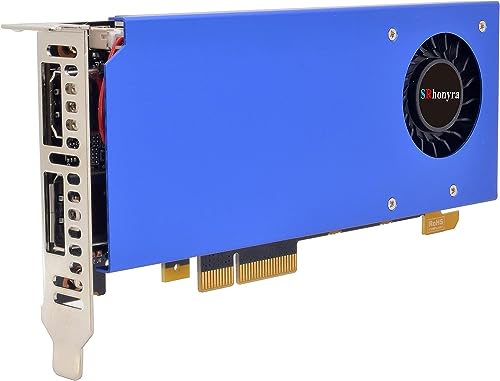
For those seeking a compact and efficient graphics solution, the SRhonyra GT 1030 2GB Low Profile Graphics Card stands out with its small form factor and impressive performance capabilities. With 2GB of GDDR5 memory and a GPU clock speed of up to 1228 MHz, you’ll experience smooth graphics in various applications. It supports dual monitors, allowing for 4K at 60Hz via HDMI or even 8K through DisplayPort. Its low power consumption of just 30W makes it ideal for small builds. Compatible with multiple operating systems, this graphics card is perfect for those needing solid performance without the bulk.
Best For: Users looking for a compact and energy-efficient graphics card that delivers solid performance for everyday tasks and light gaming.
Pros:
- Compact Design: Low profile design allows for installation in small form factor cases.
- Dual-Monitor Support: Capable of supporting high-resolution displays, including 4K @60Hz and 8K @60Hz.
- Low Power Consumption: Operates at just 30W TDP, making it an energy-efficient choice for budget builds.
Cons:
- Limited Performance for Gaming: Not suitable for high-end gaming or demanding graphics applications.
- Only 2GB Memory: May struggle with memory-intensive tasks or applications requiring more VRAM.
- Single HDMI Port: Limited connectivity options may require adapters for additional displays.
Factors to Consider When Choosing 4U GPU Servers
When choosing a 4U GPU server, you need to assess your performance requirements to guarantee it meets your workload needs. Consider GPU compatibility options and efficient cooling solutions, as these are essential for maintaining peak performance. Don’t forget to check the power supply capacity and the server’s dimensions to fit your space.
Performance Requirements Assessment
To guarantee you get the most out of your 4U GPU server, it’s vital to assess the performance requirements specific to your applications. Start by evaluating the number of CUDA cores; higher counts, like 4992 in server-grade GPUs, can greatly enhance parallel processing. Next, consider memory size—24GB GDDR5 in high-performance GPUs enables efficient handling of larger datasets and complex computations. Power efficiency is also key; modern architectures, like NVIDIA Ampere, offer improved performance per watt for intensive workloads. Additionally, factor in the types of applications you’ll run, as certain GPUs excel in areas like machine learning or scientific simulations. Finally, confirm the server chassis accommodates the physical dimensions and cooling needs of your chosen GPU for ideal performance.
GPU Compatibility Options
Choosing the right GPU compatibility options is essential for maximizing the performance of your 4U GPU server. Start by ensuring the server supports modern GPU interfaces like PCIe 3.0 or PCIe 4.0, as this will accommodate the latest graphics cards. Don’t overlook the physical dimensions of the GPU; the server may have specific height and length restrictions that could hinder installation. Check the number of available PCIe slots to determine how many GPUs you can install and their configuration. Also, make sure the power supply meets the requirements of high-performance models, as they often demand significant wattage and specific connectors. By considering these factors, you’ll optimize your server’s potential for high-performance computing.
Cooling Solutions Efficiency
Efficient cooling solutions are essential for maintaining the performance and longevity of your 4U GPU server, especially since high-performance GPUs can generate significant heat. Overheating leads to thermal throttling, reducing both performance and lifespan. Consider implementing advanced cooling technologies like liquid cooling systems or enhanced airflow designs to improve thermal management in dense GPU configurations. For instance, GPUs like the NVIDIA Tesla K80 need dedicated cooling to stay below 85°C during intensive tasks. Using high-quality fans with a higher CFM rating boosts air circulation, effectively dissipating heat. Additionally, proper thermal paste application and maintaining adequate spacing between GPUs maximize heat dissipation, preventing thermal buildup in your server case. Prioritizing these factors guarantees ideal performance and reliability.
Power Supply Capacity
Power supply capacity plays a pivotal role in the performance of 4U GPU servers, as it must meet the demanding power needs of multiple high-performance GPUs, which can consume anywhere from 150W to over 300W each. It’s essential to choose a power supply that offers at least 20-30% more wattage than your total calculated demand. This extra capacity guarantees stability and accommodates peak loads. Look for power supplies with an 80 PLUS efficiency rating to reduce energy consumption and heat output, which can impact cooling and costs. Additionally, redundant power supplies enhance reliability by guaranteeing continuous operation if one fails. Finally, prioritize proper cable management to prevent overheating and ensure stable power delivery to all components.
Space and Dimensions
When it comes to 4U GPU servers, considering space and dimensions is vital to confirm peak performance and compatibility. A standard 4U height of about 7 inches can limit your GPU and cooling options. The server’s depth, usually between 20 and 30 inches, affects its fit in existing racks. Ascertain adequate airflow, as GPUs generate a lot of heat; spacing between components is important for ideal thermal management. Keep in mind that a fully populated server can weigh over 100 pounds, so check your rack’s weight capacity to avoid structural issues. Finally, evaluate the internal component arrangement to maximize space usage and performance efficiency, making sure your setup runs smoothly and effectively.
Budget Constraints Evaluation
As you evaluate your budget for a 4U GPU server, it’s crucial to establish a clear financial framework that aligns with your performance needs. Prices can range from around $1,000 for entry-level options to over $10,000 for high-performance configurations. Don’t forget to take into account additional costs like power consumption, cooling solutions, and potential upgrades, which can greatly influence your overall investment. Assess your performance requirements to choose a server with adequate GPU memory and processing power to avoid costly future upgrades. Also, factor in warranty and support plans, as thorough support can minimize downtime and repair costs. Finally, make sure your budget allows for scalability, so your server can grow with your needs without requiring a complete replacement.
Future Upgrade Potential
Choosing the right 4U GPU server involves not just meeting your current needs but also planning for the future. Start by checking the maximum number of GPU slots; more slots mean greater potential for future upgrades. Verify compatibility with PCIe 4.0 or 5.0 to support the latest GPUs that offer enhanced performance. Don’t overlook the power supply; you’ll want a robust capacity to handle more powerful GPUs or multiple units down the line. Investigate the cooling solutions, as upgraded GPUs can generate extra heat that needs managing. Finally, assess the motherboard’s compatibility for future CPU and RAM upgrades, verifying it can keep pace with the evolving technologies to fully leverage your upgraded GPUs.
