
If you need to capture physical objects, parts, or people from a home office or shared workspace, the right scanner can streamline every step of remote collaboration.
These picks focus on portability, scan quality, and practical software support so you can move from capture to sharing without slowing down your workflow.
Best 10 3D Scanners for Remote Work Picks for 2026
Studio-Ready Portability
Revopoint POP3 Plus for Full-Color Scans
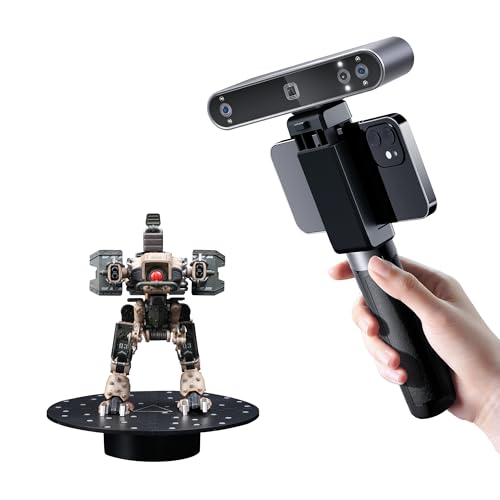
- Lightweight 190g design with Wi‑Fi 6 and USB-C
- Up to 18 fps scanning with 9-axis IMU stabilization
- Full-color capture plus wide export format support
Best For: Remote product design, 3D printing prep, and full-color scans
Ultra-Portable Precision
Creality Pika Wireless 3D Scanner

- 0.03 mm accuracy with dual blue laser and IR scanning
- Wi‑Fi 6 plus dual hot-swappable batteries for mobility
- AI tools for retouching, body completion, and hole filling
Best For: Mobile scanning, detailed parts, and fast AI-assisted cleanup
Quiet Desktop Detail
3DMakerpro Moose Lite for Remote Teams
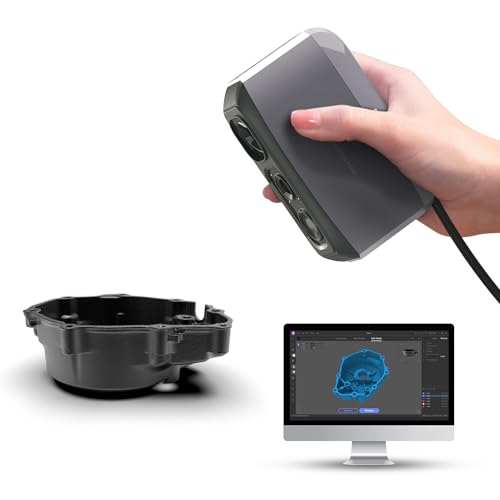
- 0.05 mm accuracy with 0.1 mm resolution
- Lightweight 250g body with no fan noise
- JMStudio handles scanning, editing, and optimization
Best For: Quiet home-office scanning, detailed print prep, and marker-free workflows
Wireless Pro Workflow
Creality Pika Portable 3D Scanner

- 0.03 mm accuracy with blue laser and NIR structured light
- Wi‑Fi 6, touchscreen, and swappable batteries for mobility
- AI body completion, retexturing, and hole filling tools
Best For: Remote scanning sessions that need precision, mobility, and fast AI cleanup
Entry-Level Medium-Format Pick

- 0.07mm accuracy, 0.10mm resolution
- Markerless AI relocks after movement
- JMStudio handles scan, edit, optimize
Best For: Beginners and hobbyists needing a practical scanner for 3D printing and modeling
Wireless Field-Ready Scanner
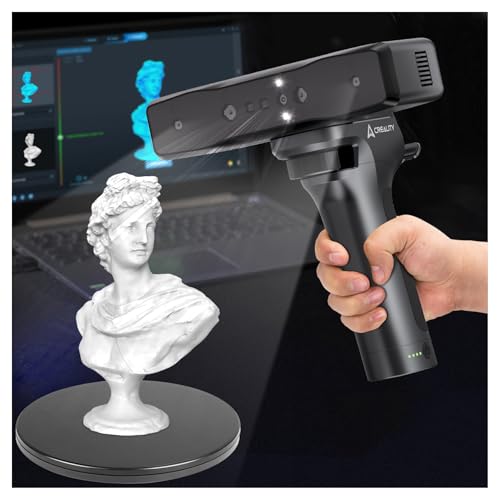
- 0.05mm accuracy across tiny to large objects
- Wi-Fi and smartphone mobile control
- 30fps scanning with anti-shake support
Best For: Engineers, designers, and remote users who need portable scanning
Precision Multi-Mode Pro Pick
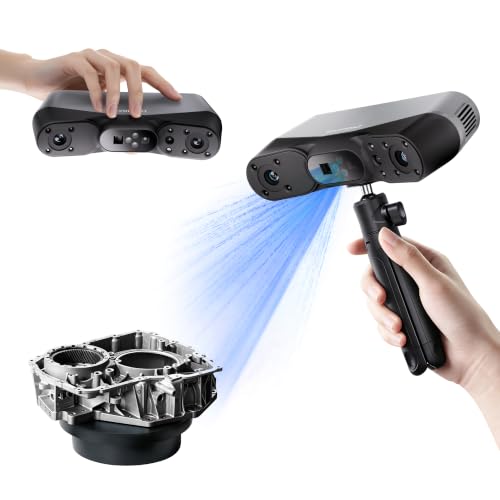
- Up to 0.03 mm single-frame accuracy
- Five modes for small parts, holes, metals, and dark objects
- Wi-Fi 6.0 and 4-hour battery grip
Best For: Professionals needing high-accuracy, multi-mode scanning for remote and field work
Ultra-Range Precision Pick
Creality Sermoon S1 for Engineering Printing
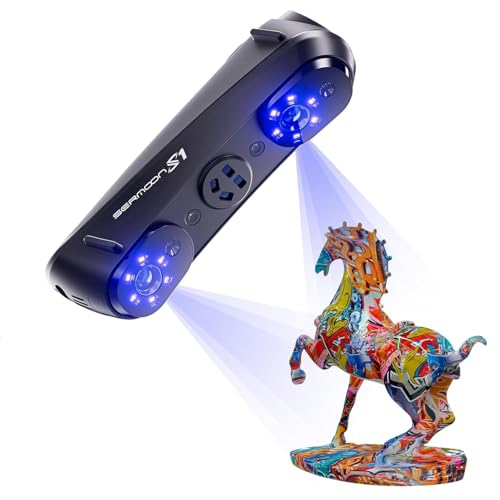
- 5 mm to 4 m scan range
- Triple blue laser modes
- Up to 0.02 mm accuracy
Best For: Remote engineering and CAD workflows that need detail plus large-object coverage
Wireless Outdoor Pick

- WiFi 6 wireless scanning
- Outdoor use up to 20,000 lux
- Up to 0.05 mm accuracy
Best For: Mobile remote scanning with wireless capture and outdoor flexibility
Beginner Portable Pick

- WiFi 6 wireless scanning
- Only 105 g for travel
- 24-bit full-color capture
Best For: Beginners and mobile makers who want a simple, lightweight scanner
Studio-Ready Portability – Revopoint POP3 Plus for Full-Color Scans
If you’re comparing 3D scanners for remote work, the POP3 Plus stands out as a lightweight option for scanning medium-sized objects and moving files cleanly into CAD, modeling, or 3D printing workflows. Its Wi‑Fi 6 and USB-C connectivity, plus broad format support, make it practical for home offices and distributed teams.
Best For: Remote product design, 3D printing prep, and full-color scans on the go
Pros:
- 20% more accuracy and precision, with calibration support aimed at 20-micron accuracy
- Up to 18 fps scanning with a 9-axis IMU for more stable capture
- Full-color scanning with HD RGB camera, advanced pixel mapping, and Flash LED lighting
- Works with iOS, Android, Windows, and macOS over Wi‑Fi 6 or USB-C
Cons:
- Revo Scan software is only compatible with x86_64 architecture
- Best suited to medium-sized objects rather than very tiny parts or massive scenes
For remote workflows, the POP3 Plus is a balanced pick when you want portability, color capture, and straightforward export options without a bulky setup. It is especially appealing if your work mixes scanning, editing, and sharing across multiple devices.
Ultra-Portable Precision – Creality Pika Wireless 3D Scanner
For remote work, the Creality Pika is built around wireless flexibility and high-detail capture, making it a strong fit when you need to scan from different locations without a full desktop setup. Its dual light source system handles both fine-detail parts and larger subjects, while AI tools help speed up model cleanup.
Best For: Mobile scanning, detailed parts, and fast AI-assisted model cleanup
Pros:
- 0.03 mm accuracy with 7-parallel blue laser detail capture
- Infrared structured light supports almost 1-minute full-body scans
- Built-in Wi‑Fi 6 and dual hot-swappable batteries for cable-free use
- AI retexturing, body completion, and hole filling reduce post-processing time
Cons:
- Recommended device specs are relatively demanding for phones and computers
- Best suited to users who want a more advanced, feature-rich scanning workflow
If your remote workflow depends on portability and speed, Pika offers a lot in a compact body. It is especially useful when you want one scanner that can handle both precision parts and broader scans without needing spray for black or metal objects.
Quiet Desktop Detail – 3DMakerpro Moose Lite for Remote Teams
Among 3D scanners for remote work, the Moose Lite is a practical desktop-friendly choice for teams that want detailed capture without a noisy setup. It combines 0.05 mm accuracy, AI tracking, and software that handles scanning, editing, and optimization in one workflow.
Best For: Quiet home-office scanning, detailed print prep, and marker-free workflows
Pros:
- 0.05 mm accuracy and 0.1 mm resolution for detailed models
- AI tracking and point cloud algorithms help improve scan reliability
- Lightweight 250g design with no fan noise
- JMStudio combines scanning, editing, and optimization in one place
Cons:
- Smart Grip smartphone accessory is optional and sold separately
- Compatibility is limited to Windows 10/11 64-bit and macOS 12/13
The Moose Lite is a solid fit if your remote setup prioritizes quiet operation and a streamlined software experience. It is less about flashy wireless extras and more about steady, detailed work from a desk or studio.
Wireless Pro Workflow – Creality Pika Portable 3D Scanner
If you need a scanner for remote work that can move between rooms, job sites, or home offices, the Creality Pika Portable is built for that kind of flexibility. It combines high-accuracy blue laser scanning, structured light for larger subjects, and AI-assisted tools to keep turnaround time low.
Best For: Remote scanning sessions that need precision, mobility, and fast AI cleanup
Pros:
- 0.03 mm accuracy and 0.1 mm resolution for detailed capture
- Dual-mode scanning supports tiny parts through life-size body scans
- Wi‑Fi 6, 3-inch touchscreen, and dual swappable batteries improve portability
- AI body completion, retexturing, and hole filling speed up model prep
Cons:
- Outdoor scanning performance is tied to the stated brightness limit
- Best results depend on using CrealityScan across supported platforms and devices
This version of the Pika is a strong fit for distributed workflows where you want one scanner to cover precision parts and full-body capture. It is especially appealing if you value wireless convenience and want to reduce cleanup time after each scan.
Entry-Level Medium-Format Pick – 3DMakerpro Fox
If you want one of the more approachable 3D scanners for remote work, the 3DMakerpro Fox is built for beginners and hobbyists who need usable detail without a steep learning curve. Its medium-format capture, markerless AI relocking, and JMStudio workflow make it a practical choice for scanning objects for 3D printing, modeling, measurement, and inspection.
Best For: Beginners, hobbyists, and remote workers who want a straightforward scanner for detailed object capture and 3D printing workflows.
Pros:
- 0.07mm accuracy and 0.10mm resolution for detailed scans
- Markerless AI visual tracking can relock after movement
- JMStudio combines scanning, editing, and optimizing in one workflow
- Designed for reliable results in 3D printing, modeling, and inspection
Cons:
- Best positioned as an entry-level option rather than a top-end professional model
- Package weight of 2.39 pounds may be less ideal for frequent travel
For remote teams or solo users who need a dependable starter scanner, the Fox balances precision with ease of use. It is a solid fit when the goal is practical output over advanced industrial features.
Wireless Field-Ready Scanner – Creality Otter Lite
The Creality Otter Lite is a strong fit if you need 3D scanners for remote work that can move easily between desk, workshop, and field locations. With wireless control, mobile preview, and 0.05mm accuracy, it is designed for flexible scanning of very small parts through large components in a range of lighting conditions.
Best For: Remote workers, engineers, and designers who want wireless scanning with broad size compatibility and portable control.
Pros:
- 0.05mm accuracy with infrared structured light
- Wi-Fi and smartphone-based mobile control reduce cable clutter
- Handles objects from 20mm³ up to 2000mm³
- 30fps real-time scanning with anti-shake support
Cons:
- Full software compatibility is tied to Windows and macOS
- Portable use still depends on the Lite Bridge battery handle
For distributed teams and on-the-go users, the Otter Lite offers a good mix of precision and mobility. Its outdoor-ready lighting support and easy wireless workflow make it especially useful when scanning needs to happen away from a fixed workstation.
Precision Multi-Mode Pro Pick – Revopoint POP 4 Premium
Among 3D scanners for remote work, the Revopoint POP 4 Premium stands out for users who need high-end accuracy, multiple scan modes, and strong outdoor performance. It is built for demanding 3D printing, reverse engineering, and precision modeling tasks, while also offering wireless scanning and cross-screen viewing for flexible work setups.
Best For: Professionals who need high-accuracy scanning, multiple capture modes, and reliable performance for indoor or outdoor projects.
Pros:
- Up to 0.03 mm single-frame accuracy for fine detail capture
- Five scanning modes cover small parts, deep holes, metals, and dark objects
- Wireless scanning with Wi-Fi 6.0 and up to 4 hours from the battery grip
- AI segmentation helps clean up scans and streamline post-processing
Cons:
- AI object segmentation is Windows only
- The feature set is broad enough that casual users may not need all modes
If your remote workflow demands one scanner that can handle varied environments and object types, the POP 4 Premium is the most capable of the three. Its mix of accuracy, outdoor readiness, and advanced capture tools makes it a strong pick for serious scanning work.
Ultra-Range Precision Pick – Creality Sermoon S1 for Engineering Printing
If you need one of the more capable 3D scanners for remote work, the Creality Sermoon S1 is built for jobs that move between detailed parts and oversized objects. Its 5 mm to 4 m scan range, triple blue laser modes, and marker-free workflow make it a practical fit for distributed engineering, prototyping, and inspection tasks.
Best For: Remote engineering teams, CAD users, and creators who need one scanner for both fine detail and large-object capture.
Pros:
- Wide 5 mm to 4000 mm scan range handles everything from small models to large structures.
- Triple laser modes support fast scanning, fine detail, and deep-hole capture.
- Up to 0.02 mm accuracy and 90 FPS scanning suit production-focused workflows.
- AI-assisted software helps streamline alignment, mesh generation, and cleanup.
Cons:
- Recommended system specs are fairly strong, especially for Windows and macOS setups.
- Best suited to professional workflows rather than casual, occasional scanning.
Overall, the Sermoon S1 stands out when remote work demands flexibility without giving up precision. It is a strong choice if you want to scan many object types and move quickly from capture to CAD or inspection.
Wireless Outdoor Pick – Revopoint INSPIRE 2 Premium
The Revopoint INSPIRE 2 is a strong option if your 3D scanners for remote work shortlist needs wireless flexibility and portable scanning outside the office. With WiFi 6, outdoor support, dual scanning modules, and AI-assisted cleanup, it is designed for mobile capture, quick handoffs, and photorealistic model workflows.
Best For: Remote creators and professionals who want wireless scanning, outdoor use, and a lightweight kit.
Pros:
- WiFi 6 enables mobile scanning and real-time PC-to-mobile interactive streaming.
- Works on reflective or dark surfaces without scanning spray, using 11 infrared laser lines.
- Up to 0.05 mm accuracy and 0.03 mm precision support detailed 3D printing and reverse engineering.
- Lightweight 190 g body and included accessories make it easy to transport and set up.
Cons:
- Revo Design is sold separately if you want the full scan-to-CAD workflow.
- Minimum system requirements are relatively demanding for peak performance.
For remote teams that value portability and wireless operation, the INSPIRE 2 offers a well-rounded feature set. It is especially appealing if you scan in mixed environments and want polished output with less post-processing friction.
Beginner Portable Pick – Creality CR-Scan Ferret Pro
For buyers comparing 3D scanners for remote work on ease of use, the Creality CR-Scan Ferret Pro focuses on portability, wireless operation, and beginner-friendly scanning. It is a practical choice for creators who want a lightweight scanner that works across PC, Android, and iOS without a complicated setup.
Best For: Beginners, DIY makers, and remote creators who want a simple wireless scanner for everyday projects.
Pros:
- WiFi 6 support enables smooth wireless scanning across Windows, macOS, Android, and iOS.
- Just 105 g, making it easy to carry for home, studio, or travel use.
- Full-color 24-bit scanning with anti-shake technology helps produce detailed models.
- Includes a handy all-in-one kit with tripod, power bank, phone holder, and carrying case.
Cons:
- Not suitable for very small or highly detailed items like jewelry or precision parts.
- Best results come from avoiding reflective, transparent, or very dark surfaces.
The Ferret Pro is a sensible remote-work scanner when convenience matters more than ultra-fine detail. It has the portability and wireless flexibility to fit casual scanning, 3D printing prep, and on-the-go capture.
How We Picked the Best 3D Scanners for Remote Work
We prioritized scanners that are easy to set up, dependable over video calls or in hybrid workflows, and useful for real-world tasks like product design, 3D printing, inspection, and content creation. That means looking closely at accuracy, tracking stability, scan speed, wireless options, and software that makes cleanup manageable for non-specialist users.
We also favored models that fit remote work habits: compact hardware, simple calibration, fast file export, and broad compatibility with common operating systems and 3D modeling pipelines.
Quick Comparison: What Matters Most
For remote teams, the biggest trade-off is usually precision versus convenience. Higher-precision scanners are better for engineering, reverse engineering, and fit-critical parts, while more portable models are easier for travel, home studios, and mixed-use scanning.
If you expect to scan people, large objects, or irregular surfaces, pay attention to tracking aids, scan range, and whether the scanner handles dark or reflective materials well. If you mainly scan smaller items for 3D printing, detail capture and ease of cleanup may matter more than maximum range.
Key Buying Factors for 3D Scanners for Remote Work
Accuracy and Repeatability
Look for a scanner with enough precision for your end use. Design work, QA checks, and part matching benefit from tighter accuracy, while content and general making can tolerate a bit more error.
Portability and Connectivity
Wireless scanning can make a big difference in shared spaces and remote setups. Lighter devices, simple cable management, and laptop-friendly operation reduce friction when you move between locations.
Scan Speed and Tracking
Faster frame rates and stable tracking help when you are scanning on deadline or without a dedicated studio. Anti-shake features and good surface tracking can save time on rescans.
Software Workflow
Choose a scanner with software that fits your team’s skill level. The best 3D Scanners for Remote Work should make it easy to preview, align, clean, and export files without turning every scan into a technical project.
Object Size and Use Case
Match the scanner to what you capture most often. Small-part scanners excel for product details, while wider-range models are better for medium-format objects, people, and field use.
Who Should Buy Which 3D Scanners for Remote Work?
Buy a compact, user-friendly scanner if you work from home, travel often, or need quick scans for 3D printing and prototyping. Choose a higher-accuracy model if you handle engineering, inspection, or detailed reverse engineering. If your work includes larger subjects, outdoor capture, or mixed environments, look for stronger tracking, broader scan range, and more forgiving software. In short, the right choice depends on whether your remote workflow values portability, precision, or versatility most.
