
Choosing among today’s 3D scanners for professionals is less about finding the highest numbers on a spec sheet and more about matching scan speed, accuracy, and workflow to your real-world jobs.
Whether you need reliable reverse engineering, inspection-ready detail, or fast capture for 3D printing, this roundup focuses on tools that balance precision, portability, and practical usability.
Best 10 3D Scanners for Professionals Picks for 2026
Precision Multi-Scale Blue Laser Scanner
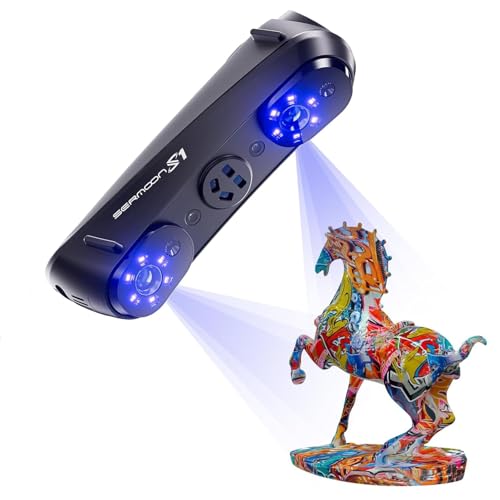
- 5 mm to 4 m scan range
- Triple blue laser modes for flexible capture
- Up to 0.02 mm accuracy and 90 FPS
Best For: Engineering, restoration, and large-object workflows
All-in-One Photogrammetry Scanner

- Photogrammetric metrology kit included
- Quad depth cameras for near and far scans
- 48MP RGB camera with onboard processing
Best For: Portable measurement and scan-to-CAD work
Lightweight AI Tracking Scanner

- 0.05 mm accuracy with blue light
- AI tracking and built-in processing
- 250 g lightweight and quiet design
Best For: Portable 3D printing scans and medium objects
Industrial Laser Precision Scanner

- Up to 0.01 mm single-frame precision
- Five modes for parts and medium objects
- Scans dark, shiny, and outdoor surfaces
Best For: Inspection, reverse engineering, and tight tolerances
Precision Laser Power

- 0.02mm claimed accuracy and 660,000 points/sec capture.
- Works on black, metallic, and transparent surfaces without spray powder.
- Covers tiny 5mm items up to 4,000mm objects with color scanning.
Best For: Professionals needing fast, high-precision scanning across many object types
AI Workflow Scanner

- Up to 0.03mm accuracy with multiple scan modes.
- AI segmentation helps isolate the target and cut background noise.
- Supports bright outdoor scanning and wireless use with optional accessories.
Best For: Users who want versatile scanning with AI cleanup and field-ready flexibility
Wireless Capture Upgrade
Raptor Pro + Scan Bridge Bundle

- Includes the Raptor Pro scanner with Scan Bridge wireless support.
- 0.02mm accuracy, 60FPS scanning, and 660,000 points/sec.
- Marker-based alignment and full-color scanning improve workflow.
Best For: Professionals who want precision scanning with added wireless convenience
Wireless Outdoor Scanner

- WiFi 6 wireless scanning and live streaming
- 11 infrared laser lines for tough surfaces
- 0.05 mm accuracy with AI cleanup tools
Best For: Mobile pros who need portable outdoor scanning and flexible capture modes
Metrology-Speed Scanner
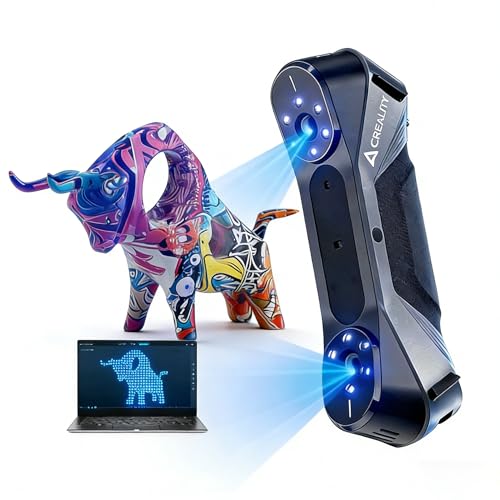
- Up to 0.02 mm accuracy for precision work
- Scans 5 mm to 2000 mm objects
- 60 fps capture with blue laser and IR modes
Best For: Precision-focused users scanning small parts, larger components, and mixed materials
Portable Full-Color Scanner

- WiFi 6 wireless scanning with mobile streaming
- Built-in RGB camera for synced full-color capture
- 0.05 mm accuracy with dual scan modules
Best For: Portable pro scanning with color texture capture for design and archiving
Precision Multi-Scale Blue Laser Scanner – Creality Sermoon S1
If you need 3D scanners for professionals that can move from tiny parts to large assemblies, the Creality Sermoon S1 is built for that range. Its 5 mm to 4 m scan window, triple blue laser modes, and marker-free workflow make it a flexible option for reverse engineering, inspection, and production-ready CAD work.
Best For: Engineering, restoration, and large-object scanning where one scanner must handle both detail and scale.
Pros:
- Wide 5 mm to 4 m scanning range covers jewelry, mechanical parts, and architectural structures.
- Triple laser modes: 34 crossed lines, 7 parallel lines, and single-line mode for deep holes and grooves.
- Up to 0.02 mm accuracy with 0.08 mm/m volumetric precision supports professional workflows.
- 90 FPS capture and AI-assisted processing help speed up alignment, cleanup, and export.
Cons:
- Recommended system specs are fairly demanding, especially on Windows and macOS.
- Large, advanced scans will still benefit from a careful setup and workflow planning.
Overall, the Sermoon S1 stands out when you want one scanner to cover a very broad range of professional jobs without switching devices. It is especially appealing if speed, detail, and versatility all matter in the same workflow.
All-in-One Photogrammetry Scanner – Revopoint MIRACO Plus
The Revopoint MIRACO Plus is aimed at professionals who want 3D scanners for professionals with built-in flexibility and measurement tools. Its all-in-one design combines scanning, photogrammetric metrology, color capture, and on-device processing, making it a practical choice for detailed work on both small and large objects.
Best For: Portable scanning, photogrammetric measurement, and scan-to-CAD workflows.
Pros:
- Photogrammetric kit supports accurate length measurement with coded targets and scale bars.
- Quad depth camera system handles both small details and larger surfaces.
- 48MP RGB camera and flash LEDs improve color scans and surface capture.
- Built-in hardware, Wi-Fi 6, and USB-C support fast, portable workflows.
Cons:
- Revo Design for scan-to-CAD is sold separately.
- The software note indicates compatibility limitations tied to x86-based systems.
For teams that need a portable scanner with metrology features, the MIRACO Plus is a strong all-in-one option. It is especially useful when you want to scan, measure, process, and export from a compact device without building a more complex setup.
Lightweight AI Tracking Scanner – 3DMakerpro Moose Lite
For buyers comparing 3D scanners for professionals, the 3DMakerpro Moose Lite focuses on high precision in a compact package. It uses blue light, AI visual tracking, and integrated pre/post processing to simplify printing-oriented scanning of medium-sized objects.
Best For: Portable 3D printing scans where accuracy and ease of use matter most.
Pros:
- 0.05 mm accuracy and 0.1 mm resolution support detailed models.
- AI visual tracking and point-cloud processing help simplify scanning and cleanup.
- Scan range from 15 mm to 1500 mm works across many object sizes.
- Very lightweight at 250 g and designed for quiet use.
Cons:
- 10 FPS scanning speed is slower than faster professional scanners.
- Best suited to medium objects, not the widest industrial scan range.
The Moose Lite makes sense if you want a travel-friendly scanner that still prioritizes detail and controlled workflow. It is a good fit for 3D printing projects where clean model output matters more than maximum scan speed.
Industrial Laser Precision Scanner – Revopoint MetroY Ultra
The Revopoint MetroY Ultra is built for professionals who need 3D scanners for professionals in inspection, reverse engineering, and tight-tolerance measurement. With blue laser modes, structured light, and strong outdoor and dark-surface performance, it is designed for demanding industrial scanning jobs.
Best For: Industrial parts, inspection work, and fast scanning of challenging surfaces.
Pros:
- Up to 0.01 mm single-frame precision and 0.015 + 0.04 mm x L(m) volumetric accuracy.
- Five scanning modes include cross-lines, parallel lines, single-line, structured light, and turntable scanning.
- Can scan black, glossy, and metallic surfaces without spray.
- Works outdoors in sunlight up to 100,000 lux and supports Wi-Fi 6 mobility.
Cons:
- Top performance depends on strong hardware, including an NVIDIA GPU for maximum FPS.
- Some users may not need the industrial-grade feature set for simple projects.
MetroY Ultra is the most inspection-focused option in this group, especially if surface finish and lighting conditions are usually a problem. It is a compelling pick when you need precision, speed, and flexibility in one scanner.
Precision Laser Power – Creality CR-Scan Raptor Pro
If you want 3D scanners for professionals that can handle everything from tiny parts to large assemblies, the Creality CR-Scan Raptor Pro is built for serious capture work. Its 0.02mm claimed accuracy, 22 crossed blue lasers, 7 parallel blue lasers, and NIR structured light give it a strong mix of detail, speed, and material flexibility for demanding scanning workflows.
Best For: Professional users who need high-precision scanning across mixed materials, large objects, and color capture workflows.
Pros:
- Up to 0.02mm accuracy with 660,000 points/sec for detailed capture.
- Scans black, metallic, and even 71% transparent glass without spray powder.
- Handles objects from 5mm to 4,000mm, including body and face scanning.
- 24-bit RGB color capture and compatibility with major pro software like SolidWorks and ZBrush.
Cons:
- Requires fairly capable computers, especially for the recommended Windows workflow.
- Best results depend on using the right mode for the object size and material.
- Wireless and outdoor use may add setup complexity compared with basic handheld scanners.
This is a strong pick if your priority is professional-grade flexibility rather than a single-purpose scanner. It combines high precision, fast frame rates, and broad material support in one handheld system.
AI Workflow Scanner – Revopoint POP 4 Standard
The Revopoint POP 4 Standard is aimed at 3D scanners for professionals who want a versatile capture tool with strong software-assisted workflows. It combines up to 0.03mm single-frame accuracy, multiple scanning modes, and AI segmentation to help streamline both scanning and post-processing for 3D printing, reverse engineering, and modeling.
Best For: Users who want an all-around scanner with AI cleanup tools, multiple capture modes, and strong outdoor flexibility.
Pros:
- Up to 0.03mm single-frame accuracy and 0.03mm + 0.05mm x L(m) volumetric accuracy.
- AI object segmentation helps isolate the target and reduce background noise.
- Five scanning modes cover small parts, large objects, dark surfaces, and deep holes.
- Wireless support and high ambient-light tolerance make it useful in field settings.
Cons:
- Outdoor filter is sold separately for the brightest conditions.
- Some advanced features are Windows-only, including AI object segmentation.
- Wireless battery grip is also sold separately.
This model stands out for workflow efficiency as much as capture quality. If you need a scanner that balances precision with AI-assisted cleanup and broad scene coverage, it’s a compelling professional option.
Wireless Capture Upgrade – Raptor Pro + Scan Bridge Bundle
For professionals looking at 3D scanners for professionals with a more convenient workflow, this Creality bundle pairs the Raptor Pro with Scan Bridge wireless scanning. It keeps the same high-precision core—0.02mm accuracy, 60FPS scanning, and 660,000 points per second—while adding wireless convenience for more flexible on-site use.
Best For: Professionals who want the Raptor Pro’s precision with added wireless scanning convenience.
Pros:
- Includes the Raptor Pro scanner plus Scan Bridge wireless scanning accessory.
- Claims 0.02mm accuracy and up to 60FPS with 660,000 points per second.
- Supports full-color scanning for realistic texture reproduction.
- Marker-based alignment helps stitch multiple scans together smoothly.
Cons:
- Wireless capability depends on using the included accessory.
- Best suited to users who already value the Raptor Pro’s scanning profile.
- Object size range is broad, but the single capture range is still limited to the listed field of view.
This bundle makes sense if you already want the Raptor Pro class of performance and prefer a less tethered setup. It is a practical step up when mobility and workflow convenience matter.
Wireless Outdoor Scanner – Revopoint INSPIRE 2 Premium
For professionals comparing 3D scanners for professionals, the Revopoint INSPIRE 2 Premium stands out as a portable option that still brings advanced scanning modes and detailed capture. Its WiFi 6 connectivity, dual scanning modules, and outdoor-ready design make it a flexible choice for scanning in the shop, on location, or in mixed lighting conditions.
Best For: Mobile users, outdoor scanning, and professional workflows that need structured-light and laser versatility.
Pros:
- WiFi 6 supports wireless scanning and PC-to-mobile interactive streaming.
- 11 infrared laser lines help scan reflective or dark surfaces without spray.
- Dual scanning modes handle different materials, object sizes, and environments.
- Includes AI segmentation, photo-grade retopology, and Revo Metro software tools.
Cons:
- Revo Design is sold separately for the full scan-to-CAD workflow.
- Windows-only AI object segmentation limits one feature to a single platform.
- Outdoor use is rated for shaded or semi-bright conditions, not full sun.
The INSPIRE 2 Premium is a strong fit if you want a compact scanner with practical pro features rather than a bulky lab setup. Its mix of portability, calibration support, and advanced post-processing makes it well suited to 3D printing, reverse engineering, and detailed model creation.
Metrology-Speed Scanner – Creality CR-Scan Raptor
The Creality CR-Scan Raptor is aimed at users shopping for 3D scanners for professionals who want high accuracy, fast capture, and broad object-size coverage. With metrological precision, multiple scanning modes, and support for both Windows and macOS, it is built for technical work from small parts to larger components.
Best For: High-accuracy scanning of small-to-large parts, including technical and industrial-style projects.
Pros:
- Up to 0.02 mm accuracy for metrological-level scanning.
- Scans objects from 5 mm to 2000 mm, covering very small and large parts.
- Blue 7-line laser and infrared structured light support different target types.
- 60 fps scanning and anti-shake processing help keep capture smooth.
Cons:
- Requires a capable computer, including at least 8 CPU cores and 16 threads.
- Some advanced capture features depend on the scanner’s software workflow.
- Outdoor full-color scanning is supported, but lighting conditions still matter.
This is a compelling pick if precision is your top priority and you need a scanner that can move between tiny parts and larger assemblies. The mix of speed, texture support, and intelligent software makes it especially practical for professional modeling workflows.
Portable Full-Color Scanner – Revopoint INSPIRE 2 Standard
If you want 3D scanners for professionals with a lighter feature set than the Premium version but the same core mobility, the Revopoint INSPIRE 2 Standard is worth a close look. It keeps the wireless workflow, dual scanning modules, and outdoor-capable design while adding built-in RGB texture capture for color-aware projects.
Best For: Portable scanning, full-color model capture, and professional use in 3D printing or digital archiving.
Pros:
- Built-in WiFi 6 enables wireless scanning and PC-to-mobile streaming.
- Dual infrared structured light and multi-line laser modes improve flexibility.
- Built-in RGB camera captures synchronized full-color texture data.
- Up to 0.05 mm accuracy and 0.03 mm precision support detailed models.
Cons:
- Revo Design is sold separately and supports Windows only.
- Outdoor scanning is limited to shaded or semi-bright conditions up to 20,000 lux.
- Some advanced workflow features depend on Revopoint software tools.
The Standard version makes sense if you need a compact professional scanner and value color capture for heritage, product, or archiving work. It delivers a balanced feature set for users who want portability and detail without stepping up to a more elaborate bundle.
How We Picked These 3D Scanners for Professionals
We prioritized scanners built for serious daily use, with a focus on accuracy, repeatability, scan speed, and support for demanding workflows like reverse engineering, prototyping, inspection, and asset capture. We also considered whether a scanner is practical in the field or shop, how easy it is to set up, and whether it can handle different object sizes without forcing constant compromises.
Quick Comparison: What Matters Most
The best choice depends on the job. High-precision handheld scanners are often the strongest fit for mechanical parts and detail work. All-in-one models can be easier for teams that want simpler operation and less setup time. Faster scanners are valuable when you need to move quickly across medium to large objects, while multi-mode systems can be better if you scan everything from small parts to larger assemblies.
Key Buying Factors for 3D Scanners for Professionals
Accuracy and Repeatability
For professional work, stated accuracy matters most when it is consistent across multiple scans. Look for scanners that can reliably capture sharp edges, holes, flat surfaces, and complex geometry without excessive cleanup.
Object Size and Scan Range
Match the scanner to the parts you actually handle. Small-detail tools may need closer-range precision, while engineering teams scanning larger components should look for wider capture ranges and stable tracking at distance.
Scan Speed and Workflow
Fast frame rates help reduce scan time and improve usability on larger objects, but speed should not come at the cost of tracking stability. The best professional scanners keep data clean while letting you work efficiently.
Lighting, Surface, and Environment
Dark, reflective, or outdoor surfaces can challenge some systems. If you scan in varied environments, favor models with stronger tracking, better surface handling, or modes designed for more difficult conditions.
Software and Export Compatibility
Professional users should check whether the scanner’s software supports mesh cleanup, alignment, and common export formats for CAD, inspection, or printing pipelines. A strong hardware spec is less useful if the software slows production.
Who Should Buy Which 3D Scanners for Professionals?
If you need the most control for technical parts, choose a high-accuracy handheld scanner. If you want a more beginner-friendly professional option for mixed use, consider an all-in-one model with simpler capture and editing. Teams that scan frequently and value throughput should lean toward faster systems with dependable tracking. For designers, makers, and engineering teams building around 3D Scanners for Professionals, the right pick is the one that fits your part size, surface type, and downstream workflow—not just the highest advertised precision.
