
Choosing among 3D scanners for beginners can feel overwhelming, especially when specs like accuracy, tracking, and texture capture all sound similar. The good news: a handful of models are genuinely easier to learn and more forgiving for first-time users.
This roundup focuses on scanners that balance simple setup with useful performance for 3D printing, hobby projects, and general object capture in 2026.
Best 10 3D Scanners for Beginners Picks for 2026
Entry-Level Medium-Format Scanner

- 0.07mm accuracy with 0.10mm resolution
- Markerless AI tracking relocks after movement
- JMStudio handles scanning, editing, and optimization
Best For: Beginners and hobbyists scanning medium-format objects
Anti-Shake Color Scanner
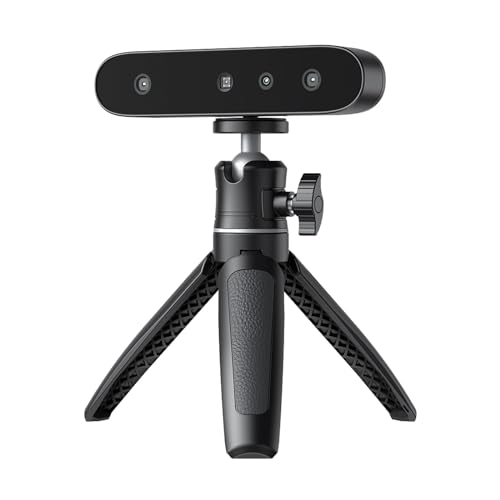
- Anti-shake tech helps reduce hand tremor issues
- 24-bit full-color scanning with a 2MP camera
- Lightweight 105g body for easy portability
Best For: Beginners who want stable, color-capable PC scanning
High-Precision Starter Scanner

- 0.05mm accuracy with 0.10mm resolution
- AI visual tracking simplifies the scan process
- Lightweight body with quiet, fanless design
Best For: Beginners wanting detailed scans in a portable package
Budget-Friendly Beginner Scanner

- Up to 0.07mm accuracy with NIR light
- Markerless tracking and anti-shake support
- Scans 40mm to 1200mm objects with JMStudio
Best For: Beginners, STEM users, and DIY prototypers willing to learn
Beginner-Friendly Wireless Pick

- Anti-shake tracking for steadier handheld scans
- 0.1mm accuracy with 30FPS capture speed
- WiFi 6 support and color scanning for portability
Best For: Beginners who want a mobile, easy-to-handle scanner
High-Detail Small Object Choice

- 0.02mm accuracy for small-format scanning
- Blue LED light source captures fine detail
- JMStudio offers alignment and export tools
Best For: Beginners scanning small indoor objects with precision
Fast Wireless All-Rounder

- 30FPS scanning with 0.1mm accuracy
- WiFi 6 bridge adds flexible wireless use
- Anti-shake tracking helps beginners scan more smoothly
Best For: Beginners who want a flexible scanner across phone and PC
Premium Wireless Pick
Creality Otter Lite for detailed scans
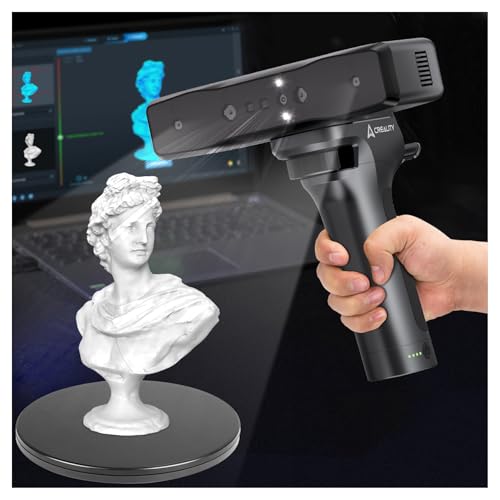
- 0.05mm accuracy for fine detail
- Wi-Fi and phone control reduce cable hassle
- Scans tiny objects up to large parts
Best For: Beginners who want higher precision and wireless flexibility
Best Balanced Starter
Revopoint INSPIRE 2 for flexible scanning

- Wireless WiFi 6 scanning with mobile streaming
- No spray needed for dark or reflective surfaces
- Lightweight 190g body with dual scan modes
Best For: Beginners who want a flexible, well-rounded scanner
Easy Beginner Choice

- Explicitly aimed at beginners and DIY creators
- WiFi 6 wireless scanning with full-color capture
- Very light 105g body and travel kit included
Best For: First-time users who want the simplest learning curve
Entry-Level Medium-Format Scanner – 3DMakerpro Fox
If you’re comparing 3D scanners for beginners, the 3DMakerpro Fox is a practical entry point for medium-format objects. It combines beginner-friendly scanning software with markerless AI tracking, so it’s built to help new users get usable results without constantly restarting scans.
Best For: Beginners and hobbyists who want an accessible scanner for 3D printing, modeling, and inspection.
Pros:
- 0.07mm accuracy and 0.10mm resolution for detailed scans
- Markerless AI visual tracking helps recover after movement
- JMStudio combines scanning, editing, and optimizing in one workflow
- Designed as an accessible medium-format option for beginners
Cons:
- As an entry-level scanner, it still benefits from some learning and practice
- Best results depend on comfortable use of the JMStudio workflow
Overall, the Fox stands out if you want a beginner-friendly scanner that still aims for serious accuracy. It’s a sensible pick for new users who want to learn the scanning process while producing practical models for printing or measurement.
Anti-Shake Color Scanner – Creality CR-Ferret SE
For buyers looking at 3D scanners for beginners, the Creality CR-Ferret SE focuses on stability and simplicity. Its anti-shake scanning is designed to reduce problems from unsteady hands, while the built-in color camera adds full-color capture for more complete-looking models.
Best For: New users who want a compact PC-only scanner with anti-shake tracking and color capture.
Pros:
- Anti-shake tech helps compensate for hand tremors during scanning
- 24-bit full-color scanning with a 2MP color camera
- Can scan black or metallic objects without spray
- Lightweight 105g design is easy to carry
Cons:
- Ferret SE supports PC scanning only
- Does not include a battery handle
- Best on non-reflective objects, per the product notes
If you want a beginner scanner that emphasizes steadiness and portability, the Ferret SE is a strong practical choice. It looks especially appealing for users who want simple setup, color models, and fewer scanning issues from hand movement.
High-Precision Starter Scanner – 3DMakerpro Moose Lite
Among 3D scanners for beginners, the 3DMakerpro Moose Lite aims at users who want more precision without moving into a complicated professional setup. It uses blue light technology, AI visual tracking, and JMStudio software to streamline the scan-to-model process for printing or display projects.
Best For: Beginners who want a lightweight scanner with high accuracy for medium objects and detailed models.
Pros:
- 0.05mm accuracy and 0.10mm resolution for fine detail
- AI visual tracking helps make scanning easier
- JMStudio supports scanning, editing, and optimizing in one place
- Lightweight design with quiet operation and no fan noise
Cons:
- Best suited to users ready to learn the workflow
- Medium-object focus may not fit every scanning need
- Works across devices, but results still depend on proper setup
The Moose Lite is a good fit if you want a beginner-friendly scanner that leans toward higher detail and more refined output. It’s best for users who value portability and precision and don’t mind spending a little time learning the software workflow.
Budget-Friendly Beginner Scanner – 3DMakerpro Fox
If you’re shopping for 3D scanners for beginners, this 3DMakerpro Fox version is aimed at accessible digitization with a clear learning curve. It combines NIR scanning, markerless tracking, and JMStudio software, but the product notes also make it clear that getting great results takes patience and some 3D/CAD experience.
Best For: Beginners, STEM students, and DIY users who want an affordable scanner and are willing to learn the workflow.
Pros:
- Up to 0.07mm accuracy with NIR technology
- Markerless tracking and anti-shake support easier setup
- Scans objects from 40mm to 1200mm in size
- JMStudio exports OBJ, STL, PLY, and ASC formats
Cons:
- Learning curve is explicitly noted for good results
- Dedicated GPU is strongly recommended
- More advanced mesh refinement and slicing knowledge helps
This Fox model is best treated as an approachable but not effortless option. It makes sense for beginners who want a capable scanner for learning, prototyping, and desktop-sized projects, provided they have a suitable PC and realistic expectations.
Beginner-Friendly Wireless Pick – Creality CR-Scan Ferret Pro
If you’re comparing 3D scanners for beginners, the Creality CR-Scan Ferret Pro stands out for its lightweight build, anti-shake tracking, and wireless workflow. It’s designed to make handheld scanning feel more forgiving while still delivering detailed models for 3D printing, DIY projects, and simple reverse-engineering tasks.
Best For: Beginners who want a portable scanner with wireless convenience, color scanning, and steady handheld capture.
Pros:
- Anti-shake tracking helps reduce stitching errors from normal hand movement.
- Up to 0.1mm accuracy and 30FPS scanning for detailed captures.
- WiFi 6 wireless transmission keeps scanning flexible and cable-free.
- Can scan black, metal, and matte surfaces without spray.
Cons:
- Like most handheld scanners, it still benefits from careful technique.
- Performance depends on meeting the compatible system and RAM requirements.
- Some surfaces, such as highly reflective or transparent objects, remain challenging.
Overall, this is a strong entry-level option if you want beginner-friendly handling without giving up speed or portability. It’s especially appealing if you want to scan on the go or avoid a more complicated setup.
High-Detail Small Object Choice – 3DMakerpro Seal Lite
For beginners who want to scan small objects with more precision, the 3DMakerpro Seal Lite is a focused option in the 3D scanners for beginners category. Its blue LED light source and small-format scanning design are aimed at capturing fine edge texture and tiny details on objects in the 10 to 300mm range.
Best For: New users who want to practice on small objects and prioritize detail over all-around portability.
Pros:
- Blue LED light source is designed for fine structured-light detail.
- Up to 0.02mm accuracy for tiny dents and edges.
- Includes scan-back and anti-shake features for more stable results.
- JMStudio software supports visual tracking, auto-alignment, and common export formats.
Cons:
- Recommended mainly for indoor use.
- Has a learning curve, so beginners should expect some practice.
- Requires a relatively powerful PC to run smoothly.
This scanner makes the most sense if your beginner projects involve smaller parts and you care more about precision than wide-area flexibility. The bundled accessories and free software support also help make the learning process more manageable.
Fast Wireless All-Rounder – Creality CR-Scan Ferret Pro
This version of the Ferret Pro is another solid pick among 3D scanners for beginners, especially if you want wireless scanning with broad device support. It combines anti-shake tracking, 30FPS scanning, and WiFi 6 bridge connectivity to make handheld scanning feel less intimidating while still producing detailed models.
Best For: Beginners who want a flexible scanner that works across mobile and computer workflows.
Pros:
- Up to 0.1mm accuracy and 0.16mm resolution for detailed models.
- WiFi 6 wireless transmission supports a smoother mobile workflow.
- Anti-shake tracking improves scanning success when hands move a bit.
- Supports export to OBJ, STL, and PLY for printing and design workflows.
Cons:
- Highly reflective, transparent, or extremely dark surfaces can be difficult.
- Requires compatible software and device specs to perform well.
- Outdoor scanning is supported, but results still depend on lighting and object type.
If you want a beginner-friendly scanner that can move between PC, Android, and iPhone use cases, this Ferret Pro configuration is easy to justify. It keeps the learning curve relatively low while offering enough performance for practical 3D printing projects.
Premium Wireless Pick – Creality Otter Lite for detailed scans
If you’re comparing 3D scanners for beginners but want room to grow, the Creality Otter Lite is a strong wireless option. It pairs 0.05mm accuracy with Wi-Fi and mobile control, making it easier to move around a part without fighting cables, while still offering the detail needed for 3D printing and model capture.
Best For: Beginners who want a higher-precision handheld scanner with wireless flexibility and color capture.
Pros:
- 0.05mm accuracy for fine-detail scanning
- Wi-Fi and smartphone control help simplify setup and movement
- Works on objects from tiny items to large parts
- 30fps real-time scanning with anti-shake support
Cons:
- Likely more than a casual first-time user needs
- Requires compatible Windows or macOS hardware
- Best results still depend on learning the software workflow
The Otter Lite stands out if you want beginner-friendly mobility without giving up precision. It is a capable pick for users who expect to scan a wider range of object sizes and want a more advanced path into handheld 3D scanning.
Best Balanced Starter – Revopoint INSPIRE 2 for flexible scanning
The Revopoint INSPIRE 2 is a compelling choice if you want one of the more adaptable 3D scanners for beginners. It combines wireless WiFi 6 scanning, dual scan modes, and outdoor support, so you can move from simple practice scans to more demanding projects without needing scanning spray for every job.
Best For: Beginners who want a flexible scanner with strong surface handling and a more guided workflow.
Pros:
- Wireless WiFi 6 scanning with mobile streaming support
- Handles reflective or dark surfaces without scanning spray
- Dual structured light and laser modes add versatility
- Lightweight 190g design is easy to carry and use
Cons:
- Some advanced workflow features rely on separate software
- Best performance requires fairly specific device specs
- Outdoor use is rated for shaded or semi-bright conditions, not full sun
Overall, the INSPIRE 2 is a practical starter-to-intermediate scanner for users who want flexibility as they learn. Its mix of wireless operation, calibration tools, and broad material support makes it a strong all-around option.
Easy Beginner Choice – Creality CR-Scan Ferret Pro
For buyers searching for 3D scanners for beginners, the Creality CR-Scan Ferret Pro is the most straightforward fit in this group. It is explicitly designed for entry-level users and DIY creators, with quick start guidance, wireless scanning, and full-color capture that makes it easier to get useful results without a steep learning curve.
Best For: First-time users who want an easy-to-learn handheld scanner with wireless scanning and portable accessories.
Pros:
- Marketed as easy to use for beginners
- WiFi 6 supports stable wireless scanning across platforms
- Lightweight 105g design is easy to carry
- Includes a practical accessory kit with case, tripod, and power bank
Cons:
- Not suitable for very small or highly detailed items like jewelry
- Best results avoid reflective, transparent, or very dark surfaces
- Requires compatible phones or computers for supported workflows
If you want a beginner-focused scanner that keeps setup and portability simple, the Ferret Pro is the safest bet here. It gives new users a clear starting point while still offering enough flexibility for home, studio, or travel use.
How We Picked These 3D Scanners for Beginners
We prioritized models that reduce frustration for first-time users: straightforward software, stable hand-tracking, reasonable scan speed, and accuracy that is useful for printing without demanding professional-level workflow knowledge. We also favored scanners that cover common beginner use cases, from small figurines to medium objects and larger household items.
Quick Comparison
In general, smaller-format scanners tend to be better for detailed miniatures, while medium-format handheld scanners are easier for larger objects and mixed-size collections. Wireless options add convenience, but wired models can be simpler and more stable for absolute beginners. If you mainly want clean meshes for 3D printing, look for consistent tracking and accuracy first, then speed and color capture second.
Key Buying Factors for 3D Scanners for Beginners
Accuracy and Detail Level
Higher accuracy helps with fitting parts, preserving surface detail, and reducing cleanup before printing. Beginners should aim for a scanner that matches the size of what they plan to scan, rather than chasing the highest spec on paper.
Tracking Stability and Ease of Use
Anti-shake features, good object tracking, and forgiving capture modes matter more than advanced controls when you are learning. A scanner that holds alignment well will save time and produce fewer failed scans.
Object Size and Scanning Range
Choose a scanner based on what you will scan most often. Small-format models are better for collectibles and parts, while flexible or medium-format models are more versatile for beginners building experience.
Software and Workflow
Beginner-friendly software should make it simple to preview, clean up, and export scans to your slicer or modeling tool. Look for clear setup guidance, easy calibration, and broad file compatibility.
Color and Lighting Needs
Full-color scanning can be useful for visual replicas, but it is not essential for most 3D printing projects. If you scan glossy, dark, or textured objects, pay attention to lighting technology and surface handling.
Who Should Buy Which 3D Scanners for Beginners?
If you want the easiest path into 3D Scanners for Beginners, choose a stable handheld model with reliable tracking and a comfortable scanning range. If your goal is high detail on smaller objects, a compact, high-accuracy scanner makes more sense. If you need flexibility for different object sizes, a medium-format or wireless handheld option is usually the best all-around starting point. For users focused on outdoor or less controlled environments, pick a scanner designed to hold tracking under less ideal conditions.
