
A quality enclosure can make 3D printing cleaner, quieter, and more comfortable by helping contain dust, fumes, odors, and stray light. It can also provide a more consistent environment for materials that benefit from stable temperatures.
This roundup compares 10 3D printer enclosures, including compact resin-printing tents, ventilated fabric covers, and larger options for popular FDM machines. Use the buying guide below to match enclosure size, ventilation, lighting, and safety features to your setup.
Best 10 3D Printer Enclosures Picks for 2026
Best Budget Tent
Creality Fireproof 3D Printer Enclosure

- Flame-resistant, dustproof tent design
- Helps stabilize printing temperature
- Folds for storage and transport
Best For: Ender-series users seeking an economical enclosure
Best for Resin Workspaces
SKOUPHY Double-Space Resin Enclosure
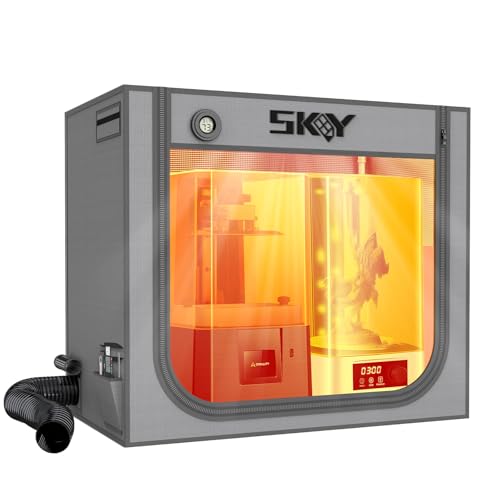
- Room for printer and curing box
- Ventilation fan with activated carbon box
- LED light and thermo-hygrometer included
Best For: Resin users building a spacious all-in-one workstation
Best Filtered Resin Tent
Ventilated UV-Blocking Resin Enclosure

- UV-blocking window for resin workflows
- Adjustable fan with three-layer filter
- Designed for compact LCD resin printers
Best For: Small resin setups needing adjustable ventilation
Best Overall for A1 Combo

- Keeps internal temperature below 40°C in testing
- Reduces reported noise to about 40 dB
- Includes LED lighting and A1 Combo-specific ports
Best For: Bambu Lab A1 Combo owners seeking quieter, cleaner printing
Best for Resin Odor Control

- Carbon filter helps absorb resin odors
- Fans and expandable pipes support ventilation
- Clear window enables monitoring without opening
Best For: Resin printers requiring odor and emissions management
Best Large Tent-Style Option

- Large 31.5 x 22.8 x 22.8-inch design
- Includes ventilation, thermohygrometer, and LED
- Uses 600D Oxford cloth with flame-retardant construction
Best For: A1 Combo users wanting roomy, monitored enclosure coverage
Best Ventilated Tent
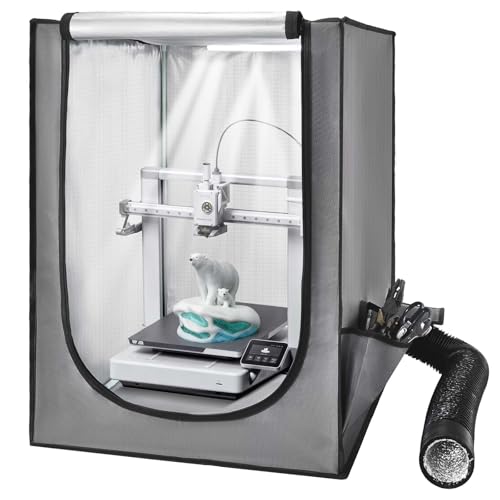
- Ventilation helps expel smoke and dust
- Fits select FDM and LCD resin printers
- Transparent window and LED aid monitoring
Best For: Small-printer users needing ventilation
Best for Two Resin Devices

- Fits a resin printer and curing machine
- Carbon filter helps reduce resin odor
- Fans and pipes support exhaust airflow
Best For: Resin users with printer-and-curing setups
Best Budget Tent – Creality Fireproof 3D Printer Enclosure
If you want a straightforward 3D printer enclosures option for an Ender-series machine, this Creality tent focuses on temperature consistency, dust protection, and easy storage. Its 18.89 x 23.62 x 28.34-inch storage size fits several Creality and similarly sized printers, but measuring your setup first is still important.
Best For: Creality Ender owners who want an economical enclosure for more stable printing and basic protection.
Pros:
- Passed a flame-resistance test and uses flame-retardant materials.
- Helps maintain a steadier printing temperature for high-temperature filaments and bed adhesion.
- Folding design, tool pockets, and multiple observation sides support convenient use.
- Lightweight 3.5-pound structure with aluminum-film interior and fiberglass support rods.
Cons:
- Compatibility depends on the printer and available interior clearance.
- It is primarily a protective tent and does not list an included powered ventilation system.
This is a practical choice when temperature stability and basic enclosure protection matter more than advanced lighting or active odor management.
Best for Resin Workspaces – SKOUPHY Double-Space Resin Enclosure
Among 3D printer enclosures, the SKOUPHY stands out for resin workflows that need room for both a printer and curing box. Its 31.5 x 18.1 x 28.3-inch interior leaves space for a larger work area, while the included ventilation kit and activated-carbon box target resin odors.
Best For: Resin printing setups that need workspace for a printer, curing machine, lighting, and odor exhaust.
Pros:
- Double-space layout accommodates a resin printer and curing box.
- Ventilation fan reaches up to 4,500 RPM and includes an activated-carbon box.
- Built-in LED lighting and an adjustable Fahrenheit/Celsius thermo-hygrometer improve monitoring.
- Double-layer cover is designed for dust, water, noise, and fire protection.
Cons:
- The large footprint requires careful workbench planning.
- Printer and curing-machine dimensions should be checked before ordering.
Choose this enclosure if your priority is a roomy resin station with integrated visibility and odor-management features rather than a compact printer-only cover.
Best All-Around Enclosure – LED Constant-Temperature 3D Printer Cover
This medium-size option is one of the more versatile 3D printer enclosures for users who want lighting, temperature control, dust protection, and noise reduction in one cover. Its listed 21.7 x 25.6 x 30.7-inch interior fits a broad range of popular printers, though the manufacturer recommends checking dimensions before purchase.
Best For: Users seeking a general-purpose enclosure with built-in lighting and broad printer compatibility.
Pros:
- Built-in LED strip improves visibility for spotting jams, adhesion issues, and misalignments.
- Enclosed design helps maintain a consistent temperature and protect against dust.
- Fire-resistant materials and a sturdy structure add protection from accidental contact.
- Quick five-minute installation, noise reduction, and support for many Creality, ELEGOO, PRUSA, and AnkerMake models.
Cons:
- It does not specify an included active ventilation or filtration system.
- Actual fit varies by printer dimensions and clearance requirements.
This is a balanced pick for everyday filament printing when you want an easy-to-install cover with useful lighting and a quieter, more controlled printing area.
Best Filtered Resin Tent – Ventilated UV-Blocking Resin Enclosure
For smaller resin machines, this ventilated enclosure combines a UV-blocking viewing window with adjustable airflow and three-layer filtration. It is designed for common LCD resin printers and wash machines, but its compact fit makes measuring the complete setup essential before ordering.
Best For: Small resin printers such as Anycubic Photon Mono, ELEGOO Mars or Saturn, and Creality Halot models.
Pros:
- UV-blocking window protects resin prints while preserving visibility.
- Adjustable-speed 12V fan system helps extract smoke and fumes.
- Three-layer filter is intended to capture dust particles and harmful gases.
- Stainless-steel support pipes and fire-resistant fabric provide a durable protective frame.
Cons:
- It is not water resistant.
- The fan setup may require printing a plastic adapter to replace the steel bracket.
- Its smaller format may not accommodate larger printers or wash stations.
This enclosure is a focused resin-printing solution for buyers who value filtered ventilation and UV protection, provided their printer and accessories fit the compact interior.
Best Overall for A1 Combo – TOPCUBE LED Enclosure
Among 3D printer enclosures, the TOPCUBE is a purpose-built option for the Bambu Lab A1 Combo. It combines temperature management, noise reduction, lighting, and protective coverage in a sturdy enclosure sized specifically for this printer setup.
Best For: Bambu Lab A1 Combo owners who want quieter, cleaner, better-monitored printing.
Pros:
- Maintains an internal temperature below 40°C during testing, helping reduce warping and breakage without risking motherboard damage.
- Reduces reported printing noise from about 60 dB to 40 dB.
- Includes a large transparent viewing window and integrated LED light strip.
- Offers fire-resistant construction, dust protection, and dedicated A1 Combo cable and pneumatic interfaces.
Cons:
- Designed specifically around the Bambu Lab A1 Combo, so compatibility with other printers should be checked carefully.
- The approximately 33 x 23 x 23-inch footprint requires dedicated workspace.
TOPCUBE stands out when the A1 Combo is your primary printer and you value a quieter, more controlled setup. Its specialized fit and monitoring features make it less flexible for mixed-printer workspaces.
Best for Resin Odor Control – YOOPAI Ventilated Enclosure
For resin users comparing 3D printer enclosures, the YOOPAI focuses on ventilation and odor management. Its carbon filter, exhaust fans, and expandable ducting help contain resin odors and emissions while the enclosed design keeps dust and splashes away from the printer.
Best For: Resin-printing users who prioritize filtered airflow and a clear view of the printing process.
Pros:
- Uses a built-in carbon filter sheet to absorb resin odors.
- Exhaust fans and expandable pipes help discharge polluting gases.
- Large transparent front window allows monitoring without opening the cover.
- Compatible with several ELEGOO Photon, Saturn, Mars, and Halot series printers.
Cons:
- Its stated compatibility is centered on resin printers and specific ELEGOO series.
- The 28 x 18 x 17-inch enclosure may not accommodate larger printers.
YOOPAI is a practical choice when emissions and odor are the main concerns. The filtered ventilation system is its strongest advantage, while buyers should confirm both printer dimensions and model compatibility before ordering.
Best Large Tent-Style Option – VEVOR Ventilated Enclosure
The VEVOR is a large tent-style choice among 3D printer enclosures, with a 600D Oxford cloth exterior, inner aluminum film, ventilation, and built-in lighting. It is designed for the Bambu Lab A1 Combo and supports printing with PLA, TPU, and ABS while helping contain dust, odors, and particles.
Best For: A1 Combo users who need a roomy enclosure with ventilation, lighting, and temperature monitoring.
Pros:
- Includes a thermohygrometer to monitor conditions and help reduce warping and cracking.
- Ventilation system expels smoke and dust and supports faster cooling after printing.
- Flame-retardant, dustproof, and waterproof design adds practical protection.
- Transparent window and built-in LED provide clear visibility in low light.
Cons:
- Its 31.5 x 22.8 x 22.8-inch size requires substantial floor or table space.
- Although designed for the A1 Combo, dimensions should be verified before purchase.
VEVOR offers a useful balance of space, monitoring, ventilation, and protection. It is a strong fit for buyers who prefer a roomy enclosure and do not mind the larger footprint of a tent-style setup.
Best with Extra Features – YOOPAI Ender 3 Enclosure with LED
If you need one of the more versatile 3D printer enclosures for an FDM printer, this YOOPAI model combines workspace lighting, environmental monitoring, noise reduction, and a fully enclosed design. Its stated compatibility covers many Creality, Neptune, AnkerMake, and Anycubic models, but measuring your printer first is essential.
Best For: FDM users who want lighting, temperature and humidity readings, and broad printer compatibility in one enclosure.
Pros:
- Built-in LED strip improves visibility during printing.
- Temperature and humidity monitoring helps track printing conditions.
- Six-sided enclosure helps reduce noise, dust, and accidental contact.
- Fire-resistant materials and a sturdy structure add practical protection.
Cons:
- Compatibility depends on staying within the 21.6 x 25.6 x 29.5-inch size limit, including spool-holder height.
- The product notes list an LR44 battery requirement for the monitoring system.
With its lighting, monitoring, and stable enclosed environment, this is a strong general-purpose option for users prioritizing convenience and print visibility. Confirm the dimensions before ordering.
Best Ventilated Tent – VEVOR Enclosure with LED
This VEVOR model is a practical choice among 3D printer enclosures for users who want ventilation, a transparent viewing window, and LED illumination. It is designed for small FDM printers and many LCD resin printers, including Photon Mono and Mars 3 models, subject to the listed dimensions.
Best For: Small-printer owners who want a ventilated, enclosed workspace with visibility for FDM or LCD resin printing.
Pros:
- Ventilation system helps expel smoke and dust while supporting faster cooling.
- Flame-retardant materials and a stable structure provide added protection.
- Transparent window and LED make print monitoring easier.
- Enclosed design helps limit dust entry and accidental contact.
Cons:
- Its 21.65 x 25.59 x 29.53-inch dimensions may not suit larger printers.
- Users should measure their printer before ordering, especially for resin-printer compatibility.
The combination of ventilation and clear visibility makes this a flexible enclosure for mixed printing setups. Its main limitation is capacity, so verify the printer footprint and height first.
Best for Two Resin Devices – YOOPAI Large Resin Enclosure
For resin workflows that need more room, this YOOPAI is one of the larger 3D printer enclosures in this roundup. Its internal space is designed to accommodate a resin printer and curing machine, while carbon filtration, exhaust fans, and expandable pipes help manage odors and emissions.
Best For: Resin-printing users who need space for both a printer and curing machine and want odor and emission management.
Pros:
- Internal dimensions of 30 x 19.7 x 28.3 inches can accommodate two resin devices.
- Built-in carbon filter sheet helps adsorb resin odors.
- Exhaust fans and expandable pipes support air discharge.
- Large transparent window allows monitoring without opening the cover.
Cons:
- Buyers must measure both the printer and curing machine before ordering.
- Activated-carbon filtration can slow airflow, so the enclosure may need time to clear before opening.
- Additional exhaust piping on both sides may be needed to increase airflow.
This enclosure is especially compelling for resin users with a combined printing and curing setup. Its filtering and observation features are useful, but airflow expectations should be realistic and the available space measured carefully.
How We Picked These 3D Printer Enclosures
We focused on the features that matter most in everyday printing: printer compatibility, usable interior space, ventilation, filtration, visibility, access, and construction. The selection includes enclosures designed for resin printers, FDM printers, and specific machines such as Creality Ender models and the Bambu Lab A1 Combo.
We also considered practical extras, including LED lighting, ventilation kits, viewing windows, cable access, storage flexibility, and fire- or dust-resistant materials. No enclosure replaces proper ventilation, supervision, or the safety guidance for your printer and printing materials.
Quick Comparison
| Best For | Look For | Why It Matters |
|---|---|---|
| Resin printing | Ventilation, filtration, and light control | Helps manage odors and provides a contained workspace |
| Ender-style FDM printers | Correct dimensions and front access | Prevents fit issues and keeps controls reachable |
| Bambu Lab A1 Combo | Model-specific sizing and spool clearance | Accommodates the printer and accessories properly |
| Large printers | Generous interior dimensions and sturdy framing | Leaves room for motion, cables, and maintenance |
Key Buying Factors for 3D Printer Enclosures
Size and Compatibility
Measure the printer itself, then allow additional clearance for the build plate, moving gantry, spool holder, cables, and routine maintenance. A close fit may save space, but an undersized enclosure can restrict movement or make access frustrating. For model-specific products, confirm the exact printer version before ordering.
Ventilation and Filtration
Ventilation is especially important for resin printing and any material that produces noticeable odors. Look for a fan, ducting, or filter system that matches your room and printer. A fan alone moves air; it does not automatically remove every contaminant, so use suitable filtration and room ventilation when needed.
Materials, Heat, and Safety
Fabric enclosures commonly use coated Oxford cloth or similar materials to block dust and help retain warmth. Fire-resistant claims vary by product and should not be treated as fireproof protection. Never leave a printer unattended solely because it is inside an enclosure, and keep the enclosure away from heat-sensitive objects.
Visibility, Lighting, and Access
Clear viewing panels let you monitor a print without opening the enclosure, while integrated LED lighting helps inspect the first layer and spot problems. Multiple access doors, cable ports, and removable panels make maintenance easier and reduce setup compromises.
Who Should Buy Which 3D Printer Enclosures?
Choose a compact resin enclosure if odor control, ventilation, and light containment are your priorities. Choose a Creality-focused enclosure when you use an Ender 3 or similar printer and want a straightforward fit with useful access. Choose a Bambu Lab A1 Combo enclosure when model-specific dimensions and accessory clearance matter more than universal compatibility.
Choose a larger VEVOR-style enclosure for a bigger printer, extra workspace, or greater storage flexibility. If you print in a bedroom, office, or shared area, prioritize ventilation, filtration, and a sealed viewing setup over decorative features. Finally, verify dimensions and safety instructions before purchase—the best enclosure is the one that fits your machine without restricting airflow, movement, or maintenance.
