
If you’re looking to enhance your AI workloads, choosing the right 2U GPU server is essential. The top contenders offer impressive specs that can greatly boost performance. With options like the HHCJ6 Dell NVIDIA Tesla K80 and the MSI Gaming GeForce GT 1030, you’ll find a range of capabilities to suit different needs. But what should you consider when selecting the best fit for your requirements?
HHCJ6 Dell NVIDIA Tesla K80 GPU Accelerator (Renewed)

The HHCJ6 Dell NVIDIA Tesla K80 GPU Accelerator is perfect for researchers and engineers looking to supercharge their high-performance computing tasks. With 24GB of GDDR5 memory and 4,992 CUDA cores, it delivers a 5-10x boost in performance across key applications. You can leverage its power for various demanding programs like CAFFE, GROMACS, and NAMD, enhancing efficiency in your scientific and engineering projects. This renewed GPU accelerator guarantees you get top-tier performance without breaking the bank. If you’re aiming for faster computations and improved throughput in your AI workloads, the Tesla K80 is an excellent choice for your 2U server setup.
Best For: Researchers and engineers seeking to enhance high-performance computing tasks with a powerful GPU accelerator.
Pros:
- High performance: Delivers a significant 5-10x boost in application performance.
- Large memory capacity: Equipped with 24GB of GDDR5 memory, ideal for handling large datasets.
- Versatile applications: Supports a wide range of demanding scientific and engineering software.
Cons:
- Older technology: As a renewed product, it may not have the latest advancements found in newer models.
- Power consumption: High-performance GPUs like the Tesla K80 can consume considerable power, impacting energy costs.
- Compatibility issues: May require specific server configurations to function optimally, limiting its usability in some setups.
MSI Gaming GeForce GT 1030 Graphics Card
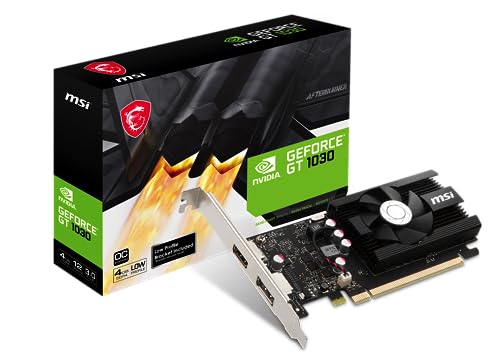
For those seeking an affordable entry point into gaming and light AI tasks, the MSI Gaming GeForce GT 1030 Graphics Card stands out with its compact design and solid performance. Powered by NVIDIA’s Pascal architecture, it features 4GB of GDDR4 memory and a boost clock of 1430 MHz. You can easily connect it to your desktop via PCI-Express x16 and enjoy stunning visuals with a maximum resolution of 4K UHD. With one fan for cooling and support for DirectX 12, this card achieves a solid average rating of 4.5 stars from users, making it a reliable choice for budget-conscious gamers.
Best For: Budget-conscious gamers and users looking for a reliable graphics card for light gaming and multimedia tasks.
Pros:
- Compact design suitable for small form factor desktops.
- 4GB of GDDR4 memory allows for smooth performance in gaming and multimedia applications.
- Supports 4K UHD resolution, providing stunning visuals for high-definition content.
Cons:
- Limited memory interface at 64-bit may restrict performance in more demanding games.
- Single fan cooling might not be sufficient for heavy usage or overclocking.
- Entry-level card may not meet the needs of hardcore gamers or high-end gaming setups.
upHere Graphics Card GPU Brace Support Video Card Sag Holder (G205)

Looking to enhance your GPU setup? The upHere Graphics Card GPU Brace Support (G205) is an excellent choice for preventing video card sag. Crafted from anodized aerospace aluminum, it provides strong, long-lasting support without the fragility of plastic. Designed to fit single or dual-slot cards, it’s compatible with MATX and ITX cases. The concealed magnet base guarantees easy installation and stability. You’ll appreciate the tool-less screws and scratch-proof pad for added convenience. With a 4.7 out of 5-star rating, this stylish black brace not only enhances performance but also complements your rig beautifully. Don’t let sagging ruin your setup!
Best For: Those looking to reinforce their GPU setup and prevent video card sag while maintaining an aesthetically pleasing rig.
Pros:
- Durable Material: Made from anodized aerospace aluminum, ensuring long-lasting support without the fragility of plastic.
- Easy Installation: Features a concealed magnet base and tool-less screws for quick setup and stability.
- Versatile Compatibility: Supports single or dual-slot graphics cards and fits various case types, including MATX and ITX.
Cons:
- Weight Limitations: May not support extremely heavy or oversized graphics cards effectively.
- Limited Color Options: Currently only available in black, which might not match all setups.
- Installation Space: Requires sufficient space within the case for proper mounting and support.
Factors to Consider When Choosing 2U GPU Servers for AI
When choosing a 2U GPU server for AI, you need to take into account several key factors. Performance specifications, GPU memory capacity, and power consumption all play essential roles in meeting your AI demands. Additionally, efficient cooling solutions and compatibility with your applications can make or break your server experience.
Performance Specifications Importance
Choosing the right 2U GPU server for AI hinges on understanding performance specifications, as they greatly impact your computations. You’ll want to take into account memory size and CUDA cores, since these factors directly influence speed and efficiency. A GPU with higher memory capacity, like 24GB GDDR5, is essential for handling larger datasets and complex models in deep learning tasks. The architecture, such as NVIDIA Pascal, improves processing of parallel tasks, enhancing performance for AI applications. Don’t overlook benchmark performance metrics; a 5-10x boost can greatly affect your productivity. Also, keep in mind DirectX support and maximum display resolution capabilities, as these can influence visualization tasks during AI development and testing.
GPU Memory Capacity
GPU memory capacity plays a pivotal role in the efficiency and effectiveness of AI applications. When you’re choosing a 2U GPU server, consider that larger memory allows you to handle more extensive datasets and complex models simultaneously. A minimum of 16GB is often recommended for deep learning tasks, while 24GB can enhance performance. If you’re tackling advanced models, like those in natural language processing or computer vision, aim for GPUs with 32GB or more memory for ideal results. Insufficient GPU memory can lead to out-of-memory errors, forcing you to adjust your models or reduce batch sizes, which ultimately decreases efficiency. Prioritizing the right GPU memory capacity will guarantee smoother workflows and faster training times.
Power Consumption Considerations
Power consumption is a critical factor to evaluate in your quest for a 2U GPU server for AI applications. You’ll want to take into account the power consumption of the GPUs; high-performance models like the Tesla K80 can greatly raise energy usage, necessitating robust power supply units (PSUs). Pay attention to the Thermal Design Power (TDP) ratings, as they indicate the maximum heat generated, directly impacting power consumption. Evaluate the efficiency ratings of the server’s power supply, since higher efficiency can reduce energy costs and heat output. Also, assess the total system power draw, ensuring your data center can handle peak usage. Finally, look for GPUs with dynamic power scaling features, which optimize energy efficiency during lighter workloads.
Cooling Solutions Efficiency
When evaluating 2U servers for AI workloads, cooling solutions play a pivotal role in maintaining peak performance and extending hardware lifespan. High-performance GPUs generate significant heat, which can hinder your server’s efficiency. Opt for effective cooling systems like liquid cooling or advanced air cooling, as they can lower GPU temperatures by up to 30%. Proper airflow design is essential; it guarantees hot air is expelled while cool air is drawn in, preventing thermal throttling during intense tasks. Incorporating multiple fans with variable speed settings optimizes cooling based on workload demands, enhancing energy efficiency and reducing noise. Don’t forget regular maintenance and monitoring of cooling systems to prevent overheating, guaranteeing stable performance and reliability in your AI computing environment.
Compatibility With Applications
Choosing the right 2U server for AI applications requires careful consideration of compatibility with specific software and frameworks. Confirm the GPU server supports applications like STAC-A2, CAFFE, and GROMACS, which demand substantial computational power. Pay attention to GPU memory size; higher capacities, like 24GB GDDR5, are vital for memory-intensive tasks such as Quantum Espresso and HOOMD-Blue. Additionally, consider the number of CUDA cores available; a higher count, such as 4992 CUDA cores, enhances parallel processing capabilities, essential for AI workloads. Verify compatibility with important frameworks like TensorFlow and PyTorch, as they thrive on GPUs optimized for AI tasks. Finally, assess performance claims, as some GPUs can deliver a significant boost of 5-10x, impacting your overall efficiency.
Expansion and Scalability Options
As you evaluate 2U GPU servers for AI, considering expansion and scalability options can greatly impact your long-term performance and adaptability. Look for servers with multiple PCI-E slots, allowing you to expand GPU capabilities as your needs grow. Make certain the server supports high-performance GPUs, like those with 24GB memory, to boost processing power. Don’t forget to assess cooling and power supply options; higher GPU density demands advanced cooling solutions and robust power supplies. Modular designs are ideal for easy upgrades, helping you adapt to evolving AI workloads. Finally, check compatibility with various AI frameworks and software, as certain architectures offer better support for applications that leverage GPU acceleration effectively.
Budget and Cost Efficiency
Understanding your budget and cost efficiency is essential for selecting the right 2U GPU server for AI. Start by evaluating the initial investment cost, which varies based on specifications and performance. Don’t forget to factor in ongoing expenses like power consumption, cooling solutions, and maintenance. To maximize cost efficiency, choose GPU models that provide a high performance-to-price ratio, critical for AI workloads that thrive on parallel processing. It’s also important to assess the total cost of ownership (TCO), encompassing hardware, software, support, and operational costs throughout the server’s lifecycle. By investing in servers that offer significant performance boosts—like a 5-10x enhancement—you can save time in computations and enhance productivity, leading to long-term gains.
