
Smart home energy monitors can show where your electricity goes, which appliances cost the most to run, and how solar production affects household consumption. The right model can turn raw usage data into practical decisions about schedules, efficiency, and energy bills.
This roundup compares 10 options with different strengths, including circuit-level monitoring, open integrations, local control, net metering, and rental-friendly installation. Use the buying guide below to narrow the list based on your electrical panel, smart-home platform, and monitoring goals.
Best 10 Smart Home Energy Monitors Picks for 2026
Best Overall Circuit Coverage

- Sixteen branch sensors for appliance-level monitoring
- Supports solar and net metering
- UL and CE listed
Best For: Detailed whole-home and circuit-level energy tracking
Best for Local Smart-Home Control

- Local Web UI, API, and MQTT access
- Native Home Assistant integration
- Five years of daily data storage
Best For: Privacy-conscious users building local energy automations
Best for Straightforward Utility Monitoring

- Monitors whole-home and up to 16 circuits
- Custom alerts for abnormal usage
- Supports solar and time-of-use management
Best For: U.S. and Canadian households wanting app-based energy monitoring
Best for Long-Term Local Analytics
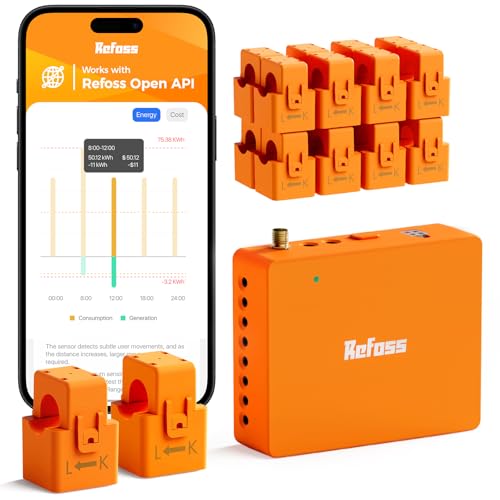
- Tracks two mains and sixteen branch circuits
- Five years of daily data with CSV export
- Local integrations and solar automation
Best For: Advanced solar and smart-home energy auditing
Best Overall

- UL and CE listed with eight circuit sensors
- Tracks whole-home, solar, and net-metering data
- App supports automation and savings insights
Best For: Whole-home and circuit-level monitoring with solar support
Best for Ethernet Connectivity
Eyedro Smart Home Energy Monitor

- Offers Wi-Fi and wired Ethernet connectivity
- Includes two 200A sensors and no-subscription cloud access
- Measures usage in watts, amps, volts, and dollars
Best For: Simple grid or solar monitoring with flexible connectivity
Best for Home Assistant
Meross 18-Circuit Energy Monitor

- Monitors up to 18 main and branch circuits
- Supports Home Assistant with local data and no subscription
- Adds smart alerts and solar-surplus detection
Best For: Advanced local energy automation and circuit-level monitoring
Flexible Privacy Pick
SEM-Meter 2-Sensor Energy Monitor

- Two 200A clamp-on sensors included
- Approximately 1% accuracy with app history
- Local MQTT mode supports privacy-focused setups
Best For: Homeowners wanting flexible monitoring and local Home Assistant integration
Certified Automation Choice

- UL and CE listed for added hardware assurance
- Supports whole-home, solar, and net-metering monitoring
- Expandable to sixteen 50A branch sensors
Best For: Buyers wanting certified hardware and cloud-based energy management
Rental Allocation Specialist

- Includes sixteen 50A circuit sensors
- Supports time-of-use cost allocation
- Tracks rooms, common areas, appliances, and EV chargers
Best For: Rental properties and shared homes needing detailed billing allocation
Best Overall Circuit Coverage – Emporia Vue 3
The Emporia Vue 3 is a strong choice for homeowners who want broad circuit-level visibility from smart home energy monitors. Its whole-home setup includes 16 branch sensors, supports solar and net metering, and provides real-time data through the Emporia app.
Best For: Homeowners who want UL-certified whole-home and appliance-level monitoring with extensive circuit coverage.
Pros:
- Includes sixteen 50A branch sensors for monitoring major appliances and circuits.
- Supports solar, net metering, time-of-use, peak-demand, and excess-solar management.
- UL and CE listed, with clamp-on installation for supported electrical systems.
- Provides live reporting, notifications, and exportable cloud data through the app.
Cons:
- Requires 2.4 GHz Wi-Fi and an internet connection.
- Some three-phase configurations require an additional 200A sensor.
- Includes a one-year warranty.
With its included 16-circuit sensor package and solar-monitoring features, the Vue 3 is particularly practical for detailed household energy audits. It is best suited to buyers comfortable with panel installation requirements and app-based monitoring.
Best for Local Smart-Home Control – Refoss EM16P
The Refoss EM16P stands out among smart home energy monitors for local control and open integrations. It offers a built-in Web UI, Open API, MQTT, and native Home Assistant support, allowing energy data and automations to remain on the home network.
Best For: Privacy-focused smart-home users, Home Assistant households, and solar owners who want local automation without cloud dependence.
Pros:
- Provides local access through the Web UI, Open API, and MQTT without relying on cloud services.
- Offers native Home Assistant integration and OpenClaw support.
- Measures voltage, current, active power, and power factor with stated accuracy of up to ±1%.
- Supports solar self-consumption automation and stores daily data for up to five years.
Cons:
- Installation requires access to the electrical panel and compatible circuit configuration.
- Accuracy is stated as ±2% at low current.
- The product’s advanced integrations may be more than casual users need.
This Refoss model is a compelling fit when local data ownership and automation matter as much as consumption tracking. Its circuit-level alerts and solar-focused controls add practical value for technically minded households.
Best for Straightforward Utility Monitoring – Siemens Inhab
The Siemens Inhab is a practical option for households seeking smart home energy monitors with whole-home and circuit-level measurement. Its mobile app tracks current and historical usage, while customizable notifications can flag unusual behavior such as an oven being left on.
Best For: U.S. and Canadian homeowners who want an established-brand monitor with app tracking, alerts, and up to 16 branch circuits.
Pros:
- Measures usage at the main panel and on up to 16 individual circuits.
- Provides real-time and historical monitoring through a mobile app.
- Supports time-of-use, peak-demand, excess-solar, and net-metering functions.
- UL listed in the U.S. and Canada and CE marked.
Cons:
- Mobile-app availability is limited to the U.S. and Canada.
- Does not specify the same local-control and open-API features as the Refoss models.
- Professional electrical-panel installation may be required.
The Inhab balances detailed circuit monitoring with approachable app-based alerts and energy-management functions. It makes sense for buyers who prefer straightforward monitoring from a recognized electrical-equipment brand.
Best for Long-Term Local Analytics – Refoss 18-Circuit Monitor
This Refoss monitor is designed for detailed energy audits, combining 18-circuit monitoring with local control and long-term data analysis. It supports Home Assistant, Open API, MQTT, and WebSocket connections, while its solar and peak-management tools help automate household electricity use.
Best For: Solar households and advanced users who want local control, five-year analytics, and broad circuit-level monitoring.
Pros:
- Monitors two main circuits and sixteen branch circuits with stated ±1% precision.
- Stores daily data for five years and supports CSV export without a subscription.
- Offers local Web UI, Open API, MQTT, WebSocket, and Home Assistant integration.
- Supports solar optimization, time-of-use management, peak-demand control, and smart alerts.
Cons:
- Its advanced local integrations may require more setup than a basic app-only monitor.
- Installation still involves electrical-panel sensors and system compatibility checks.
- Branch sensors are rated up to 60A, so circuit requirements should be checked before purchase.
For users who want to audit energy over several years rather than simply view a current reading, this Refoss model offers an especially capable feature set. The local architecture and exportable history are useful for privacy-conscious solar and automation projects.
Best Overall – Emporia Vue 3
The Emporia Vue 3 is a versatile choice among smart home energy monitors, combining whole-home tracking with eight circuit sensors and support for solar and net metering. Its UL listing, app-based reporting, and configurable energy-management features make it practical for homeowners who want detailed data and potential ways to reduce electricity costs.
Best For: Homeowners seeking whole-home and circuit-level monitoring with solar or net-metering support.
Pros:
- UL and CE listed for added safety assurance.
- Includes eight circuit sensors and supports real-time monitoring.
- Works with iPhone, Android, and web apps.
- Supports time-of-use, peak-demand, excess-solar, and rewards-program settings.
Cons:
- Requires 2.4 GHz Wi-Fi and an internet connection.
- Some three-phase configurations require an additional 200A sensor.
- Covered by a one-year warranty.
The Vue 3 stands out for combining broad system compatibility, circuit-level visibility, and automation-oriented controls. Keep its connectivity requirements and electrical-panel installation in mind before buying.
Best for Ethernet Connectivity – Eyedro Smart Home Energy Monitor
The Eyedro Smart Home Energy Monitor is a straightforward option for tracking household electricity in real time over 2.4 GHz Wi-Fi or wired Ethernet. It measures usage in watts, amps, volts, and dollars, and includes access to the MyEyedro cloud without a subscription.
Best For: Homeowners and solar users who prefer flexible Wi-Fi or Ethernet connectivity and simple cloud-based tracking.
Pros:
- Supports both 2.4 GHz Wi-Fi and wired Ethernet.
- Includes two 200A directional current sensors.
- Tracks grid, solar, or net-metering data in real time.
- MyEyedro cloud access is included with no subscription.
Cons:
- A single unit monitors grid energy, solar, or net metering—not all simultaneously.
- Two meters are needed to separate grid usage from solar generation.
- Installation or setup may require contacting technical support.
Eyedro is a good fit when reliable connectivity and uncomplicated whole-home or solar tracking matter most. Buyers planning separate grid-and-solar monitoring should budget for the additional meter required.
Best for Home Assistant – Meross 18-Circuit Energy Monitor
The Meross 18-Circuit Energy Monitor is designed for detailed smart home energy management, covering two main circuits and up to 16 branch circuits. With Home Assistant support, local data storage, smart alerts, and solar-surplus detection, it is one of the more automation-focused smart home energy monitors in this group.
Best For: Home Assistant users who want local, circuit-level monitoring and solar automation without subscriptions.
Pros:
- Monitors two 200A main circuits plus 16 branch circuits.
- Supports Home Assistant, Open API, and Web Control.
- Provides local data, smart alerts, and no subscription requirement.
- Offers up to five years of data storage and exportable hourly reports.
Cons:
- Its advanced features may be more than needed for basic whole-home monitoring.
- Compatibility is specified for certain electrical configurations, including no-Delta three-phase systems.
- Requires installation inside the electrical panel.
Meross is the strongest choice here for users building an energy-aware automation system, especially around Home Assistant and solar surplus. Its extensive circuit coverage and local-data approach also appeal to privacy-conscious households.
Flexible Privacy Pick – SEM-Meter 2-Sensor Energy Monitor
This SEM-Meter is a practical option for homeowners seeking smart home energy monitors with whole-home and selected-appliance tracking. Its two 200A clamp-on sensors support real-time monitoring, solar and net-metering visibility, and app-based usage history.
Best For: Homeowners who want flexible electrical-system support, appliance monitoring, and local MQTT operation.
Pros:
- Supports single-phase, split-phase, and certain three-phase systems up to 415Y/240VAC.
- Includes two 200A sensors and supports up to eight additional sensors.
- Offers approximately 1% accuracy, app history, data exports, and privacy-focused local MQTT operation.
- Can monitor solar and net metering.
Cons:
- Requires 2.4GHz Wi-Fi for the standard connected setup.
- Three-phase Delta systems are not supported.
- Panels with busbar-only access require separately available flexible sensors.
Choose this model if system compatibility and control over your energy data matter more than having a large set of included branch sensors. Its local-network mode is especially useful for Home Assistant users comfortable configuring MQTT.
Certified Automation Choice – Emporia Vue 3 Energy Monitor
The Emporia Vue 3 is a strong choice among smart home energy monitors for buyers who prioritize certified hardware and app-based energy management. It tracks whole-home usage, supports solar and net metering, and can expand to monitor individual circuits.
Best For: Homeowners who want UL-listed equipment, cloud reporting, and configurable energy-management features.
Pros:
- UL and CE listed, with a one-year warranty.
- Supports single-phase, split-phase, and compatible three-phase Wye configurations.
- Can add up to sixteen 50A branch sensors for appliance-level monitoring.
- App features include time-of-use, peak-demand, excess-solar, and rewards-program settings.
Cons:
- Requires 2.4GHz Wi-Fi and an internet connection.
- Additional 200A or branch sensors may be needed for some installations.
- One-second data is available only while the app is actively open and retained for three hours.
The Vue 3 is a sensible pick when safety certification and guided cloud-based energy management are priorities. Consider the sensor costs and internet requirement before choosing it for a more advanced or offline-focused installation.
Rental Allocation Specialist – SEM-Meter 16-Sensor Monitor
This SEM-Meter is designed for detailed circuit-level tracking, making it one of the more specialized smart home energy monitors for rental homes and shared properties. Sixteen included 50A sensors can help separate usage by room, common area, appliance, or EV charger.
Best For: Landlords, property managers, and shared households that need circuit-level usage and cost allocation.
Pros:
- Includes sixteen 50A sensors for extensive circuit-level monitoring.
- Supports customizable peak, off-peak, and holiday electricity-rate templates.
- Calculates usage and cost by room or circuit to support transparent allocation.
- Offers approximately 1% accuracy, solar and net-metering monitoring, and local MQTT operation.
Cons:
- Requires 2.4GHz Wi-Fi for the standard app-connected setup.
- Three-phase Delta systems are not supported.
- Installation may require separately available flexible sensors when only busbars are accessible.
The included sensor count makes this model particularly well suited to multi-room properties where buying and configuring several separate meters would be inconvenient. It is less compelling if you only need basic whole-home monitoring.
How We Picked the Best Smart Home Energy Monitors
We focused on the capabilities that matter most in everyday energy monitoring: measurement accuracy, number of supported circuits, real-time reporting, app quality, installation requirements, solar and net-metering support, and compatibility with popular smart-home platforms. We also considered whether a monitor depends on cloud services or offers local access through an open API, Home Assistant, or other integrations.
Because electrical panels differ, a suitable monitor must match your service rating, breaker layout, available sensor capacity, and installation constraints. Installation inside a live electrical panel should be handled by a qualified electrician unless the manufacturer specifically permits a safer user-installation method.
Quick Comparison
For broad whole-home and solar visibility, look for models with main sensors rated for common 200A services. If appliance-level detail matters, prioritize products with more circuit sensors or expandable monitoring. Home Assistant users should check for explicit support, while privacy-focused buyers may prefer local control or no-cloud operation. Rental-friendly models can be useful when you need practical tracking without a complex permanent setup, but always confirm installation and removal requirements.
Key Buying Factors for Smart Home Energy Monitors
Panel and Sensor Compatibility
Check the monitor’s main-sensor amperage, circuit-sensor range, wire size requirements, and supported electrical system before buying. Some products monitor only the mains, while others can track individual circuits such as HVAC, water heating, cooking, or electric vehicle charging.
Whole-Home Versus Circuit-Level Data
Whole-home monitoring is usually enough for identifying broad usage trends. Circuit-level monitoring costs more and requires more installation work, but it can reveal which systems drive peak demand and help verify whether efficiency upgrades are working.
Solar, Net Metering, and Cost Tracking
Solar owners should confirm that the monitor can distinguish consumption from production and support surplus or net-metering data where needed. Also check whether electricity-cost calculations support your utility rate, time-of-use pricing, and changing tariffs.
Connectivity and Smart-Home Integration
Wi-Fi and Ethernet are common, but reliability varies by panel location and network coverage. Home Assistant, open APIs, and local control provide more automation flexibility and can reduce dependence on a vendor cloud. Confirm exactly which features remain available if internet access is lost.
Who Should Buy Which Smart Home Energy Monitors?
Choose a whole-home monitor with solar support if your main goal is understanding total consumption, generation, and utility imports. Select a circuit-rich model if you want to identify individual appliance loads or manage high-demand equipment. Home Assistant users should favor products with documented integrations and local or open access. Buyers prioritizing privacy should look for no-cloud or local-control designs. For a straightforward overview of household electricity costs, a monitor with dependable app history and rate tracking may be the better choice than a highly expandable system.
