
Professional thermal imaging cameras can help reveal overheating components, electrical resistance, cooling-system problems, and uneven brake or tire temperatures before they become expensive failures.
We compare 10 standout options for automotive inspections, from compact smartphone accessories to dedicated cameras with higher resolution, wireless connectivity, and advanced temperature-tracking features.
Best 10 Professional Thermal Imaging Cameras for Cars Picks for 2026
Best All-Around Diagnostic Camera

- TISR-enhanced thermal imaging with a 320×240 display
- -4°F to 1,022°F measurement range with smart alerts
- 8GB storage, Windows analysis, laser, LED, and IP54 housing
Best For: Automotive engine inspections and versatile field diagnostics
Best for Night Driving

- Thermal hazard detection advertised up to 656 feet
- AI alerts for vehicles, pedestrians, and animals
- Front-mount system with iOS and Android app support
Best For: Forward-facing nighttime and adverse-weather driving visibility
Best Compact Value

- Pocket-friendly body with 240×240 TISR-enhanced imaging
- 15-hour claimed runtime and storage for up to 8,000 photos
- IP54 and 2-meter drop resistance for mobile inspections
Best For: Portable automotive, electrical, and maintenance diagnostics
Best for Detailed App Analysis

- 320×240 QuadIR enhancement with 25Hz imaging
- Broad -4°F to 1,112°F range and adjustable emissivity
- App-based fusion, spot, line, area, graph, and report tools
Best For: Phone-connected automotive inspections and detailed thermal analysis
Best Smartphone Attachment
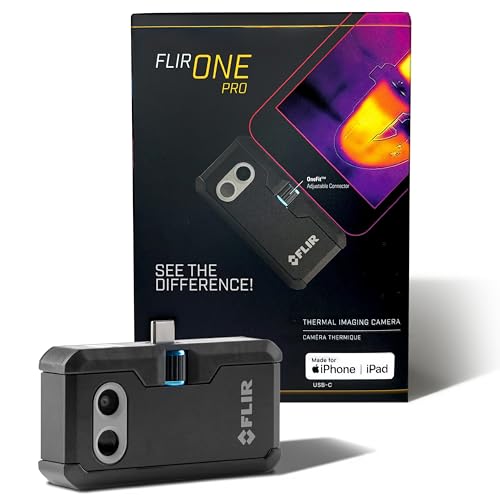
- USB-C connection for iPhone 15 and newer
- 480x360 enhanced imagery with MSX
- Drop-rated to 1.5 meters
Best For: Portable automotive inspections with a compatible iPhone
Best Dedicated Night-Driving System

- Thermal viewing up to 328 yards
- AI alerts for vehicles, people, and animals
- 6.4-inch display with three viewing modes
Best For: Vehicle-mounted night-driving assistance
Best Handheld Inspection Camera
FLIR C3-X Compact Thermal Camera
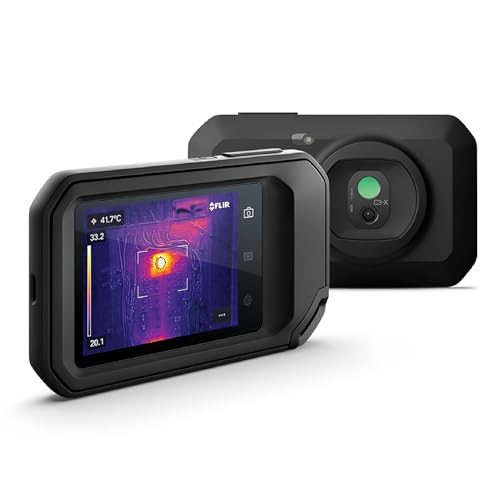
- 128x96 true infrared imaging
- -20°C to 300°C measurement range
- Wi-Fi and FLIR Ignite reporting support
Best For: Documented automotive troubleshooting and inspections
Best Smartphone-Compatible Pick
FLIR One for iPhone 15 and Newer

- USB-C connection for iPhone 15 and newer
- 240x180 enhanced imagery with MSX
- Drop-rated for demanding work environments
Best For: Portable automotive checks with a compatible iPhone
Best Professional Handheld

- 160x120 thermal resolution with MSX
- -20°C to 400°C measurement range
- Wi-Fi cloud storage and sharing
Best For: Professional automotive diagnostics and reporting
Best Compact Standalone Camera
FLIR C5 Thermal Imaging Camera

- 160x120 true thermal resolution
- Wi-Fi uploads and FLIR Ignite reports
- Compact 190-gram handheld design
Best For: Portable automotive inspections and customer documentation
Best All-Around Diagnostic Camera – FOXWELL RT280
For buyers comparing professional thermal imaging cameras for cars, the FOXWELL RT280 is a versatile handheld option for engine checks, mechanical diagnosis, electrical work, and broader inspection tasks. Its enhanced thermal resolution, temperature alerts, laser targeting, and rugged housing make it practical for routine shop or field use.
Best For: Automotive engine inspections and general-purpose mechanical, electrical, HVAC, or plumbing diagnostics.
Pros:
- 320×240 display with TISR-enhanced effective resolution up to 240×180 and a 25Hz frame rate.
- Measures from -4°F to 1,022°F with stated accuracy of ±3.6°F/±2% and automatic hot, cold, and center-point detection.
- 8GB eMMC storage holds more than 20,000 images and videos.
- Rugged 6.6-foot drop resistance, IP54 protection, laser pointer, LED light, and nine color palettes.
Cons:
- Included PC analysis software is for Windows and is not compatible with Mac.
- Its handheld format is less specialized for continuous in-vehicle night driving than a thermal dashcam system.
The RT280 stands out when you want one thermal imager for automotive troubleshooting and other inspection jobs. Windows users who value storage, reporting tools, and field durability get a particularly well-rounded package.
Best for Night Driving – Robofinity InsightDrive
Unlike a handheld inspection tool, the Robofinity InsightDrive is an automotive thermal imaging system designed for forward-facing night visibility. It combines thermal detection, a 720p display system, AI recognition, and app customization to help drivers identify vehicles, pedestrians, and animals in difficult viewing conditions.
Best For: Drivers seeking long-range thermal hazard detection for nighttime, foggy, rainy, snowy, or glare-heavy travel.
Pros:
- Detects road hazards at distances up to 656 feet, according to the supplied product information.
- Designed to operate in total darkness and challenging weather conditions such as rain, snow, fog, and glare.
- AI recognition identifies vehicles, pedestrians, and animals and provides collision-risk alerts.
- Plug-and-play installation is advertised for most cars, SUVs, trucks, and RVs, with iOS and Android app support.
Cons:
- Its 40-degree field of view and front mounting make it specialized for forward road monitoring rather than close-up engine diagnosis.
- At 1.65 kg, it is heavier than a compact handheld thermal camera.
- The supplied details list a one-year free warranty, not lifetime warranty coverage.
InsightDrive is the most purpose-built choice here for driving safety rather than workshop troubleshooting. Its long detection range and alert-focused design may appeal to drivers who want thermal assistance integrated into the front of a vehicle.
Best Compact Value – TOPDON TC004 Mini
The TOPDON TC004 Mini is a pocket-friendly choice for buyers who want professional thermal imaging cameras for cars without carrying a larger inspection unit. TISR enhancement, automatic temperature warnings, long claimed runtime, and drop and water resistance make it suitable for automotive checks as well as electrical, leak, and machinery inspections.
Best For: Mobile technicians and DIY users who need a lightweight thermal camera for engine, electrical, and general maintenance checks.
Pros:
- TISR enhances native 128×128 imaging to 240×240, with a 40°×30° field of view and 25Hz refresh rate.
- Measures -4°F to 842°F with stated accuracy within ±3.6°F/2% and automatically identifies high, low, and center temperatures.
- Advertised 15-hour runtime, automatic shutoff options, and 512MB storage for up to 8,000 photos.
- Compact design, 2-meter drop resistance, IP54 rating, and five color palettes.
Cons:
- The charging cable is included, but a charging head is not.
- The supplied temperature range is lower than the range offered by some larger inspection cameras.
- The electronic manual must be downloaded rather than supplied as a paper manual.
For routine vehicle troubleshooting, the TC004 Mini offers a practical balance of portability, image enhancement, alerts, and battery life. It is especially attractive when a camera needs to stay in a tool bag or travel between service locations.
Best for Detailed App Analysis – RISION Magic Thermal Camera
The RISION Magic is a USB-C thermal camera built around smartphone and Windows analysis. For automotive technicians who want to inspect a specific wire, terminal, component, or engine area, its visible-thermal image fusion, adjustable emissivity, broad temperature range, and app-based measurement tools provide a detailed workflow.
Best For: Users who prefer phone-connected thermal inspection with image fusion, live temperature analysis, and reporting features.
Pros:
- QuadIR enhancement produces a 320×240 image from a native 160×120 sensor, with a 25Hz refresh rate and 52°×39° view.
- Measures -4°F to 1,112°F, offers stated ±3.6°F accuracy, and includes adjustable emissivity control.
- App provides spot, line, area, threshold, PIP, graph, isotherm, photo, video, and report analysis tools.
- Works with iOS, Android, and Windows devices and requires no app registration; twelve color palettes are included.
Cons:
- Mac devices are not supported.
- It depends on a compatible USB-C-connected phone or Windows device rather than having its own standalone screen.
- The supplied notes list an item weight of 0.8 ounces but do not provide details about drop or water resistance.
RISION Magic is a strong fit for technicians who want more than a basic thermal snapshot. Its phone-based fusion and measurement tools can help document subtle automotive temperature differences, provided the user has a supported host device.
Best Smartphone Attachment – FLIR ONE Pro for iPhone USB-C
The FLIR ONE Pro is a practical choice among professional thermal imaging cameras for cars when you want a compact inspection tool that connects directly to a compatible iPhone. Its 160×120 native infrared sensor, enhanced to 480×360 with VividIR, and MSX image overlay can help reveal temperature differences and add visual context during automotive checks.
Best For: iPhone 15 and newer users who need a portable thermal camera for automotive troubleshooting and general inspection work.
Pros:
- Connects directly to USB-C iPhones, including iPhone 15 and newer.
- VividIR super resolution and MSX help produce clearer, more detailed images.
- Measures temperatures with stated accuracy of ±3°C or ±5% under specified conditions.
- Drop-rated to 1.5 meters for better jobsite durability.
Cons:
- Compatibility is limited to USB-C iPhones rather than a built-in standalone display.
- Temperature accuracy depends on the stated ambient and scene temperature ranges.
Choose the FLIR ONE Pro if portability and phone-based sharing matter most. It is well suited to quick automotive checks, though users wanting a dedicated vehicle-mounted system should consider a different design.
Best Dedicated Night-Driving System – Thermal Master NV300 Max
The Thermal Master NV300 Max is a dedicated option among professional thermal imaging cameras for cars, designed for forward-facing night and low-visibility driving assistance. It combines thermal, visible-light, and fusion display modes with a 256×192 infrared resolution, AI collision warnings, and a built-in 6.4-inch display.
Best For: Drivers of cars, trucks, RVs, buses, and pickups who want long-range thermal night vision with on-screen alerts.
Pros:
- Provides stated thermal visibility up to 328 yards or 300 meters.
- AI alerts can identify vehicles, pedestrians, animals, and other obstacles.
- Offers visible-light, infrared, and fusion viewing modes.
- Quick-install design includes a floating display and magnetic 3D adjustment.
Cons:
- Its roof-mounted, vehicle-integrated design is less portable than a handheld camera.
- The 25-degree field of view may not suit every driving setup.
- Features and installation add more complexity than a basic inspection imager.
The NV300 Max is the strongest fit for active night-driving assistance rather than diagnosing individual vehicle components. Its long-range view, built-in display, and collision alerts make it a more specialized automotive system.
Best Handheld Inspection Camera – FLIR C3-X Compact Thermal Camera
The FLIR C3-X is a compact handheld choice among professional thermal imaging cameras for cars, offering true 128×96 infrared imaging, MSX enhancement, and a temperature range from -20°C to 300°C. Wi-Fi and FLIR Ignite cloud connectivity also make it useful for documenting findings and sharing reports after an inspection.
Best For: Automotive technicians and inspectors who need a standalone camera for troubleshooting, documentation, and customer-ready reports.
Pros:
- Measures temperatures from -20°C to 300°C.
- 128×96 true thermal resolution helps identify hidden faults.
- MSX overlays visual details for easier image interpretation.
- Wi-Fi and FLIR Ignite support image uploads and professional reports.
Cons:
- Fixed focus provides less focusing flexibility for different inspection distances.
- Its 128×96 infrared resolution is lower than the enhanced output of the FLIR ONE Pro.
- Cloud-based sharing depends on using Wi-Fi and FLIR Ignite.
The C3-X is a balanced option for repeatable automotive inspections where saving and sharing evidence matters. It offers a more dedicated handheld workflow than a smartphone attachment, with useful reporting features built in.
Best Smartphone-Compatible Pick – FLIR One for iPhone 15 and Newer
For iPhone 15 and newer users seeking professional thermal imaging cameras for cars, the FLIR One offers a compact, phone-connected option. Its 80×60 native infrared sensor is enhanced to 240×180 with Vivid IR, while MSX overlays visual details to make automotive heat patterns easier to interpret.
Best For: iPhone 15 and newer users who want a portable thermal tool for automotive checks and general inspections.
Pros:
- Plugs directly into compatible iPhones with USB-C.
- Vivid IR and MSX provide improved detail and visual context.
- Measures temperatures within ±3°C or ±5% under stated conditions.
- Rated to withstand a 1.5-meter drop.
Cons:
- Compatibility is limited to iPhones with USB-C, including iPhone 15 and newer.
- Its native infrared resolution is 80×60 before super-resolution enhancement.
This is a practical choice when portability and smartphone integration matter most. It is especially convenient for quick automotive inspections, though users needing a standalone handheld camera may prefer the FLIR E5 Pro or C5.
Best Professional Handheld – FLIR E5 Pro Thermal Camera
The FLIR E5 Pro is a dedicated handheld option for shoppers comparing professional thermal imaging cameras for cars. It combines 160×120 thermal resolution with MSX image enhancement and measures temperatures from -20°C to 400°C, giving automotive technicians useful range for locating and documenting heat-related issues.
Best For: Professional automotive troubleshooting where a standalone camera, broad temperature range, and cloud connectivity are valuable.
Pros:
- 160×120 thermal resolution provides 19,200 pixels for fault identification.
- Measures temperatures from -20°C to 400°C (-4°F to 752°F).
- Wi-Fi and FLIR Ignite support automatic storage, editing, and sharing.
- Includes a 2-year camera warranty and 10-year detector coverage.
Cons:
- At 1.27 pounds, it is less pocketable than a smartphone-connected camera.
- It is a dedicated device rather than a phone accessory.
Choose the E5 Pro when repeatable field work and straightforward image sharing outweigh the need for the smallest possible form factor. Its temperature range and dedicated controls make it the strongest fit here for more demanding automotive diagnostics.
Best Compact Standalone Camera – FLIR C5 Thermal Imaging Camera
The FLIR C5 is a compact standalone choice among professional thermal imaging cameras for cars. Its true 160×120 thermal resolution, MSX enhancement, and -20°C to 400°C measurement range support practical troubleshooting, while built-in Wi-Fi and FLIR Ignite make it easier to document and share findings.
Best For: Technicians who need a compact handheld camera for automotive inspections, image documentation, and customer reports.
Pros:
- 160×120 true thermal imaging delivers 19,200 pixels.
- MSX adds visual details for sharper, easier-to-read images.
- Wi-Fi and FLIR Ignite support uploads, reports, and email sharing.
- Measures temperatures from -20°C to 400°C (-4°F to 752°F).
Cons:
- Fixed focus has a listed macro focus range of 0.3 meters.
- Its compact design may offer fewer dedicated features than a larger professional handheld.
The C5 balances portability with the imaging resolution and reporting tools expected for regular inspection work. It is a sensible middle ground for automotive users who want a dedicated device without choosing the larger E5 Pro.
How We Picked the Best Professional Thermal Imaging Cameras for Cars
We evaluated these cameras by looking at the features that matter during real automotive inspections: thermal resolution, image clarity, temperature measurement, field of view, portability, battery or phone compatibility, and workflow features such as Wi-Fi, image storage, and cloud reporting. We also considered whether a camera is better suited to quick DIY checks, mobile technicians, or professional repair-shop diagnostics.
Higher resolution is not automatically better for every job. A compact phone-based camera may be easier to keep in a tool bag, while a dedicated unit can offer a more consistent grip, display, battery, and inspection workflow.
Quick Comparison
- Best for detailed handheld diagnostics: Choose a dedicated camera with a larger thermal sensor, clear display, and reliable temperature measurement.
- Best for mobile convenience: Smartphone-connected models are compact and easy to share, but compatibility and phone power requirements matter.
- Best for night driving or monitoring: Automotive thermal dashcam-style products are designed for forward visibility rather than close-up component inspection.
- Best for connected reporting: Wi-Fi and cloud-enabled models simplify transferring images and building inspection records.
Key Buying Factors for Professional Thermal Imaging Cameras for Cars
Thermal Resolution and Image Quality
Resolution affects how easily you can distinguish nearby hot spots, damaged wiring, restricted airflow, or temperature differences across a component. For professional work, higher-resolution sensors and image-enhancement systems such as MSX or TISR can make images easier to interpret, especially at a distance.
Temperature Measurement
Look for a useful measurement range, adjustable emissivity, spot measurements, hot- and cold-spot tracking, and center-point readings. These features help you compare cylinders, brake rotors, fuses, bearings, hoses, and battery connections more consistently.
Design, Display, and Durability
A dedicated screen is valuable when inspecting a vehicle in bright daylight or when you do not want to handle a phone near moving machinery. Consider grip comfort, startup time, battery life, focus or fixed-focus behavior, drop resistance, and protection from dust or moisture.
Connectivity and Documentation
Wi-Fi, USB-C, image capture, video, and cloud tools can speed up customer reports and before-and-after comparisons. Verify phone operating-system support before buying a smartphone accessory, particularly with newer USB-C devices.
Who Should Buy Which Professional Thermal Imaging Cameras for Cars?
DIY owners should prioritize simple operation, portability, and clear hot-spot readings. Mobile mechanics will benefit from a compact camera with a built-in display, good battery life, and rapid image sharing. Repair shops and inspection professionals should favor higher resolution, repeatable temperature measurements, rugged construction, and reporting features. Drivers seeking added nighttime awareness should choose an automotive thermal-vision product designed for forward viewing, rather than a close-range diagnostic camera.
