
Faulty cables can waste setup time, cause intermittent noise, and make otherwise reliable audio systems difficult to diagnose. The right tester helps you identify wiring problems before they become show-stopping failures.
We compare 10 professional audio cable testers spanning compact continuity checkers, multi-connector tools, line testers, and models with signal-generation or cable-tracing features.
Best 10 Professional Audio Cable Testers Picks for 2026
Versatile Connector Coverage
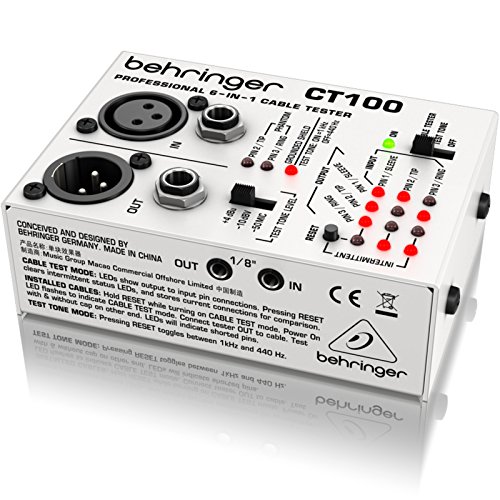
- Tests cable and installed-cable connections
- Supports XLR, TRS, RCA, MIDI, and more
- Adds continuity, phantom-power, and shield checks
Best For: Broad audio connector testing in studios, PA systems, and portable rigs
Broad Format Testing
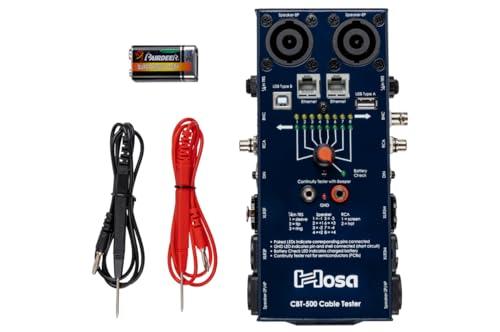
- Supports XLR, BNC, Ethernet, and SpeakON
- Uses ohmmeter-based cable testing
- Includes a limited lifetime warranty
Best For: Mixed-format audio, speaker, network, and video cable checks
Advanced Installed-Cable Testing
dbx CT-3 Advanced Cable Tester

- Tests cables with up to eight pins
- Two-piece chassis handles installed cables
- Supports audio, network, DMX, and other connectors
Best For: Installation work and complex multi-format cable troubleshooting
Audio and Ethernet Coverage
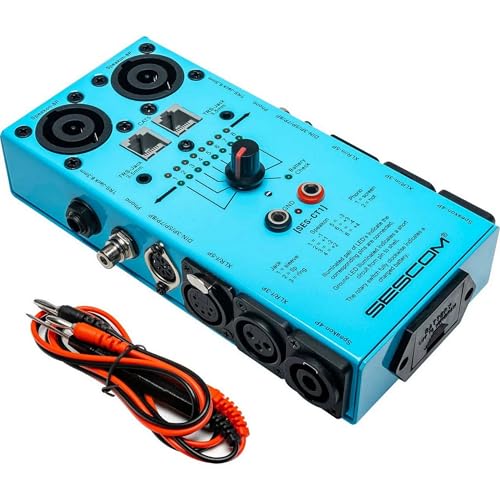
- Tests audio, speaker, DIN, and RJ45 CAT5 cables
- Uses a nine-way connection selector
- Includes battery and ground-status checks
Best For: Field testing of mixed audio, speaker, and Ethernet cabling
Rugged Pin-Test Specialist
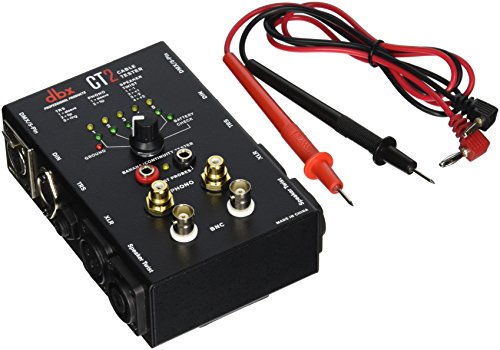
- Six-position selector with pin LEDs
- Tests XLR, speaker twist, and more
- Rugged build with continuity beeper
Best For: Durable, hands-on continuity testing across common audio connectors
15-Connection Workhorse
MFL 15-Plug Audio Cable Tester

- Supports up to 13 cables at once
- LED indicators show conductor connections
- Rugged metal casing and 10-way switch
Best For: Broad audio-connector checking in recording and live-performance setups
Versatile Signal Troubleshooter

- Tests 11 connector types
- Detachable chassis suits long cable runs
- Includes selectable tone generator
Best For: Professional installations and troubleshooting beyond basic continuity testing
Signal-Trace Pro
Whirlwind Qbox Audio Line Tester
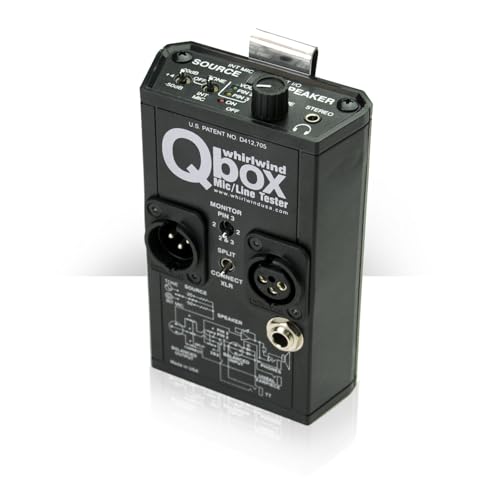
- Tests XLR and TT Bantam connections
- Adds tone generation and built-in speaker
- Offers selectable impedance and 60 dB gain
Best For: Live sound, maintenance, and installation signal tracing
Touring Multi-Tester
Cable Guy Multi-Function Cable Tester
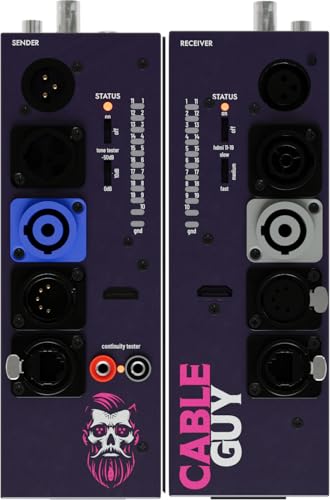
- Covers audio, lighting, video, and network cables
- Uses LED indicators for continuity checks
- Separates for through-wall testing
Best For: Production crews and mixed-system cable installation
Handheld Continuity Check
Whirlwind Tester Cable and Line Tester

- Checks XLR, 1/4-inch, and RCA connections
- Includes LED status indication
- Handheld body has a belt clip
Best For: Portable checks of common analog audio cables
Versatile Connector Coverage – Behringer CT100
The Behringer CABLE TESTER CT100 is a practical choice for anyone comparing professional audio cable testers for a recording setup, PA system, or portable rig. Its microprocessor-controlled design supports cable and installed-cable testing, plus a test-tone mode, while the LED display keeps operation straightforward.
Best For: Users who need broad connector compatibility and quick continuity checks across common audio cables.
Pros:
- Tests XLR, TRS, RCA, MIDI, and other standard connectors.
- Supports cable tests, installed-cable tests, and test-tone mode.
- Detects continuity, intermittent contacts, phantom power, and ground-shield issues.
Cons:
- Battery powered, so a battery must be available for operation.
- Its feature set is focused on audio and related connector testing rather than specialized network testing.
The CT100 stands out as a compact, easy-to-use option when connector variety and basic fault detection matter more than advanced test instrumentation.
Broad Format Testing – Hosa CBT-500
The Hosa CBT-500 is worth considering among professional audio cable testers when your inventory includes more than standard microphone and instrument leads. Its supplied specifications identify support for XLR, 75-ohm BNC, Ethernet, and SpeakON connections, with ohmmeter-based testing and battery operation.
Best For: Audio technicians who need one tester for mixed audio, speaker, network, and video-related cable formats.
Pros:
- Supports XLR, 75-ohm BNC, Ethernet, and SpeakON cable types.
- Uses ohmmeter-style measurement for cable checking.
- Includes a limited lifetime warranty according to the supplied details.
Cons:
- The supplied notes provide fewer operating-mode details than some competing models.
- At 2 pounds, it is less lightweight than compact battery testers.
The CBT-500 makes the most sense for technicians who value format coverage across audio and adjacent cabling, especially in a varied installation or service kit.
Advanced Installed-Cable Testing – dbx CT-3 Advanced Cable Tester
The dbx CT-3 is an advanced option for buyers comparing professional audio cable testers for complex systems. It can test cables with up to eight pins, includes a two-piece chassis for installed-cable testing, and provides a test-tone generator for tracing and verification tasks.
Best For: Installers and audio technicians working with diverse connector formats and cables that are difficult to remove.
Pros:
- Tests cables with up to eight pins.
- Two-piece chassis supports testing installed cables.
- Handles connectors including BNC, DIN, DMX, MIDI, RCA, RJ11, RJ45, TRS, TS, XLR, and banana connectors.
Cons:
- It is corded electric rather than battery powered.
- At 2.2 pounds, it is not the lightest option for mobile kits.
With its extensive connector support and installed-cable design, the CT-3 is particularly well suited to structured troubleshooting where access and connector variety are major concerns.
Audio and Ethernet Coverage – Sescom SES-CT1
The Sescom SES-CT1 is a compact-looking 9-in-1 choice for shoppers evaluating professional audio cable testers with Ethernet support. It covers several audio connector families along with RJ45 CAT5, and its nine-way selector, battery check, and ground-connection status checker are designed for convenient field testing.
Best For: Audio professionals and installers who need to check common audio, speaker, and CAT5 connections with one battery-powered tester.
Pros:
- Tests XLR, RCA, TRS, SpeakON, DIN, and RJ45 CAT5 connections.
- Includes a nine-way switch for selecting the connection type.
- Provides battery and ground-connection status checks.
Cons:
- Its listed minimum operating voltage is 9 volts, requiring a suitable battery.
- The supplied notes do not specify an installed-cable test mode or test-tone generator.
The SES-CT1 is a strong fit when convenient coverage of both audio and Ethernet cabling is more important than specialized signal-generation features.
Rugged Pin-Test Specialist – dbx CT-2 Cable Tester
The dbx CT-2 is a practical choice for professionals comparing professional audio cable testers for studio, live-sound, and installation work. Its rotary selector, pin-specific LEDs, audible continuity check, and broad connector support make routine cable diagnosis straightforward.
Best For: Technicians who need rugged construction and flexible testing for XLR, speaker twist, banana, BNC, DIN, DMX, phono, TRS, and TS connections.
Pros:
- Six-position rotary selector with individual LEDs for pin testing and a battery-life check.
- Supports multiple connector formats, including XLR and speaker twist.
- Includes a beeper and LED indicator for banana-connector continuity testing.
- Rugged construction is designed for durability.
Cons:
- Battery powered, so a suitable battery is required for operation.
- Its listed connector set may not cover every newer digital or computer-oriented cable type.
The CT-2 stands out when durability and essential pin-by-pin continuity checks matter more than advanced signal-generation features.
15-Connection Workhorse – MFL 15-Plug Audio Cable Tester
For buyers comparing professional audio cable testers, the MFL 15-Plug Audio Cable Tester offers a broad, all-in-one approach to continuity troubleshooting. Its LED indicators, 10-way switch, and compact metal casing are suited to audio setups involving several cable types.
Best For: Recording, live-performance, and repair setups that need wide connector compatibility and support for testing up to 13 cables at the same time.
Pros:
- Accepts a wide range of cable types, including TRS, XLR, RCA, DIN, and Speakon.
- LED indicators help identify conductor connections and faults.
- 10-way switch provides selectable connection testing.
- Compact metal casing is described as rugged and durable.
Cons:
- Battery is required but not included.
- The notes do not specify a tone generator or detachable chassis for remote testing.
This tester is a sensible option when connector coverage and straightforward visual fault identification are the main priorities.
Versatile Signal Troubleshooter – Multi-Function Cable Tester
This multi-function model is a strong contender among professional audio cable testers for users who need more than basic continuity checks. It combines pin-by-pin LEDs and audible tones with a detachable dual-chassis design, selectable tone output, and support for audio, network, USB, and control connectors.
Best For: Studios, live-sound teams, AV installers, broadcast facilities, and home-theater users handling long or permanently installed cable runs.
Pros:
- Tests 11 connector types, including XLR, TRS, Speakon, RJ45, RCA, BNC, DIN, USB, and 3.5mm connections.
- Detachable dual-chassis design helps with permanently installed and long cable runs.
- Built-in tone generator offers selectable +0 dB, -10 dB, and -50 dB output levels.
- LEDs and audible tones support pin-by-pin wiring verification.
Cons:
- Requires a 9-volt power source.
- Its wider feature set may be more than needed for simple continuity-only checks.
Choose this model if cable identification, remote testing, and signal troubleshooting are as important as verifying continuity.
Signal-Trace Pro – Whirlwind Qbox Audio Line Tester
For professional audio cable testers that also help diagnose live signal paths, the Whirlwind Qbox combines cable and line testing with a test-tone generator and built-in speaker. Its broad connector support, selectable output impedance, and 60 dB gain make it useful for tracing signals across varied audio setups.
Best For: Live sound, maintenance, installation, and technicians who need both cable checks and signal tracing.
Pros:
- Supports XLR and TT Bantam inputs, plus XLR, 1/4-inch unbalanced, and stereo outputs.
- Includes a test-tone generator, built-in speaker, and 2 kOhm earpiece output.
- Selectable 950-ohm or 20 kOhm output impedance and 60 dB gain support flexible diagnostics.
- Compact, battery-powered design with high 40 kOhm input impedance to minimize signal loading.
Cons:
- Its feature-rich signal-testing design may be more than needed for basic continuity checks.
- The supplied notes list both a 3-year limited warranty reference and a 1-year limited warranty description, so warranty details should be confirmed.
The Qbox is a versatile choice when a simple cable tester is not enough. It is especially suited to professionals who need to locate and evaluate audio signals as well as verify connections.
Touring Multi-Tester – Cable Guy Multi-Function Cable Tester
For professional audio cable testers used across audio, lighting, video, and networking work, Cable Guy’s multi-function tester covers an unusually broad range of connectors. LED indicators provide quick continuity feedback, while the detachable sender and receiver support through-wall testing.
Best For: Production crews and installers checking mixed cable systems, including permanent or through-wall runs.
Pros:
- Tests 3-pin and 5-pin XLR, HDMI, RJ45, powerCON, powerCON TRUE1, TRS, RCA, and BNC cables.
- Matching LED indicators provide immediate continuity feedback.
- Two-piece sender and receiver can be separated for through-wall testing.
- Durable steel housing is designed for heavy professional use.
Cons:
- Requires two 9V batteries, which are not included.
- At 1.06 kg, it is less lightweight than a basic handheld cable tester.
This is the strongest fit for teams that regularly move between audio and lighting systems or need to test installed cabling. Its connector coverage and separated testing units add flexibility beyond standard audio-only models.
Handheld Continuity Check – Whirlwind Tester Cable and Line Tester
For straightforward professional audio cable testers, the Whirlwind Tester provides a handheld way to check compatible XLR, 1/4-inch, and RCA connections. Its LED indicator, on/off switch, and belt clip keep the design focused on convenient field continuity testing.
Best For: Audio technicians who need a simple, portable tester for common cable and line connections.
Pros:
- Compatible with devices using XLR, 1/4-inch, or RCA audio inputs and outputs.
- LED indicator provides a clear visual status during testing.
- Handheld format includes a belt clip for convenient portability.
- Battery-powered operation supports use away from a fixed workbench.
Cons:
- Connector coverage is narrower than multi-function testers that also support HDMI, RJ45, or lighting cables.
- The supplied notes do not specify battery type or included accessories.
The Whirlwind Tester is a practical choice when you want a compact, focused tool for common analog audio cables. It avoids unnecessary complexity while covering the main XLR, 1/4-inch, and RCA connections listed for the unit.
How We Picked the Best Professional Audio Cable Testers
We focused on practical diagnostic capability rather than connector count alone. The products in this roundup were selected for their ability to test common professional audio connections, including XLR, TRS, TS, RCA, 3.5 mm, speakON, and related cable types. We also considered portability, clarity of status indicators, switch or test-mode usability, construction, and suitability for studio, live-sound, installation, and maintenance work.
Because testers vary widely, a higher number of supported connectors does not automatically mean a better choice. A simple continuity tester may be ideal for routine cable checks, while a line tester or tone generator can be more useful when troubleshooting an installed system.
Quick Comparison
- Best for broad connector coverage: Choose a multi-function tester that supports several audio and data connector formats.
- Best for basic cable checks: A compact continuity tester is fast, affordable, and easy to keep in a gig bag.
- Best for installed systems: Look for line-testing, cable-tracing, or tone-generation features.
- Best for frequent professional use: Prioritize rugged construction, clear indicators, dependable switches, and easy battery access.
Key Buying Factors for Professional Audio Cable Testers
Connector Compatibility
List every connector you expect to encounter before buying. Standard XLR and ¼-inch cables are common, but speakON, DIN, RCA, 3.5 mm, RJ45, HDMI, USB, and power connectors may require a more specialized tester. Check whether the unit supports the exact pin count and connector configuration you use.
Testing Depth
Basic models typically identify continuity, opens, shorts, and crossed conductors. More advanced units may add cable tracing, remote testing, line-level checks, or an audio tone generator. Choose advanced functions only when they solve a real workflow problem; otherwise, a simpler tester may be quicker to operate.
Readability and Operation
LED indicators should be easy to interpret in dim venues and busy work areas. A clear pin-by-pin display, intuitive selector, and useful remote module can reduce mistakes. Automatic scanning is convenient, while manual controls may offer better control during fault isolation.
Portability and Durability
For mobile technicians, size, weight, battery life, and protective construction matter. For fixed workshop use, a larger tester with more connectors and a stable housing may be preferable. Confirm the required battery type and remember that a tester cannot repair a damaged cable—it only helps locate the fault.
Who Should Buy Which Professional Audio Cable Testers?
Musicians and small studios usually need a compact tester covering XLR, ¼-inch, and RCA connections. Live-sound technicians should favor rugged models with quick visual results and support for stage-standard connectors such as speakON. Installers and system technicians may benefit from line testers, tone generators, remote ends, and broader connector coverage. Schools, venues, and rental departments should prioritize straightforward operation, durable construction, and compatibility with the largest portion of their cable inventory.
