
Choosing the right network video recorder can make a small business security system easier to install, monitor, and expand. The best NVR depends on camera count, storage needs, remote access, and the type of detection your team needs.
We compared 10 options across channel capacity, PoE connectivity, resolution support, AI detection features, storage configuration, and upgrade potential to help you find a practical fit for your premises and budget.
Best 10 Network Video Recorders for Small Businesses Picks for 2026
High-Capacity Pick

- Manages up to 36 Reolink IP cameras
- Supports up to 48TB across three drive bays
- Requires external PoE switches and separate hard drives
Best For: Large Reolink camera deployments needing expandable storage
Compact PoE Pick

- Built-in six-port PoE switch
- Supports up to six 4K cameras
- Requires a Gateway or Layer 3 switch
Best For: Small Ubiquiti camera systems with straightforward PoE needs
Hybrid Surveillance Pick

- Supports 16 analog plus two IP cameras
- Includes a 2TB surveillance hard drive
- Offers human and vehicle detection
Best For: Businesses upgrading mixed analog and IP camera systems
Easy-Setup Pick

- Supports up to eight Reolink cameras
- Built-in PoE simplifies installation
- Includes a 2TB hard drive
Best For: Small Reolink systems prioritizing simple installation
High-Capacity Expansion Pick
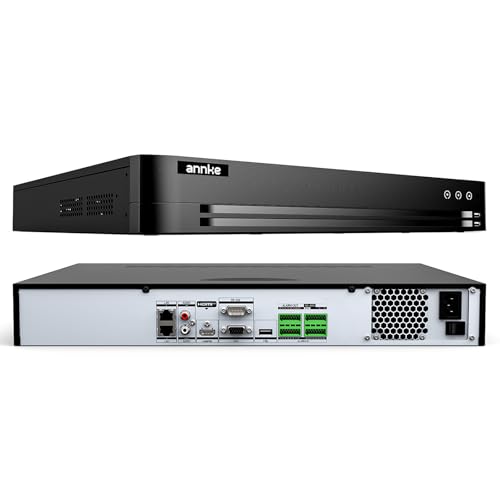
- Supports up to 32 IP cameras
- Four SATA bays support up to 32TB
- Requires separate PoE switches and HDDs
Best For: Large small-business camera deployments needing expansion flexibility
Ready-to-Run Choice
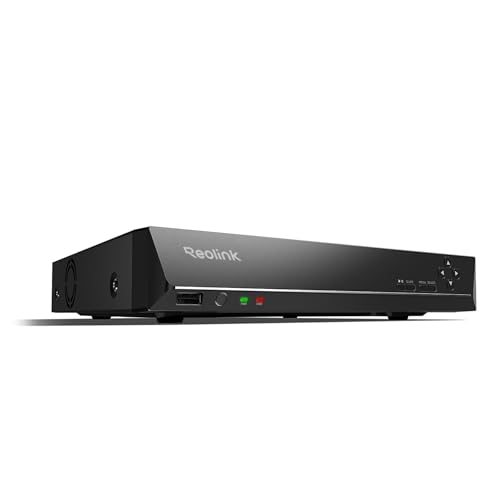
- Includes a 4TB hard drive
- 16 built-in PoE channels
- Supports Reolink cameras only
Best For: Reolink installations seeking simple PoE setup and included storage
Compact PoE Starter

- Supports eight ANNKE IP cameras
- Built-in PoE simplifies installation
- Hard drive not included
Best For: Small sites needing an eight-camera PoE recorder
Expandable 4K Coverage

- Eight built-in PoE ports
- Expandable to 16 channels
- Remote access with no monthly fee
Best For: Growing businesses planning a larger PoE camera system
Simple Reolink Integration

- Four plug-and-play PoE ports
- Up to 8TB local HDD storage
- Local AI footage search
Best For: Businesses using Reolink cameras exclusively
Flexible ONVIF Setup
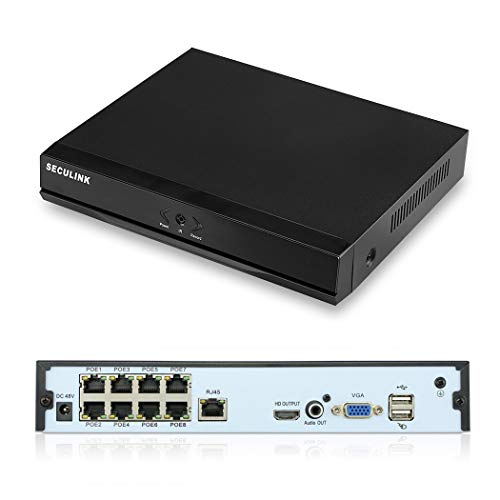
- Eight-channel 4K recording
- Built-in eight-port PoE switch
- ONVIF camera compatibility
Best For: Businesses wanting an adaptable eight-camera system
High-Capacity Pick – Reolink RLN36
For small businesses planning a larger Reolink-based camera deployment, the RLN36 is a high-capacity option among network video recorders for small businesses. It manages up to 36 compatible Reolink IP cameras and supports up to 48TB of storage across three hard-drive bays, but it requires separate PoE switches and hard drives.
Best For: Businesses building a centralized Reolink surveillance system with many cameras and expandable storage.
Pros:
- Supports up to 36 Reolink IP cameras.
- Three bays support up to 16TB each, for up to 48TB total.
- Supports 24/7 recording, human and vehicle detection, and USB 3.0 backups.
- Includes a two-year warranty and lifetime technical support.
Cons:
- Works only with Reolink IP cameras.
- Has no built-in PoE ports; external PoE switches are required.
- Hard drives are not included.
The RLN36 is best suited to a growing installation rather than a simple plug-and-play setup. Its storage and channel capacity are compelling, but plan for compatible Reolink cameras, external PoE hardware, and separate drives.
Compact PoE Pick – Ubiquiti UNVR-Instant
The Ubiquiti UNVR-Instant is a compact choice for small businesses that want network video recorders for small businesses with integrated PoE connectivity. It includes a six-port PoE switch, supports a 3.5-inch hard drive, and can handle up to six 4K or 15 Full HD cameras.
Best For: Small installations using a compatible Ubiquiti camera and network setup.
Pros:
- Built-in six-port PoE switch simplifies camera connections.
- Supports up to six 4K or 15 Full HD cameras.
- Includes an HDMI viewing port.
- Compatible with 3.5-inch hard drives.
Cons:
- Must link to a Gateway or Layer 3 switch.
- The supplied notes do not specify a hard drive capacity or inclusion.
- Camera compatibility should be confirmed before purchase.
With integrated PoE and HDMI viewing, the UNVR-Instant can reduce hardware clutter in a smaller deployment. Its required Gateway or Layer 3 switch connection makes network planning important.
Hybrid Surveillance Pick – ANNKE 3K Lite 16CH
The ANNKE 3K Lite 16CH is a flexible option among network video recorders for small businesses that may be upgrading an existing mixed-camera installation. Its hybrid design supports up to 16 TVI, AHD, CVI, or CVBS cameras plus two IP cameras, and it includes a 2TB surveillance hard drive.
Best For: Small businesses combining analog cameras with a limited number of IP cameras.
Pros:
- Supports multiple analog formats plus two additional IP cameras.
- Includes a security-grade 2TB hard drive.
- Human and vehicle detection can reduce irrelevant motion alerts.
- H.265+ coding is designed to extend recording time and reduce storage use.
Cons:
- Only two IP cameras are supported.
- It is primarily suited to hybrid or analog systems rather than an all-IP setup.
- Remote access requires connection to a router and use of the ANNKE Vision app.
The ANNKE is a practical choice when preserving existing analog cameras matters. Businesses planning an all-IP system or substantial future expansion should consider its two-camera IP limit carefully.
Easy-Setup Pick – Reolink RLN8-410
The Reolink RLN8-410 is a straightforward choice for small businesses seeking network video recorders for small businesses with up to eight Reolink PoE cameras. Its built-in PoE ports provide plug-and-play power and data over one Ethernet cable, while a pre-installed 2TB hard drive supports continuous recording.
Best For: Small Reolink installations needing simple PoE setup and local or remote viewing.
Pros:
- Supports up to eight compatible Reolink IP cameras.
- Built-in PoE enables one-cable camera connections up to 330 feet.
- Includes a pre-installed 2TB hard drive for 24/7 recording.
- Supports free Reolink apps and remote access without monthly fees.
Cons:
- Works only with Reolink cameras and does not support third-party cameras.
- Capacity is limited to eight cameras.
- Additional storage requires a separate drive through the eSATA port.
The RLN8-410 is the most accessible fit for a modest Reolink deployment, especially when built-in PoE and included storage are priorities. Its proprietary camera compatibility limits flexibility, so confirm your camera plans before buying.
High-Capacity Expansion Pick – ANNKE 32CH 12MP NVR
For small businesses planning a larger camera deployment, this ANNKE recorder is one of the more expandable network video recorders for small businesses. It supports up to 32 IP cameras, uses H.265+ compression, and includes four SATA interfaces for adding storage—though PoE switches and hard drives must be purchased separately.
Best For: Businesses that need up to 32-channel coverage and want to choose their own PoE switching and storage configuration.
Pros:
- Supports up to 32 IP cameras and up to 12MP recording and streaming.
- AI detection can identify people and vehicles and support line-crossing and intrusion alerts.
- Four SATA interfaces support up to 32TB total storage, with H.265+ helping reduce storage use.
- Gigabit networking is designed for simultaneous streaming, recording, and remote viewing.
Cons:
- Hard drives are not included.
- There are no built-in PoE ports, so compatible PoE switches are required.
- ANNKE recommends using its own IP cameras for compatibility and performance.
This is a strong choice when channel capacity and storage flexibility matter more than an all-in-one installation. Budget for two 16-port PoE switches and hard drives to build out the full system.
Ready-to-Run Choice – REOLINK RLN16-410 16CH NVR
The REOLINK RLN16-410 is a practical option among network video recorders for small businesses that want built-in storage and straightforward PoE setup. Its 16 PoE channels connect compatible Reolink cameras with one cable for power and data, and the included 4TB hard drive supports continuous recording.
Best For: Reolink-based installations needing 16-camera support, built-in storage, and local or remote access without monthly app fees.
Pros:
- Includes a pre-installed 4TB hard drive for 24/7 recording.
- Provides 16 PoE channels with one-cable power and data connections up to 330 feet.
- Works with Reolink camera detection features such as human, vehicle, and pet recognition.
- Reolink apps and desktop clients support local and remote viewing without monthly fees.
Cons:
- Only works with Reolink IP cameras.
- Additional storage requires a separately purchased hard drive, up to 8TB extra.
- Its included 4TB capacity may be limiting for larger deployments or extended retention.
With PoE ports and a pre-installed drive, this model simplifies setup compared with a bare recorder. It is most suitable when your camera system will remain within the Reolink ecosystem.
Compact PoE Starter – ANNKE 8CH 12MP NVR
For a smaller installation, this ANNKE unit offers a compact starting point among network video recorders for small businesses. It supports eight ANNKE IP cameras, includes PoE ports for one-cable connections, and uses H.265+ compression for continuous recording, but the hard drive is not included.
Best For: Small offices and shops building an eight-camera ANNKE system with simple PoE wiring and flexible hard-drive selection.
Pros:
- Supports up to eight ANNKE cameras at resolutions up to 12MP.
- Built-in PoE provides power and data through one cable, with up to 30W output.
- H.265+ can reduce storage and bandwidth use while supporting 24/7 recording.
- Free ANNKE Vision apps enable remote viewing and playback on supported devices.
Cons:
- Hard drive is not included.
- AI detection features depend on compatible ANNKE AI cameras; the NVR itself has no built-in AI.
- ANNKE recommends its own cameras, and third-party compatibility may require support confirmation.
This recorder balances easy PoE installation with support for high-resolution cameras and user-selected storage. It is a sensible fit for smaller sites that do not need more than eight channels.
Expandable 4K Coverage – Hiseeu 8-Port PoE NVR
For small businesses planning to grow their camera system, this Hiseeu recorder combines eight built-in PoE ports with support for expansion to 16 channels through a separate PoE switch. It supports up to 4K/8MP cameras, remote viewing without a monthly fee, and H.265+ compression to help reduce storage use. Note that the NVR requires a hard drive for recording and is not fully plug-and-play with third-party cameras.
Best For: Small businesses that want an expandable PoE system and are comfortable configuring compatible third-party cameras.
Pros:
- Eight built-in PoE ports can power cameras over Ethernet.
- Can expand to 16 channels with an additional PoE switch.
- Supports remote access through the Guard Live app and Guard Station software.
- H.265+ compression can help save hard-drive space.
Cons:
- Hard drive is not included, so recording and playback require a separately purchased HDD.
- Third-party camera compatibility may require Virtual Host and IP-address configuration.
- An expansion PoE switch is required to use channels beyond the built-in eight.
This is a flexible option for businesses that expect to add cameras over time. Its expansion capacity and remote access are useful, but buyers should budget for storage and verify camera compatibility before installation.
Simple Reolink Integration – REOLINK RLN4E 4CH PoE NVR
The REOLINK RLN4E is a compact choice for small businesses using Reolink cameras. Its four PoE ports provide plug-and-play power and data connections, while local recording can continue without internet access when paired with a compatible internal HDD. It also adds local AI search, remote viewing, and support for up to 8TB of HDD storage, but it works only with Reolink IP cameras.
Best For: Small businesses building a straightforward security system around Reolink cameras.
Pros:
- PoE setup uses one Ethernet cable for compatible Reolink cameras.
- Supports 24/7 continuous recording with a separately purchased surveillance-grade HDD.
- Local AI search can help find people, vehicles, or events in recorded footage.
- Local recording can continue without an internet connection.
Cons:
- Only works with Reolink IP cameras.
- HDD and microSD card are not included.
- Four PoE channels limit expansion compared with larger NVRs.
For businesses already committed to Reolink equipment, the RLN4E offers stable wired connections and convenient local management. Its limited camera compatibility and four-camera PoE capacity make it less suitable for mixed-brand or rapidly expanding installations.
Flexible ONVIF Setup – SECULINK 8-Channel 4K PoE NVR
This SECULINK recorder is designed for small businesses that want an eight-camera, 4K-capable system with broad ONVIF compatibility. Its built-in eight-port PoE switch simplifies installation by carrying power and data over one Ethernet cable, while motion alerts and XMEYE remote access support day-to-day monitoring. The unit does not include a hard drive.
Best For: Small businesses assembling an eight-camera PoE system with compatible ONVIF cameras.
Pros:
- Supports up to 8MP/4K recording across eight channels.
- Built-in eight-port PoE switch simplifies camera installation.
- ONVIF compatibility supports a wider selection of IP cameras.
- Offers customizable motion detection, push notifications, and email alerts.
Cons:
- Hard drive is not included.
- Compatibility still depends on the specific ONVIF camera model.
- XMEYE app access requires setup through the supported mobile platform.
This model offers a practical balance of resolution, channel capacity, and installation simplicity for small-business surveillance. Its ONVIF support is useful for camera flexibility, while the missing HDD should be included in the project budget.
How We Picked the Best Network Video Recorders for Small Businesses
We focused on the features that matter most in a working business environment: the number of supported cameras, built-in PoE ports, recording resolution, storage flexibility, remote viewing, motion or AI detection, and compatibility with common IP-camera standards. We also considered whether each recorder includes a hard drive, supports expansion, or is best suited to a specific camera ecosystem.
Channel count is only part of the decision. A recorder should provide enough bandwidth for simultaneous recording, reliable playback, and future cameras without forcing an immediate replacement. Ease of setup and clear management tools are especially important for small businesses without a dedicated security or IT team.
Quick Comparison
| What to Compare | Best For | Why It Matters |
|---|---|---|
| 4–8 channels | Small shops and offices | Lower cost and simpler installation |
| 16 channels | Growing businesses | Room for additional cameras |
| 32–36 channels | Large sites or multi-area coverage | More capacity for expansion |
| Built-in PoE | Streamlined deployments | One cable can carry power and video |
| No included HDD | Custom storage plans | Lets you select capacity and surveillance-rated hardware |
Key Buying Factors for Network Video Recorders for Small Businesses
Camera Capacity and Expansion
Count the cameras you need today, then leave headroom for entrances, stockrooms, parking areas, or future locations. An eight-channel NVR may suit a compact business, while a 16-, 32-, or 36-channel model offers a safer upgrade path.
PoE Ports and Installation
Built-in Power over Ethernet ports simplify wiring by supplying compatible cameras with power and network connectivity. Check the recorder’s total PoE budget, cable distance limits, and whether extra cameras require a separate PoE switch.
Resolution, Bandwidth, and Storage
Higher-resolution cameras can improve identification but consume more bandwidth and disk space. Confirm that the NVR supports your cameras’ resolution and compression format. If a hard drive is not included, choose a surveillance-rated drive sized for your retention target, recording schedule, and camera count.
Detection and Remote Access
Human and vehicle detection can reduce nuisance alerts compared with basic motion sensing. Review how alerts are delivered, whether remote viewing requires an app or subscription, and whether the system supports secure account controls and firmware updates.
Who Should Buy Which Network Video Recorders for Small Businesses?
Choose a four- or eight-channel recorder for a small office, retail space, or workshop with limited camera coverage. A 16-channel model is a better fit for businesses expecting to expand. Select a 32- or 36-channel unit for larger properties, multiple buildings, or installations that may grow substantially.
For the simplest installation, prioritize a model with integrated PoE and matching cameras. Buyers who already own compatible ONVIF cameras should verify interoperability before purchasing. Finally, decide whether you prefer an included hard drive for convenience or a no-drive recorder that gives you more control over storage capacity and retention.
