
Thermal imaging can reveal overheating components, electrical resistance, coolant-flow problems, and hidden heat patterns that ordinary visual inspections miss. The right camera can make automotive troubleshooting faster, more targeted, and easier to document.
Our selection covers dashcam-style systems, smartphone-connected modules, and standalone handheld cameras in several resolution and price classes. Use the guide below to match image quality, portability, measurement features, and vehicle-diagnostic needs.
Best 10 High-Performance Thermal Imaging Cameras for Cars Picks for 2026
Best Automotive Night-Vision System

- Detects hazards up to 656 feet away
- AI identifies vehicles, pedestrians, and animals
- Designed for darkness and difficult weather
Best For: Drivers wanting a dedicated forward-facing thermal safety system
Best Phone-Based Engine Troubleshooter

- 512×384 TISR-enhanced thermal output
- Measures temperatures up to 842°F
- Battery-free USB-C design for compatible devices
Best For: Android-based engine and component inspections
Best Professional Handheld

- 512×384 X³ thermal resolution with 25 Hz refresh
- Up to 10.5 hours of battery life
- Rugged IP54 body with laser and temperature alarms
Best For: Technicians needing a standalone inspection camera
Best Value Handheld for Vehicle Maintenance

- 260×260 TISR-enhanced thermal imaging
- Temperature alarms and readings from 14°F to 932°F
- Eight-hour battery life with IP54 protection
Best For: DIY and routine vehicle-maintenance inspections
Rugged Diagnostic Pick

- 4,800-pixel infrared camera with -25°C to 300°C range
- MSX enhancement and Bullseye laser targeting
- Drop-tested IP54 design with 2-10 year warranty
Best For: Automotive DIYers needing a durable, easy-to-use thermal camera
Professional Analysis Pick

- TISR-enhanced resolution with 320×240 display
- Windows software for 2D/3D analysis and reports
- -4°F to 1022°F range, alarms, laser, and LED light
Best For: Technicians who need detailed automotive inspections and PC reporting
Long-Run Value Pick

- 192×192 infrared resolution with smooth 25Hz imaging
- 8-hour battery and storage for over 30,000 pictures
- Adjustable emissivity, alarms, and 6.6-foot drop testing
Best For: Mobile technicians and vehicle owners needing extended inspection runtime
Best Mobile Pick

- 384×384 enhanced thermal imagery
- Phone and Windows compatibility
- -4°F to 1,022°F measurement range
Best For: DIY automotive inspections with a phone or Windows device
Best Standalone Runtime
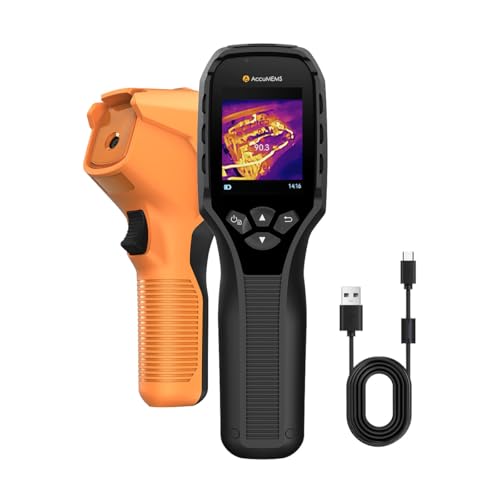
- Up to 14 hours of operation
- 50° field of view for broad scans
- Thermal and thermometer modes
Best For: Extended handheld vehicle inspections
Best Rugged Compact Camera

- 240×240 enhanced thermal resolution
- 15-hour runtime and 8,000-photo storage
- IP54 rated with 2-meter drop resistance
Best For: Portable inspections with onboard photo recording
Best Automotive Night-Vision System – InsightDrive Thermal Camera
For drivers seeking high-performance thermal imaging cameras for cars, the Robofinity InsightDrive is purpose-built for forward road awareness. It combines thermal imaging, AI recognition, and a dedicated display to help identify vehicles, pedestrians, and animals in darkness and challenging weather.
Best For: Drivers, SUV owners, truck owners, RV users, and off-road motorists who want long-range thermal hazard detection.
Pros:
- Detects road hazards up to 656 feet away.
- Designed to work in darkness, rain, snow, fog, and glare.
- AI recognizes vehicles, pedestrians, and animals and provides real-time alerts.
- Plug-and-play installation, app customization, and lifetime OTA updates.
Cons:
- Uses a 720p video capture resolution.
- Requires front hood or grille-center mounting and has a 40-degree field of view.
- Its 1.65 kg weight may be less convenient than a compact plug-in imager.
The InsightDrive stands out as a dedicated automotive system rather than a general inspection camera. Its long detection range and alert-focused design make it the strongest choice here for drivers prioritizing nighttime and adverse-weather road visibility.
Best Phone-Based Engine Troubleshooter – AMPBANK M256 Thermal Camera
For hands-on automotive diagnostics, the AMPBANK M256 is a compact option among high-performance thermal imaging cameras for cars. Its USB-C design connects to compatible Android devices or computers, making it useful for locating engine hot spots and other temperature anomalies without carrying a separate display.
Best For: Android users, mechanics, and DIYers inspecting engines, HVAC systems, electrical equipment, and tight spaces.
Pros:
- Uses TISR to upscale 256×192 infrared data to 512×384.
- Measures from -4°F to 842°F with stated ±3.6°F accuracy.
- Battery-free, 0.07-pound design draws power from the connected device.
- App and PC software offer temperature alerts, multiple palettes, and data-export tools.
Cons:
- Requires an OTG-enabled Android device or compatible computer.
- Does not include a built-in display or battery.
- Its 25 Hz refresh rate is suited to inspection rather than dedicated road viewing.
The M256 is a practical diagnostic accessory rather than a driving camera. Its wide temperature range, small form factor, and extension cable are especially useful when checking engine compartments or other confined automotive areas.
Best Professional Handheld – Thermal Master Thor002
The Thermal Master Thor002 is a full-featured handheld choice for buyers comparing high-performance thermal imaging cameras for cars. It combines 512×384 X³ thermal resolution, a visible-light camera, onboard storage, wireless transmission, and a long-lasting battery for detailed automotive troubleshooting in the field.
Best For: Professional technicians and inspectors who need extended, portable diagnostics for engines, mechanical systems, electrical equipment, and buildings.
Pros:
- 512×384 X³ thermal resolution, 25 Hz refresh, and 40 mK sensitivity.
- Wide -4°F to 1022°F measurement range with stated ±3.6°F accuracy.
- Up to 10.5 hours of battery life with 18W fast charging.
- Includes laser positioning, alarms, 4× digital zoom, Wi-Fi, and USB connectivity.
Cons:
- At 3.12 pounds, it is heavier than phone-connected thermal modules.
- Its feature-rich handheld design may be more than occasional DIY users need.
- Wireless image transmission and PC analysis require compatible connected devices.
With its large screen, rugged IP54 construction, drop resistance, and extensive documentation features, the Thor002 is the most complete standalone inspection tool in this group. It is a strong fit when automotive work is part of broader professional field service.
Best Value Handheld for Vehicle Maintenance – FOXWELL HT280 Thermal Camera
The FOXWELL HT280 offers a balanced feature set for buyers who want high-performance thermal imaging cameras for cars without moving to a larger professional model. Its 2.8-inch display, TISR enhancement, temperature alarms, and wide field of view support quick checks of engines and other vehicle components.
Best For: DIYers and technicians who want a portable standalone camera for vehicle maintenance and general inspection work.
Pros:
- 260×260 TISR-enhanced thermal images on a 320×240 LCD.
- Measures from 14°F to 932°F with stated ±3.6°F or ±2% accuracy.
- Offers automatic high, central, and low temperature readings plus configurable alarms.
- Stores more than 20,000 images or video and supports Windows PC analysis.
Cons:
- PC analysis software is not compatible with Mac.
- Its 50 mK sensitivity is lower than the Thor002’s stated 40 mK sensitivity.
- The 2.8-inch screen is smaller than the Thor002’s 3.5-inch display.
The HT280 is a sensible middle ground for routine automotive checks. Its broad 50-degree field of view, eight-hour battery life, and durable IP54, drop-resistant design make it convenient for scanning larger areas and documenting findings.
Rugged Diagnostic Pick – FLIR TG165-X
For shoppers seeking high-performance thermal imaging cameras for cars, the FLIR TG165-X is a compact option for quickly checking temperature patterns around engines and other automotive components. Its Bullseye laser helps indicate the measurement area, while FLIR MSX technology adds visible details to thermal images.
Best For: Automotive DIYers and technicians who want a rugged, straightforward thermal camera for non-contact temperature checks.
Pros:
- Measures temperatures from -25°C to 300°C (-13°F to 572°F).
- MSX imaging creates sharper, easier-to-interpret thermal pictures.
- Drop-tested, with an IP54 enclosure for protection from dirt, dust, and oil.
- Includes a rechargeable battery, USB-C cable, wrist strap, and carry pouch.
Cons:
- Its 4,800-pixel infrared camera is less detailed than higher-resolution models in this roundup.
- Temperature response time is listed at 3 seconds.
The TG165-X stands out for durability and ease of use rather than advanced image resolution. Its laser targeting, broad temperature range, and long warranty coverage make it a practical choice for routine vehicle diagnostics.
Professional Analysis Pick – FOXWELL RT280
The FOXWELL RT280 is designed for detailed inspections, making it a strong contender among high-performance thermal imaging cameras for cars. Its TISR technology improves effective thermal resolution, while PC software supports deeper analysis and automatic reporting for documented automotive diagnostics.
Best For: Technicians and inspectors who need high-resolution thermal views, temperature alarms, and Windows-based reporting tools.
Pros:
- 320×240 display and TISR-enhanced effective resolution up to 240×180.
- 25Hz frame rate, 50°×38° field of view, and a temperature range of -4°F to 1022°F.
- Windows software supports point, line, and area analysis, plus 2D/3D views and reports.
- Stores more than 20,000 images and videos on built-in 8GB eMMC storage.
Cons:
- Included analysis software is not compatible with Mac computers.
- The feature-rich design may be more than casual users need.
With high-temperature coverage, automatic hot- and cold-point detection, alarms, and PC analysis, the RT280 is well suited to systematic engine inspections. Its 6.6-foot drop resistance and IP54 rating also support regular field use.
Long-Run Value Pick – MILESEEY TR10
The MILESEEY TR10 combines smooth 25Hz imaging with practical monitoring features, making it a capable choice among high-performance thermal imaging cameras for cars. Its 192×192 infrared resolution, adjustable emissivity, and automatic temperature markers help users investigate automotive hot spots with consistent readings.
Best For: Vehicle owners and mobile technicians who value long battery life, storage capacity, and quick anomaly detection.
Pros:
- 192×192 infrared resolution with a 25Hz refresh rate and NETD below 50mK.
- Measures from -4°F to 1022°F with stated accuracy of ±2°C.
- Adjustable emissivity supports readings across different materials.
- 8-hour battery life and built-in 8GB storage for more than 30,000 pictures.
Cons:
- Its infrared resolution is lower than the FOXWELL RT280’s effective resolution.
- The supplied details list wired connectivity rather than wireless transfer.
The TR10 is a sensible fit for extended inspection sessions. Its high/low alarms, automatic maximum/minimum/center readings, recessed lens protection, and 6.6-foot drop testing give it a useful balance of convenience and durability.
Best Mobile Pick – TOPDON TC001 Mini
For shoppers seeking high-performance thermal imaging cameras for cars, the TOPDON TC001 Mini is a compact phone-connected option. Its TISR processing enhances 96×96 sensor data to 384×384 thermal images, while the wide temperature range and vehicle-focused inspection capability help reveal heat differences quickly.
Best For: DIY automotive inspections using a compatible iPhone, Android, iPad, or Windows device.
Pros:
- Enhanced 384×384 thermal images with ≤40 mK sensitivity and a 25 Hz refresh rate.
- Measures from -4°F to 1,022°F for automotive, electrical, HVAC, and leak checks.
- Offers hot/cold spots, isotherms, alarms, measurement areas, reporting, and AI-powered image guidance.
- Compact 30 g plug-and-play design needs no separate battery or wireless pairing.
Cons:
- Requires a compatible phone or Windows device for operation and analysis.
- Does not have a built-in battery.
The TC001 Mini is a strong choice when portability and mobile analysis matter most. It is especially practical for quick automotive troubleshooting, though users wanting a standalone camera may prefer a handheld model.
Best Standalone Runtime – GT14S Thermal Imaging Camera
The GT14S is a handheld option for buyers comparing high-performance thermal imaging cameras for cars. It combines thermal imaging with thermometer readings, a 50° field of view, adjustable emissivity and distance settings, and a rechargeable battery rated for up to 14 hours.
Best For: Extended vehicle inspections where a standalone handheld camera and broad scanning coverage are useful.
Pros:
- NETD below 50 mK can detect temperature differences as small as 0.05°C.
- Provides center, hot, and cold spot modes plus thermometer mode.
- 50° field of view supports broad inspection coverage, with customizable high/low temperature alarms.
- Built-in 2,500 mAh battery offers up to 14 hours of continuous operation.
Cons:
- At 240 g, it is less pocket-light than a phone-connected thermal camera.
- Its stated measurement range and features may be more than needed for occasional quick checks.
With its balanced grip, physical controls, alert functions, and long battery life, the GT14S is suited to longer inspection sessions. It is a practical fit for users who prefer a dedicated tool rather than a smartphone accessory.
Best Rugged Compact Camera – TOPDON TC004 Mini
The TOPDON TC004 Mini offers a self-contained approach to high-performance thermal imaging cameras for cars. TISR enhancement raises 128×128 thermal data to 240×240 resolution, while automatic alerts, photo capture, onboard storage, and a 15-hour runtime support repeatable diagnostic work.
Best For: Portable automotive and mechanical inspections that benefit from stored images, temperature alerts, and durable construction.
Pros:
- 240×240 enhanced resolution, 40°×30° field of view, and 25 Hz refresh rate.
- Measures -4°F to 842°F and automatically identifies central, highest, and lowest temperatures.
- Can automatically capture photos when preset temperatures are exceeded and stores up to 8,000 images.
- Offers up to 15 hours of battery life, IP54 protection, and 2-meter drop resistance.
Cons:
- Temperature range tops out at 842°F, below the range of some alternatives.
- Charging cable is included, but a charging head is not.
- Paper manual is not included; the electronic manual must be downloaded.
The TC004 Mini stands out for users who want a rugged, battery-powered camera with useful documentation and alert features. Its onboard storage and automatic captures make it convenient for recording automotive findings without relying on a phone.
How We Picked the Best High-Performance Thermal Imaging Cameras for Cars
We focused on features that matter during real automotive inspections: infrared resolution, refresh rate, temperature-measurement capability, display or phone compatibility, portability, and ease of use. Higher resolution generally makes it easier to distinguish nearby heat sources, while a faster refresh rate helps when scanning moving components or following changing temperatures.
We also considered practical details such as laser pointers, emissivity controls, image enhancement, onboard storage, battery design, and whether a camera works independently or requires an Android or iOS device. The best choice depends on the job, not simply the highest advertised resolution.
Quick Comparison
- Highest-resolution options: The AMPBANK M256 and Thermal Master Thor002 offer 512 × 384 imagery for detailed inspections.
- Phone-connected flexibility: The TOPDON TC001, TOPDON TC004, and AMPBANK models are compact options for compatible mobile devices.
- Standalone convenience: FOXWELL, FLIR, MILESEEY, and GT14S cameras include built-in displays or self-contained controls.
- In-car monitoring: The Robofinity InsightDrive is designed around infrared night vision and dashcam-style use.
Key Buying Factors for High-Performance Thermal Imaging Cameras for Cars
Resolution and Thermal Sensitivity
Choose at least 192 × 192 for general troubleshooting, but consider 320 × 240 or 384 × 384 when inspecting small connectors, fuses, bearings, or densely packed engine bays. Sensitivity also affects how clearly subtle temperature differences appear.
Refresh Rate and Response
A 25Hz camera provides smoother scanning than a slower unit and is useful for moving around an engine compartment. For stationary checks, refresh rate may matter less than resolution, focus, and measurement accuracy.
Measurements and Targeting
Look for spot temperature readings, adjustable emissivity, a center marker, or a bullseye laser. These features help you identify the exact component producing heat, especially when several parts are close together.
Form Factor and Compatibility
Handheld models are simple for roadside work, while phone modules are lightweight and easy to store. Confirm Android or iPhone compatibility before buying a plug-in camera, and check whether your phone case or USB connector could interfere with the connection.
Who Should Buy Which High-Performance Thermal Imaging Cameras for Cars?
DIY mechanics should prioritize a standalone camera with a built-in screen, clear spot measurements, and straightforward controls. Professional technicians may prefer higher-resolution models with better reporting, image storage, and adjustable measurement settings. Roadside and fleet users should favor compact, durable cameras with fast startup and dependable battery life. Drivers seeking night visibility should consider a dashcam-oriented thermal system rather than a diagnostic-only handheld unit.
Before purchasing, verify the manufacturer’s stated temperature range, warranty, app support, charging method, and operating requirements. Thermal cameras identify heat patterns; they do not replace a multimeter, scan tool, pressure gauge, or hands-on mechanical diagnosis.
