
The best commercial-grade single-board computer kits combine dependable hardware, practical expansion options, and the accessories needed to move from testing to deployment. This roundup compares ten options spanning Raspberry Pi, Orange Pi, Jetson, RISC-V FPGA, and compact embedded platforms.
Whether you are building an edge-AI prototype, industrial controller, robotics system, media device, or networked appliance, use the buying guide below to match processing power, connectivity, software support, and kit contents to your project.
Best 10 Commercial-Grade Single-Board Computer Kits Picks for 2026
High-Performance AI Pick

- 12-core processor with 45 TOPS AI NPU
- 16GB LPDDR5 and dual M.2 Key-M slots
- Supports Linux, Android, Windows, and ROS2
Best For: Edge AI and high-performance development
Connected Communications Kit

- Adds RTL-SDR, LoRa, GPS, and RTC
- Includes USB 3.0, hub, and RJ45 Ethernet
- Multiple antennas are supplied
Best For: Portable wireless and navigation projects
Edge AI Development Pick

- Ampere GPU with 32 Tensor Cores
- Up to 34–67 TOPS AI performance
- Supports CUDA, TensorRT, cuDNN, and OpenCV
Best For: Computer vision and accelerated AI prototypes
Compact Vision Controller

- 1 TOPS NPU for quantized edge inference
- 8MP ISP with HDR and WDR support
- MIPI CSI, GPIO, UART, SPI, and I2C interfaces
Best For: Embedded camera and smart-imaging systems
FPGA Powerhouse

- 138K-LUT FPGA with RISC-V SoC
- PCIe x4, dual SFP, and 187 GPIOs
- Compact industrial-ready SOM design
Best For: Industrial FPGA prototyping and high-speed image or data processing
Starter Kit Favorite

- Raspberry Pi 5 with 4GB RAM
- Linux support for versatile projects
- Four USB ports and broad peripheral compatibility
Best For: General-purpose Linux projects and beginner-friendly development
Edge AI Performer
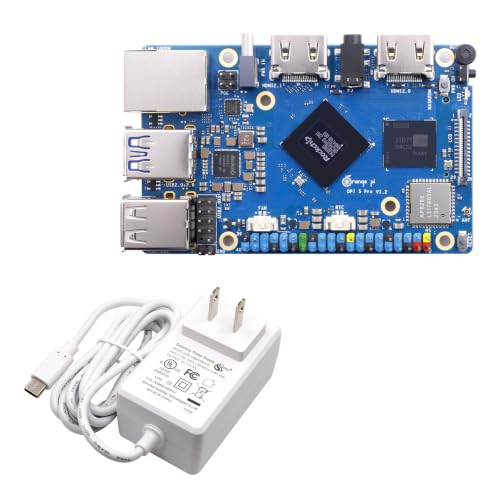
- 8-core RK3588S processor with 8GB LPDDR5
- 6TOPS NPU for edge AI workloads
- 8K decoding, Wi-Fi 5, Bluetooth 5.0, and M.2
Best For: Edge AI, high-resolution media, and connected embedded systems
Best Overall Performance
Raspberry Pi 5 4GB Basic Starter Kit

- 2.4GHz quad-core Cortex-A76 processor
- 27W PD supply for high-power peripherals
- Active cooling for sustained workloads
Best For: Developers and industrial users needing a fast, expandable Pi 5 setup
Best for Embedded Development

- 16GB eMMC storage included
- Android 12 and Ubuntu 22.04 support
- 20-pin interface for hardware projects
Best For: IoT gateways, multimedia terminals, and custom embedded builds
Best Complete Starter Bundle
Raspberry Pi 5 4GB Kit with Case

- Includes board, cooler, ABS case, and screwdriver
- 4GB RAM for 4K, programming, and IoT tasks
- Case provides access to ports and buttons
Best For: Beginners and hobbyists starting protected Pi 5 projects
High-Performance AI Pick – Orange Pi 6 Plus 16GB
The Orange Pi 6 Plus 16GB is a strong choice among commercial-grade single-board computer kits for demanding edge-AI, development, and high-performance computing projects. Its 12-core processor, 45 TOPS NPU, LPDDR5 memory, broad OS support, and multiple storage interfaces give it room to scale beyond basic hobby applications.
Best For: Edge AI development, industrial automation, smart security, home servers, and high-performance personal computing.
Pros:
- 12-core 64-bit CIX processor with integrated graphics and 45 TOPS AI acceleration.
- 16GB LPDDR5 memory and two M.2 Key-M slots for NVMe storage.
- Broad connectivity, including USB 3.0, HDMI, 5Gb Ethernet, camera support, and a 40-pin header.
- Supports Debian, Ubuntu, Android, Windows, and ROS2.
Cons:
- The extensive feature set may be more than needed for simple embedded projects.
- Storage is not listed as included, so an NVMe drive or TF card may be required.
- The product listing provides no warranty description.
Choose this board when compute capacity, AI acceleration, and software flexibility matter more than minimizing hardware complexity. The included cooling fan and heat-dissipation assembly are useful for sustained workloads.
Connected Communications Kit – uConsole AIO V2
The uConsole AIO V2 is a specialized option for commercial-grade single-board computer kits focused on wireless communication, positioning, timing, and connectivity. It combines RTL-SDR, LoRa, GPS, RTC, USB expansion, USB 3.0, and RJ45 Ethernet in one expansion board designed for the uConsole platform.
Best For: Wireless experimentation, LoRa projects, GPS-enabled systems, networked devices, and portable communications builds.
Pros:
- Integrates RTL-SDR, LoRa, GPS, RTC, USB hub, USB 3.0, and Ethernet.
- Includes multiple antennas for Wi-Fi, LoRa, Bluetooth, GNSS, and other functions.
- Designed for compatibility with uConsole and intended to be portable and straightforward to install.
- Includes the listed development board and antenna accessories.
Cons:
- The uConsole itself is not included.
- It is a specialized expansion board rather than a general-purpose standalone computer kit.
- The listing specifies a 0.5-year manufacturer warranty.
This is a practical add-on for builders who already use, or plan to use, uConsole hardware and need several communications functions without sourcing each module separately. Confirm platform compatibility before ordering.
Edge AI Development Pick – Yahboom Jetson Orin Nano
The Yahboom Jetson Orin Nano kit targets developers who need a compact platform for computer vision, large AI models, and accelerated Linux workloads. With an Ampere GPU, Tensor Cores, up to 34–67 TOPS depending on the module configuration, and support for CUDA, TensorRT, and cuDNN, it is one of the more capable commercial-grade single-board computer kits for edge AI.
Best For: Computer vision, LLM and VLM experimentation, real-time video analysis, robotics, and embodied AI prototypes.
Pros:
- 1024-core Ampere GPU with 32 Tensor Cores and up to 34–67 TOPS AI performance.
- Supports CUDA 12.6, TensorRT 10.7.0, cuDNN 9.6.0, and OpenCV 4.10.0.
- Yahboom carrier board supports the 25W power mode and includes a power switch.
- Ubuntu 22.04 provides a desktop Linux environment for AI development.
Cons:
- The listing contains inconsistent memory references: the title says 4GB, while the specifications mention 8GB LPDDR5.
- External NVMe storage is required for the listed M.2 storage option.
- The stated delivery window is up to 90 days.
This kit makes sense for developers prioritizing NVIDIA’s accelerated AI software ecosystem and GPU performance. Verify the exact module and memory configuration before purchase because the supplied listing details conflict.
Compact Vision Controller – KLAYERS RV1106G3 SBC
The KLAYERS RV1106G3-based board is a compact, cost-conscious choice among commercial-grade single-board computer kits for embedded imaging and edge inference. Its Cortex-A7 processor, 1 TOPS NPU, camera-focused ISP, and broad low-level interfaces suit targeted Linux devices rather than general-purpose desktop computing.
Best For: Camera modules, smart imaging, lightweight edge-AI inference, and compact embedded Linux applications.
Pros:
- 1 TOPS NPU supports INT4, INT8, and INT16 hybrid quantization.
- ISP supports up to 8-megapixel sensors with HDR, WDR, and noise reduction.
- Smart video encoding is designed to reduce bandwidth by more than 50% versus standard CBR mode.
- Provides MIPI CSI, GPIO, UART, SPI, I2C, USB, Wi-Fi, and Bluetooth connectivity.
Cons:
- The single-core Cortex-A7 processor and 256MB RAM limit broader workloads.
- Only one USB port is listed.
- It is better suited to focused embedded systems than high-performance computing.
For a camera-centric product, this board offers useful hardware acceleration and control interfaces in a small package. Select it when efficient imaging and inference are the priority, not large applications or extensive memory.
FPGA Powerhouse – Tang Mega 138K Pro Dock
For commercial-grade single-board computer kits focused on programmable hardware, the Sipeed Tang Mega 138K Pro Dock stands out with a large GW5AST FPGA, RISC-V SoC, high-speed memory, and expansion interfaces. Its compact SOM format is particularly suited to industrial prototyping and specialized data-processing systems.
Best For: Industrial FPGA development, AI image processing, high-speed communications, and custom digital-logic projects.
Pros:
- GW5AST FPGA provides 138,240 LUT4 and 12 PLLs for complex logic designs.
- Includes 1GB DDR3, dual Flash, PCIe 2.0 x4, and dual SFP interfaces.
- Offers MIPI D-PHY, DVI, Gigabit Ethernet, and 187 GPIOs.
- Compact 70mm × 50mm SOM design supports system integration.
Cons:
- Its FPGA-focused architecture may require more specialized development knowledge than a general-purpose SBC.
- The listed 1GB memory capacity is modest for some broader computing workloads.
This is a highly specialized choice rather than a plug-and-play desktop board. Choose it when programmable logic, image processing, fiber connectivity, or industrial integration matters more than a conventional operating-system experience.
Starter Kit Favorite – Raspberry Pi 5 Essentials Kit
The CanaKit Raspberry Pi 5 Essentials Starter Kit is a straightforward option for buyers seeking commercial-grade single-board computer kits with a familiar Linux-capable platform. With 4GB of RAM and broad compatibility with common peripherals, it fits general-purpose projects, learning, and everyday maker development.
Best For: Linux projects, education, home servers, camera builds, and general-purpose Raspberry Pi development.
Pros:
- Includes a Raspberry Pi 5 with 4GB of RAM.
- Linux operating-system support suits a wide range of software projects.
- Compatible with cameras, monitors, keyboards, mice, speakers, storage, and other USB devices.
- Provides four USB ports for connecting peripherals.
Cons:
- The supplied notes identify the package as an essentials starter kit but do not specify every included accessory.
- Connectivity details are less extensive than those listed for the other boards in this roundup.
This kit is the most accessible all-purpose option here. It makes sense for buyers who want a recognizable Raspberry Pi platform and flexible Linux support, though specialized hardware projects may call for a board with more explicitly documented interfaces.
Edge AI Performer – Orange Pi 5 Pro 8GB
The Orange Pi 5 Pro 8GB combines an eight-core RK3588S processor, 8GB of LPDDR5 memory, integrated graphics, and a 6TOPS NPU in a compact board. Among commercial-grade single-board computer kits, it is a strong fit for edge AI, high-resolution media, and connected embedded applications.
Best For: Edge AI, 8K media applications, smart-home systems, computer vision, and connected embedded devices.
Pros:
- Eight-core processor runs at up to 2.4GHz and uses fast LPDDR5 memory.
- Integrated NPU supports INT4, INT8, and INT16 mixed computing up to 6TOPS.
- Supports 8K video decoding at up to 60Hz.
- Includes Wi-Fi 5, Bluetooth 5.0, Gigabit Ethernet with PoE+ support, and an M.2 slot.
Cons:
- No warranty is listed in the supplied product details.
- PoE+ requires a separate PoE+ HAT.
- The broad software support may still require setup and compatibility testing for a specific deployment.
With substantial memory, an AI accelerator, wireless networking, and rich expansion, this board is the most capable general-purpose computing platform in the group. It is best suited to performance-oriented embedded builds where power and media capabilities justify a more involved setup.
Best Overall Performance – Raspberry Pi 5 4GB Basic Starter Kit
For buyers seeking commercial-grade single-board computer kits with strong processing headroom, this Raspberry Pi 5 bundle combines the 4GB board with a 27W USB-C PD supply and active cooling. Its quad-core Cortex-A76 processor, dual 4K display support, and four USB ports make it a capable foundation for desktop, development, and embedded workloads.
Best For: Developers and industrial users who need a fast, well-cooled Raspberry Pi 5 setup with power for demanding peripherals.
Pros:
- Quad-core 2.4GHz Cortex-A76 processor delivers a substantial performance increase over Pi 4.
- 27W PD power supply supports high-power peripherals such as hard drives and SSDs.
- Active cooler helps maintain performance during extended high-load operation.
- Supports dual 4Kp60 displays and includes Ethernet, USB, and Wi-Fi connectivity.
Cons:
- The package includes the board, power supply, and cooler but not a case or storage device.
- Its capabilities may be more than needed for basic single-board projects.
This is the strongest performance-oriented option in the group, especially when sustained workloads and accessory power are priorities. Plan separately for storage and enclosure needs.
Best for Embedded Development – KICKPI K2B 2GB SBC with eMMC
This KICKPI K2B is a practical choice among commercial-grade single-board computer kits for compact embedded projects. It pairs an Allwinner H618 quad-core processor with 16GB eMMC storage, 4K video decoding, dual-band wireless connectivity, and a 20-pin expansion interface.
Best For: IoT gateways, multimedia terminals, and developers who want Android 12 or Ubuntu 22.04 with built-in storage.
Pros:
- Allwinner H618 provides four Cortex-A53 cores and Mali-G31 MP2 graphics.
- Hardware decoding supports H.264/H.265 4K at 60Hz.
- 16GB eMMC storage is included, alongside SD card support.
- 20-pin expansion supports UART, SPI, PWM, I2C, I2S, SPDIF, and USB.
Cons:
- The listed configuration has less memory than the 4GB Raspberry Pi options.
- It has two USB ports, limiting direct peripheral expansion.
- The package notes include the board and manual, but not a power supply or case.
Choose the K2B when integrated storage, flexible operating-system support, and hardware expansion matter more than maximum RAM. Its compact design suits purpose-built deployments and custom prototypes.
Best Complete Starter Bundle – Raspberry Pi 5 4GB Kit with Case
For buyers who want commercial-grade single-board computer kits with the basic accessories covered, this SANOOV Raspberry Pi 5 bundle includes the 4GB board, active cooler, ABS case, and screwdriver. It is designed for accessible setup while retaining the performance and connectivity needed for IoT, robotics, retro gaming, and media projects.
Best For: Beginners, students, and hobbyists who want a protected Raspberry Pi 5 kit ready for hands-on projects.
Pros:
- Includes the Raspberry Pi 5 4GB board, active cooler, ABS case, and screwdriver.
- Supports 4K playback, programming, AI projects, and daily computing tasks.
- Case preserves access to the board’s ports and buttons.
- Includes Gigabit Ethernet, dual-band Wi-Fi, Bluetooth 5.0, HDMI, USB, and GPIO connectivity.
Cons:
- The case cannot accommodate an M.2 HAT add-on board and solid-state drive.
- The supplied notes do not list a power supply or storage device in the bundle.
This is the easiest package to start with if physical protection and cooling are more important than adding expansion hardware immediately. Verify power and storage requirements before ordering.
How We Picked These Commercial-Grade Single-Board Computer Kits
We selected these kits for their balance of processing capability, connectivity, expandability, software compatibility, and practical value. The list includes mainstream boards with broad community support, AI-focused platforms, FPGA development hardware, and lower-cost embedded options. We also considered whether each package includes useful essentials such as power supplies, cooling, storage, cases, or expansion hardware. Because requirements vary widely, no single board is best for every deployment.
Quick Comparison
| Best For | Recommended Type | What to Prioritize |
|---|---|---|
| General-purpose development | Raspberry Pi 5 kit | Operating-system support, accessories, community resources |
| Edge AI and computer vision | Jetson Orin Nano or high-end Orange Pi | GPU/NPU performance, supported frameworks, cooling |
| Robotics and embedded control | Orange Pi, KLAYERS, or Raspberry Pi | GPIO, camera interfaces, UART, SPI, and I2C |
| FPGA and high-speed experimentation | Sipeed Tang Mega 138K Pro | Logic capacity, PCIe, networking, toolchain support |
| Portable or radio-enabled projects | uConsole AIO V2 | Integrated display, battery strategy, wireless peripherals |
Key Buying Factors for Commercial-Grade Single-Board Computer Kits
Processor, Memory, and Acceleration
Choose the processor around the workload rather than headline core counts. Video processing, local AI inference, robotics vision, and multitasking benefit from strong GPU or NPU acceleration, while lightweight controllers may need only modest CPU performance. More RAM helps with containers, browsers, databases, and machine-learning workloads, but it does not compensate for an unsuitable software stack.
Connectivity and Expansion
Check the exact ports and interfaces your design requires. Gigabit Ethernet, Wi-Fi, Bluetooth, USB 3.0, HDMI, MIPI CSI, GPIO, UART, SPI, and I2C each serve different roles. For deployed equipment, also consider storage reliability, PCIe availability, camera compatibility, and whether headers remain accessible inside an enclosure.
Cooling, Power, and Storage
High-performance boards often need active cooling and a sufficiently rated power adapter to avoid throttling or instability. Kits that include a cooler, case, power supply, or eMMC can reduce setup friction, but verify connector compatibility and regional plug specifications. For write-heavy systems, favor robust external or onboard storage and plan for backups.
Software and Long-Term Support
Confirm that the board supports the operating system, drivers, libraries, and development tools your project uses. Raspberry Pi generally offers the broadest ecosystem, while specialized AI, FPGA, and newer ARM boards may require more platform-specific setup. For commercial deployments, review documentation, update policies, community activity, and supply availability before standardizing.
Who Should Buy Which Commercial-Grade Single-Board Computer Kits?
Choose a Raspberry Pi 5 kit for the easiest general-purpose starting point, classroom use, home automation, and broadly documented prototypes. Pick an Orange Pi model when you want stronger specifications or multimedia capability and are comfortable checking board-specific software support. The Jetson Orin Nano is the clearest fit for serious edge-AI and computer-vision development. Select the Sipeed FPGA kit for hardware-logic experimentation and high-speed interfaces rather than conventional Linux applications.
The KLAYERS and K2B boards suit cost-conscious embedded projects where required interfaces matter more than ecosystem size. The uConsole AIO V2 is the specialized choice for a portable, integrated development platform with radio and expansion features. Before buying, list your required interfaces, operating system, power budget, enclosure dimensions, and expected production quantity; those constraints usually narrow the choice faster than performance specifications alone.
