
Choosing among commercial-grade network video recorders means balancing camera count, recording resolution, storage capacity, networking, and long-term expandability. The right NVR should support your current deployment without creating costly limits as your surveillance needs grow.
This roundup compares 10 options across compact PoE systems, high-capacity enterprise-style recorders, and ecosystem-focused platforms. Use the guide below to narrow your shortlist by installation size, camera requirements, storage strategy, and management priorities.
Best 10 Commercial-Grade Network Video Recorders Picks for 2026
PoE Deployment Pick
Diamond NVR302A-16/16P 4K 16-Channel NVR

- 16 channels with 16 integrated PoE ports
- ONVIF and RTSP camera support
- 4K HDMI plus VGA simultaneous output
Best For: Small business PoE camera deployments
High-Capacity Business Pick
ONWOTE 32-Channel 6K NVR with 8TB

- 32-channel recorder with 8TB included
- Four SATA bays support up to 40TB
- Supports 6K/12MP IP cameras
Best For: Large ONWOTE-based business systems
UniFi Ecosystem Pick
Ubiquiti UniFi Protect UNVR-Pro

- Works with the UniFi Protect application
- Supports up to 60 cameras
- Stores footage locally
Best For: Existing UniFi Protect installations
Flexible Storage Pick

- Supports 32 IP cameras up to 6K/12MP
- Four SATA bays support up to 40TB
- Hard drive is not included
Best For: Custom ONWOTE storage configurations
High-Capacity Central Monitoring

- 64-channel IP camera support with up to 32MP decoding
- 400 Mbps incoming and outgoing bandwidth
- Four SATA bays plus eSATA expansion; drives not included
Best For: Large centralized IP-camera deployments without built-in PoE
Cloud-Managed Commercial Recording

- 6TB included across two 3TB hard drives
- Supports up to 16 compatible 4MP camera streams
- Dual 4K outputs and cloud-based remote management
Best For: Alarm.com Pro Series systems needing included storage
Integrated PoE Deployment

- Built-in PoE for simplified camera power and data
- Up to 64TB across four SATA drives; drives not included
- 320 Mbps throughput with RTSP/ONVIF compatibility
Best For: Expandable 32-camera PoE systems with remote access
Maximum-Capacity Choice
Amcrest NV6864-XI 64-Channel NVR

- 64-channel recording and 32MP/4K support
- Eight SATA bays, up to 16TB each
- AI detection, facial recognition, and H.265 compression
Best For: Large, high-density surveillance installations
Streamlined Reolink System
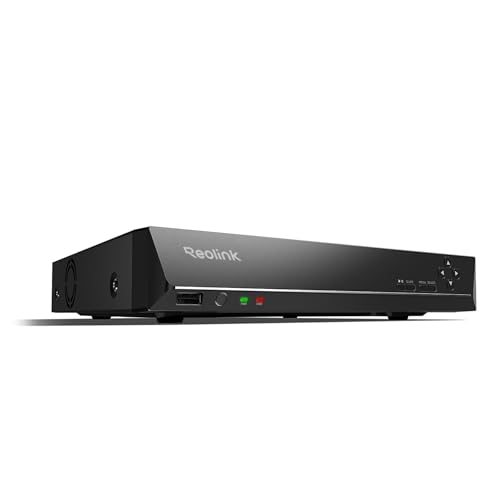
- 16-channel Reolink PoE camera support
- Pre-installed 4TB drive with 8TB expansion
- Local and remote access without monthly fees
Best For: Reolink-focused plug-and-play installations
Compact PoE+ Platform

- 16-channel PoE+ recorder
- Compact 3 kg chassis
- Storage media is not included
Best For: Smaller TP-Link VIGI camera installations
PoE Deployment Pick – Diamond NVR302A-16/16P 4K 16-Channel NVR
For smaller business installations, this Diamond recorder offers a practical commercial-grade network video recorder setup with 16 channels and 16 integrated PoE ports. It supports 4K HDMI output, mainstream ONVIF and RTSP cameras, and H.265 Lite compression.
Best For: Small businesses needing an all-in-one 16-camera PoE recorder with broad protocol support.
Pros:
- 16 channels and 16 built-in PoE ports simplify camera deployment.
- Supports mainstream ONVIF and RTSP cameras.
- HDMI and VGA outputs can operate simultaneously, with HDMI supporting up to 4K.
- Offers P2P remote surveillance and mobile video playback.
Cons:
- Storage uses two SATA bays, but the supplied notes do not specify an included hard drive.
- Playback and decoding specifications are more limited at higher camera counts, with 16-channel decoding listed at 720p and 30 FPS.
This is a straightforward choice when integrated PoE matters more than extensive storage expansion. Confirm the required hard drive and camera resolutions before deployment.
High-Capacity Business Pick – ONWOTE 32-Channel 6K NVR with 8TB
This ONWOTE unit is a commercial-grade network video recorder for larger installations, combining 32-channel support, 6K/12MP input capability, and an included 8TB hard drive. Its four SATA bays support storage expansion up to 40TB.
Best For: Businesses building an ONWOTE-only system that needs substantial capacity and high-resolution recording.
Pros:
- Supports up to 32 IP cameras, including 6K 12MP and 4K 8MP models.
- Includes an 8TB hard drive and four SATA ports supporting up to 40TB.
- H.265+ compression helps reduce bitrate while retaining video quality.
- Supports 16-channel synchronous playback and offers 24/7 technical support.
Cons:
- Works only with ONWOTE cameras and PoE switches, limiting cross-brand flexibility.
- The supplied warranty is one year.
The included drive and expansion capacity make this a strong fit for growing business systems. Its brand-locked compatibility should be verified before purchasing.
UniFi Ecosystem Pick – Ubiquiti UniFi Protect UNVR-Pro
The UNVR-Pro is a suitable commercial-grade network video recorder for organizations already using UniFi Protect. It stores footage locally, supports remote access through the UniFi Protect application, and can add up to 60 cameras to the system.
Best For: UniFi users who want centralized local video storage and remote camera access.
Pros:
- Works with the UniFi Protect application.
- Supports adding up to 60 cameras.
- Stores recordings locally rather than on a cloud server.
- Provides SFP+ and Gigabit Ethernet connectivity.
Cons:
- Its feature set is centered on the UniFi Protect ecosystem.
- The supplied notes list 8TB storage but do not clarify whether that capacity is included or expandable.
This recorder is most compelling when UniFi Protect is already part of the network. Buyers building a mixed-brand camera system should confirm compatibility first.
Flexible Storage Pick – ONWOTE 32-Channel 6K NVR
This ONWOTE model provides a commercial-grade network video recorder platform for up to 32 IP cameras, with 6K/12MP support and four SATA bays for up to 40TB. It ships without a hard drive, giving buyers control over the storage configuration.
Best For: Businesses that want a high-resolution ONWOTE recorder and prefer to select their own surveillance drives.
Pros:
- Supports 32 IP cameras and resolutions up to 6K/12MP.
- Four SATA ports support up to 40TB of recording storage.
- Includes AcuSearch technology for targeted video searching.
- Supports H.265+ compression, dual streaming, and 16-channel synchronous playback.
Cons:
- No hard drive is included.
- Works only with ONWOTE IP cameras and PoE switches.
- Storage installation and configuration are left to the buyer.
This is a good option for a custom storage build, especially when existing drives or a specific retention target are part of the plan. Factor in the separate hard-drive cost and ONWOTE compatibility requirement.
High-Capacity Central Monitoring – 64-Channel 32MP NVR
For large installations that need commercial-grade network video recorders, this 64-channel NVR emphasizes bandwidth, decoding capacity, and storage expansion. It supports H.265+ encoding, up to 400 Mbps incoming and outgoing bandwidth, and high-resolution multi-screen output. The hard drives are not included.
Best For: Large-scale centralized monitoring systems using separate PoE infrastructure and IP cameras.
Pros:
- Supports up to 64 IP camera channels with broad multi-resolution decoding capability.
- 400 Mbps incoming and outgoing bandwidth supports recording, live viewing, and remote access.
- Four SATA bays plus one eSATA interface provide flexible storage expansion.
- Dual HDMI and VGA outputs support up to 8K single display or dual 4K output.
Cons:
- Hard drives are not included.
- Does not have built-in PoE ports, so cameras need separate power or a PoE switch.
This is a strong fit when channel count and expansion matter more than an all-in-one installation. Confirm that your network and camera system can take advantage of its high bandwidth and that separate PoE equipment is available if needed.
Cloud-Managed Commercial Recording – Pro Series 16-Camera NVR
This Pro Series recorder is a practical option among commercial-grade network video recorders for smaller systems that prioritize included local storage and remote administration. It provides 6TB across dual 3TB drives, supports up to 16 camera streams at 4MP with compatible Alarm.com Pro Series cameras, and includes dual 4K monitor outputs.
Best For: Alarm.com Pro Series camera installations needing local recording with cloud-based access and system health monitoring.
Pros:
- Includes dual 3TB hard drives for 6TB of stated storage capacity.
- Supports up to 16 camera streams at 4MP with compatible Pro Series cameras.
- Dual 4K monitor outputs support detailed live viewing and playback.
- Cloud-based remote access, configuration, and health monitoring are included.
Cons:
- Camera support is specified for Alarm.com Pro Series cameras.
- It supports fewer channels than larger commercial recorders.
- The product information lists a non-PoE configuration.
Choose this model when a 16-camera ceiling, included storage, and cloud management align with your installation. Before buying, verify camera compatibility and the storage specification for your intended recording schedule.
Integrated PoE Deployment – HELIX 32-Channel 4K NVR
For commercial-grade network video recorders with simplified camera installation, the HELIX NV3832E combines 32-channel recording with built-in PoE ports. It supports up to four 16TB hard drives, 4K or 12MP recording at up to 30fps across 32 channels, and third-party camera connectivity through RTSP/ONVIF. Hard drives are not included.
Best For: PoE-based 32-camera systems that need expandable storage, remote viewing, and integration flexibility.
Pros:
- Built-in PoE supports plug-and-play power and data over a single Ethernet cable.
- Supports up to 64TB through four SATA drives, with drives purchased separately.
- 320 Mbps throughput and H.265/H.264 compression support high-resolution recording efficiency.
- Offers RTSP/ONVIF compatibility, AI features through compatible HELIX cameras, and free remote apps.
Cons:
- Hard drives are not included.
- Advanced AI features depend on compatible HELIX cameras.
- The recorder is built primarily around PoE camera installations.
This model stands out for installations where reducing separate PoE hardware and simplifying setup are priorities. Its storage expansion, ONVIF support, NDAA compliance, and no-subscription remote apps add flexibility, but confirm camera compatibility and plan for separate hard drives.
Maximum-Capacity Choice – Amcrest NV6864-XI 64-Channel NVR
For large installations comparing commercial-grade network video recorders, the Amcrest NV6864-XI stands out with 64-channel recording, playback, and live viewing. It supports up to 32MP/4K video at 30fps and accepts up to eight SATA hard drives, although storage must be purchased separately.
Best For: Large commercial or multi-camera deployments that need high channel capacity, expandable storage, and advanced AI search features.
Pros:
- Records and views up to 64 channels, with support for resolutions up to 32MP/4K at 30fps.
- Supports eight SATA drives, up to 16TB each, for substantial storage expansion.
- Includes H.265/H.264 compression, human and vehicle detection, facial recognition, and perimeter protection features.
- Provides 1024Mbps throughput, or 512Mbps when AI functions are enabled, plus USB backup.
Cons:
- Hard drives are not included.
- Requires a hardwired Ethernet connection and has no built-in Wi-Fi or Bluetooth.
- Its 18-pound chassis may be more than smaller installations require.
The NV6864-XI is the strongest fit here for high-density surveillance systems. Its expandable storage and broad AI feature set are useful for demanding deployments, but buyers should budget for drives and plan a wired network connection.
Streamlined Reolink System – RLN16-410 16-Channel PoE NVR
The Reolink RLN16-410 is a straightforward option among commercial-grade network video recorders for installations built around Reolink cameras. Its 16 PoE channels simplify setup, while the included 4TB hard drive supports simultaneous recording from up to 16 cameras.
Best For: Reolink-based security systems that prioritize plug-and-play PoE installation, local recording, and no monthly app fees.
Pros:
- Supports up to 16 compatible Reolink PoE cameras.
- Uses one Ethernet cable per camera for power and data, with cable runs up to 330 feet.
- Includes a pre-installed 4TB hard drive and supports adding an extra 8TB drive.
- Offers local and remote access through Reolink apps and desktop clients without monthly fees.
Cons:
- Works only with Reolink IP cameras.
- Advanced detection features depend on compatible Reolink cameras.
- Its 16-channel capacity is less suitable for larger deployments.
The RLN16-410 is appealing when the camera ecosystem is already Reolink. It delivers an easy PoE setup and useful storage out of the box, but its proprietary compatibility limits flexibility compared with more open NVR platforms.
Compact PoE+ Platform – TP-Link VIGI NVR2016H-16MP
The TP-Link VIGI NVR2016H-16MP is a compact 16-channel PoE+ recorder for buyers evaluating commercial-grade network video recorders in a smaller deployment. Its supplied specifications identify HDMI connectivity, 16 channels, and a 140-watt power rating, while built-in media is not included.
Best For: Small to midsize camera systems seeking a 16-channel TP-Link VIGI PoE+ recording platform.
Pros:
- Provides 16 channels for a midsize surveillance installation.
- Uses PoE+ connectivity for compatible camera deployments.
- Compact 3 kg chassis is easier to accommodate than larger rack-oriented recorders.
Cons:
- Built-in media is not included, so storage must be supplied separately.
- The supplied notes provide limited detail about recording features and camera compatibility.
- Its 16-channel capacity may not meet the needs of expanding enterprise systems.
The VIGI NVR2016H-16MP is best considered a compact foundation for a 16-camera PoE+ system. Confirm storage requirements and installation compatibility before buying, since the supplied specifications do not identify included media or extensive feature details.
How We Picked These Commercial-Grade Network Video Recorders
We focused on the specifications that matter most in business, industrial, property-management, and larger residential surveillance deployments: channel capacity, supported resolution, incoming bandwidth, PoE availability, hard-drive support, playback performance, output options, and intelligent detection features. We also considered whether each recorder suits a complete camera ecosystem or a mixed-brand IP camera installation.
The selection includes 16-, 32-, and 64-channel models, plus systems with included storage, multiple SATA bays, integrated PoE, or compatibility with higher-resolution cameras. Because advertised capabilities can vary by firmware, camera codec, and recording mode, confirm current manufacturer specifications before purchasing.
Quick Comparison
- Best for compact PoE deployments: Diamond, REOLINK, and TP-Link VIGI 16-channel models.
- Best for larger camera counts: The 32- and 64-channel ONWOTE, HELIX, Hikvision, and Amcrest options.
- Best for expandable storage: ONWOTE, Hikvision, and Amcrest models with multiple drive bays.
- Best for an integrated ecosystem: Ubiquiti UniFi Protect users should consider the UNVR-Pro.
- Best for commercial display setups: Choose a recorder with dual 4K monitor outputs when operators need simultaneous live views and playback.
Key Buying Factors for Commercial-Grade Network Video Recorders
Channel Count and Camera Resolution
Buy more channels than you need today if expansion is likely. Also verify that the NVR can decode the number of high-resolution streams you plan to view or play back simultaneously. Recording support and live-view decoding are not always the same.
PoE and Network Design
Integrated PoE simplifies installation by carrying power and data over one cable, but check the total PoE budget and per-port limits. Non-PoE recorders may be better for larger, distributed networks using dedicated PoE switches and managed VLANs.
Storage and Retention
Estimate storage from camera count, resolution, frame rate, codec, motion activity, and desired retention days. Multiple SATA bays provide more flexibility, while an included hard drive offers a faster start but may not meet long-term retention requirements.
Management and Reliability
Look for dependable remote access, user permissions, alerts, camera compatibility, firmware support, and sensible backup options. Commercial installations should also account for rack space, cooling, surge protection, and uninterrupted power.
Who Should Buy Which Commercial-Grade Network Video Recorders?
Choose a 16-channel PoE model for a small business, retail site, office, or home installation with a defined camera limit. A 32-channel recorder is a stronger choice for campuses, warehouses, multifamily properties, and businesses expecting phased expansion. Select a 64-channel unit when the site needs many cameras, centralized monitoring, or substantial headroom.
Buy a storage-expandable NVR if retention requirements are strict or camera resolution may increase. Choose a non-PoE model when networking is already centralized or cameras are spread across multiple buildings. Finally, prioritize ecosystem compatibility: a UniFi-focused deployment benefits from UniFi Protect hardware, while mixed-brand installations should favor broad ONVIF and codec support.
