
The right conference room camera can make hybrid meetings feel more natural by keeping speakers visible, voices clear, and remote participants engaged. Commercial-grade models range from compact all-in-one systems to advanced PTZ and dual-lens cameras for larger spaces.
We compared these 10 options by image quality, room coverage, tracking features, audio capabilities, connectivity, and installation flexibility so you can choose a system that fits your room and meeting platform.
Best 10 Commercial-Grade Conference Room Cameras Picks for 2026
Flexible 4K Room Coverage

- 4K/30fps video with 20x optical zoom
- AI face and humanoid tracking
- USB, HDMI, LAN, and Bluetooth audio
Best For: Large rooms, streaming, and events
Premium Room Performance

- UHD 4K video at 30fps
- 15x optical zoom with autofocus
- Optical stabilization and low-light support
Best For: Permanent professional conference rooms
Intelligent Large-Room Framing

- Dual 4K lenses for room coverage
- Speaker tracking and group framing
- Motorized electronic privacy shutter
Best For: Poly-equipped rooms up to 25 feet
Wide-Angle Huddle Room Value
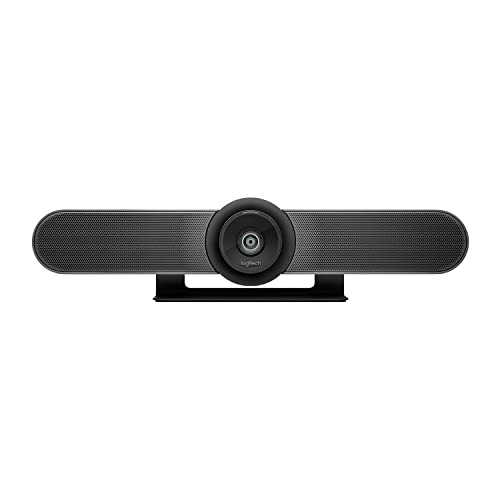
- 4K sensor with 120-degree field of view
- Beamforming microphones for small rooms
- USB BYOD and room-solution support
Best For: Huddle rooms and small conference rooms
Most Versatile System
TONGVEO 4K PTZ Camera with Speakerphone
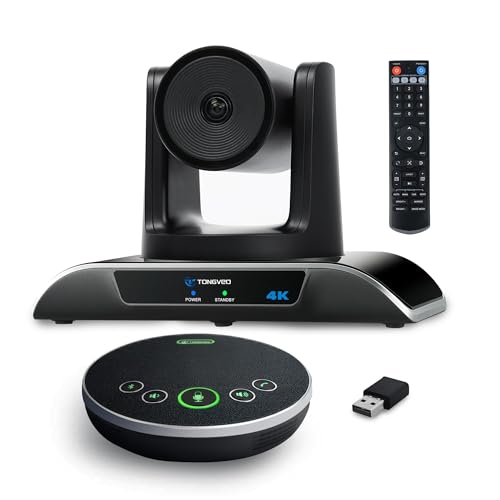
- 4K/30fps PTZ camera with 120° field of view
- AI tracking, gestures, remote control, and presets
- Includes speakerphone with 16.4-foot pickup range
Best For: Flexible small and medium-sized meeting setups
Best Panoramic Coverage
Jabra PanaCast 50 180° Meeting Room Webcam

- Three-camera system with 90°–180° viewing options
- Eight microphones and four integrated speakers
- Plug-and-play and compatible with Teams and Zoom
Best For: Room-wide meeting coverage with integrated audio
Best Traditional PTZ Value
Logitech PTZ Pro 2 1080p Camera

- 1080p video with 3x optical and 10x digital zoom
- 90° viewing angle with smooth PTZ preset movement
- Processes video onboard to help conserve bandwidth
Best For: Traditional PTZ conference and training-room setups
Large-Room 4K All-in-One
AI Auto-Framing Conference Camera

- 4K video with 120° view and 5x optical zoom
- AI framing plus presenter and speaker tracking
- Four-mic array and built-in speakers
Best For: Medium and large conference rooms
360-Degree Room Coverage
TOUCAN SC360 Conference Camera
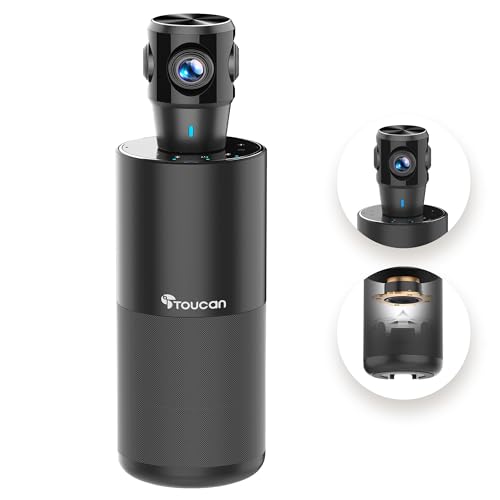
- 360° capture for participants around the room
- 1080p video with four noise-reduction microphones
- Built-in speaker and plug-and-play USB setup
Best For: Flexible rooms with varied seating layouts
Small-Room Managed Setup

- 4K video with AI framing and autofocus
- AI noise suppression and built-in privacy shutter
- Remote management through Logitech Sync
Best For: Small meeting rooms and huddle spaces
Flexible 4K Room Coverage – TONGVEO 20x PTZ System
For teams comparing commercial-grade conference room cameras, the TONGVEO system combines 4K PTZ video, AI subject tracking, and a separate Bluetooth speakerphone. Its 20x optical zoom, 63-degree lens, and HDMI, USB 3.0, and LAN outputs make it adaptable to large meetings, streaming, lectures, and events.
Best For: Large meeting rooms and professional streaming setups that need flexible video outputs and integrated audio.
Pros:
- 4K video at up to 30 frames per second with 20x optical zoom.
- AI face and humanoid tracking helps keep speakers framed.
- Speakerphone supports USB, Bluetooth 5.0, and wireless dongle connections.
- Supports PoE, RTSP, RTMP, and H.264/H.265 encoding.
Cons:
- The separate camera and speakerphone require more setup space than an all-in-one bar.
- The 63-degree lens is narrower than the ultra-wide views on some small-room systems.
This is a strong option when connectivity and long-range framing matter as much as image quality. The included speakerphone also makes it a more complete starting point for larger rooms.
Premium Room Performance – Logitech Rally Plus
Logitech Rally Plus is a professional fixed-installation choice among commercial-grade conference room cameras. It pairs UHD 4K video with autofocus, low-light support, optical image stabilization, and 15x optical zoom for polished room coverage with compatible computers and tablets.
Best For: Professional conference rooms that prioritize studio-quality 4K video and a permanent installation.
Pros:
- Captures UHD 4K video at 30 frames per second.
- 15x optical zoom supports detailed views from farther away.
- Autofocus, optical stabilization, and low-light capability support consistent footage.
- USB connectivity works with laptops, personal computers, and tablets.
Cons:
- The fixed-installation design and 17-pound weight may require careful mounting.
- The supplied details identify the system as professional equipment rather than a compact huddle-room camera.
Rally Plus fits buyers seeking a more installed, presentation-ready system rather than a portable webcam. Its optical zoom and stabilization are particularly useful when participants sit at varying distances.
Intelligent Large-Room Framing – Poly Studio E70
The Poly Studio E70 is designed for large-room deployments where intelligent framing is central to the meeting experience. Its dual 4K lenses, Poly DirectorAI speaker tracking, group framing, and motorized electronic privacy shutter give it a focused role in commercial-grade conference room cameras for rooms up to 25 feet long.
Best For: Large conference rooms already using a Poly G7500 or Poly Microsoft Teams Room system.
Pros:
- Dual 4K lenses and sensors provide professional-quality video.
- DirectorAI supports speaker tracking and group framing.
- Motorized integrated privacy shutter adds a physical privacy feature.
- Poly Lens tools support device management and analytics.
Cons:
- Requires a Poly G7500 or Poly Microsoft Teams Room system, sold separately.
- PoE is required, so installation needs compatible network infrastructure.
- Its ecosystem requirements may limit plug-and-play use with other platforms.
E70 makes the most sense as part of a planned Poly room solution. Buyers who already have the required platform can gain intelligent framing and centralized management without relying on a basic USB camera.
Wide-Angle Huddle Room Value – Logitech MeetUp
Logitech MeetUp is a compact all-in-one option for smaller spaces in the commercial-grade conference room cameras category. Its 4K sensor, 120-degree field of view, beamforming microphones, and motorized pan/tilt are designed to capture participants and room activity without requiring a larger PTZ installation.
Best For: Huddle rooms and small conference rooms using USB BYOD meetings or a supported room solution.
Pros:
- 4K video and a 120-degree field of view cover small rooms broadly.
- Motorized pan and tilt can expand the view up to 170 degrees.
- Beamforming microphones pick up voices up to 4 meters, or up to 5 meters with the optional expansion mic.
- Supports wall, credenza, and TV mounting.
Cons:
- The expansion microphone is sold separately.
- Its intended small-room design is less suited to large conference spaces.
- The listed operating-system support centers on Windows 10 and Mac OS X.
MeetUp is a practical fit when simple installation and broad framing are more important than long-range optical zoom. It also provides a straightforward path from USB BYOD meetings to Teams Rooms, Zoom Rooms, or Google Meet deployments.
Most Versatile System – TONGVEO 4K PTZ Camera with Speakerphone
For teams comparing commercial-grade conference room cameras, the TONGVEO system combines a 4K PTZ camera with a separate speakerphone. Its 120-degree field of view, AI auto-tracking, gesture controls, and USB 3.0 connectivity make it suited to flexible meeting setups.
Best For: Small and medium-sized meetings that need camera tracking plus a portable speakerphone.
Pros:
- Records in UHD 4K at 30 fps with a 120-degree wide-angle view.
- Supports face tracking, multi-person tracking, gesture control, remote control, and up to nine presets.
- Includes a speakerphone with dual noise-reduction microphones and a stated 16.4-foot pickup range.
- Offers USB 3.0 plug-and-play connectivity plus RS232 and RS485 support.
Cons:
- Some remote focus buttons do not apply to this version.
- 4K requires compatible equipment and software.
- The camera and speakerphone use separate connection arrangements.
This is a feature-rich choice when automated framing and flexible control matter more than a single integrated bar. Its included mounting accessories and broad platform compatibility also make it adaptable to different rooms.
Best Panoramic Coverage – Jabra PanaCast 50 180° Meeting Room Webcam
Jabra PanaCast 50 180° Panoramic-4K Meeting Room Webcam, 4 Kilopixel Video Resolution, Black
Check Price On AmazonThe Jabra PanaCast 50 is a strong option among commercial-grade conference room cameras for teams that want broad room coverage from one video bar. Its three-camera design provides real-time video stitching, adjustable viewing angles, and built-in microphones and speakers.
Best For: Meeting rooms where panoramic coverage and integrated audio are priorities.
Pros:
- Uses three 13 MP cameras with real-time stitching and viewing options from 90 to 180 degrees.
- Includes eight microphones and four speakers for an integrated meeting-room setup.
- Supports plug-and-play USB connection and works with leading conferencing platforms, including Teams and Zoom.
- Provides anonymous room occupancy insights through its safety and room-usage features.
Cons:
- Its listed maximum video resolution is 3840 × 1080 pixels rather than standard 16:9 4K.
- The 25.59-inch-wide bar may require substantial mounting space.
- The product is primarily a fixed video bar rather than a remotely steerable PTZ camera.
The PanaCast 50 emphasizes room-wide visibility and an all-in-one design. It is particularly compelling for teams that prefer automatic framing and integrated audio over manual pan, tilt, and zoom control.
Best Traditional PTZ Value – Logitech PTZ Pro 2 1080p Camera
Logitech PTZ Pro 2 Camera – USB HD 1080P Video Camera for Conference Rooms | Conference Rooms
Check Price On AmazonThe Logitech PTZ Pro 2 is a practical pick among commercial-grade conference room cameras for rooms that need dependable pan, tilt, and zoom control without moving to 4K. It delivers 1080p video, a wide field of view, and smooth preset-to-preset movement for meetings, training, and presentations.
Best For: Conference rooms, training environments, and professional video applications using a computer-based setup.
Pros:
- Provides 1080p video at up to 30 frames per second.
- Offers a 90-degree viewing angle, 3x optical zoom, and 10x digital zoom.
- Enhanced pan, tilt, and zoom motors support smoother movement between presets.
- Processes video within the camera to help free bandwidth for smoother streaming.
Cons:
- It is limited to 1080p rather than 4K resolution.
- The camera has a narrower stated field of view than the 120- and 180-degree alternatives here.
- The supplied notes identify it as a camera only, without an integrated microphone or speakerphone.
The PTZ Pro 2 makes sense when optical zoom and controllable framing are more important than panoramic coverage or ultra-high resolution. Its straightforward USB design and included power adapter support conventional conference-room installations.
Large-Room 4K All-in-One – AI Auto-Framing Conference Camera
For teams comparing commercial-grade conference room cameras for medium and large spaces, this WYRESTORM system combines 4K video, room-filling audio, and automated camera control in one unit. Its 120-degree view, 5x optical zoom, AI auto framing, and speaker tracking are designed for meetings where participants and presenters move around the room.
Best For: Medium and large conference rooms, hybrid meetings, training sessions, webinars, and client presentations.
Pros:
- 4K camera with a 120-degree viewing angle and 5x optical zoom.
- AI auto framing and presenter or speaker tracking help keep participants visible.
- Four-microphone array with noise reduction and built-in dual speakers simplify room audio.
- Plug-and-play USB connection works with Teams, Zoom, Google Meet, and other PC-based platforms.
Cons:
- The system is relatively wide at 18 inches, so placement should be planned.
- It is a wired USB solution and is not water resistant.
This is the most feature-rich option here for larger meeting spaces. The combination of 4K capture, tracking, integrated microphones, and speakers can reduce equipment clutter while supporting more dynamic meetings.
360-Degree Room Coverage – TOUCAN SC360 Conference Camera
If broad room coverage is the priority when choosing commercial-grade conference room cameras, the TOUCAN SC360 uses 360-degree capture to show participants around the room. It pairs a 1080p camera with four noise-reduction microphones, a speaker, AI tracking, and plug-and-play USB connectivity.
Best For: Flexible conference rooms where participants may sit or speak from different positions around the room.
Pros:
- 360-degree viewing helps capture participants throughout the room.
- Four noise-reduction microphones support clearer voice pickup.
- Includes a speaker and works with Zoom, Microsoft Teams, Google Voice, and other conferencing software.
- Supports USB plug-and-play use and includes a Type-C male-to-USB-A female adapter.
Cons:
- Its listed video resolution is 1080p rather than 4K.
- The fixed-focus and autofocus specifications may offer less predictable control than a dedicated zoom camera.
- Bluetooth compatibility and the speaker may require setup choices depending on the meeting device.
The SC360 stands out for its omnidirectional perspective rather than maximum image resolution. It is a practical choice for rooms where seating layouts vary and a conventional forward-facing camera may leave participants out of frame.
Small-Room Managed Setup – Logitech MeetUp 2
The Logitech MeetUp 2 is a compact option for organizations evaluating commercial-grade conference room cameras for small meeting spaces. It offers 4K video, autofocus, AI-based framing and noise suppression, a built-in privacy shutter, and flexible deployment with either an in-room computer or a laptop in BYOD mode.
Best For: Small meeting rooms, huddle spaces, and organizations that want centralized device management.
Pros:
- 4K capture with autofocus, AI video features, and automatic framing.
- AI noise suppression supports clearer conference audio.
- Works with Microsoft Teams, Zoom Rooms, and Google Meet.
- Logitech Sync enables remote monitoring, updates, and settings management.
Cons:
- It is designed primarily for small spaces rather than large conference rooms.
- Digital zoom is limited to 4x.
- BYOD use requires a compatible USB-C 3.1 Gen 2 cable with DisplayPort Alternate Mode.
MeetUp 2 is a strong fit when simple deployment and fleet management matter as much as image quality. Its compact design, privacy shutter, mounting options, and Logitech Sync support make it particularly suitable for standardized small-room installations.
How We Picked These Commercial-Grade Conference Room Cameras
We focused on cameras designed for dependable use in meeting rooms rather than casual desktop webcams. Our comparison considered resolution, field of view, PTZ or digital zoom capability, speaker tracking, automatic framing, microphone and speaker integration, mounting flexibility, and compatibility with common platforms such as Zoom, Microsoft Teams, and Google Meet.
We also considered room size and deployment style. A compact all-in-one camera may be ideal for a small huddle room, while a larger boardroom may require wider coverage, stronger microphones, multiple lenses, or optical zoom.
Quick Comparison
- Best for large rooms: Dual-lens or PTZ systems with speaker tracking and optical zoom.
- Best for small meeting rooms: Compact all-in-one cameras with integrated microphones and speakers.
- Best for wide coverage: 180-degree panoramic cameras or 360-degree systems.
- Best for flexible installation: Models with USB, HDMI, LAN, or multiple mounting options.
- Best for budget-conscious upgrades: 1080p cameras with reliable USB connectivity and automatic framing.
Key Buying Factors for Commercial-Grade Conference Room Cameras
Room Size and Viewing Angle
Measure the distance between the camera and participants before choosing a model. Wide-angle cameras work well in compact rooms, while PTZ cameras and optical zoom are more useful when attendees sit farther away. Panoramic cameras can cover long tables but may introduce distortion at the edges.
Resolution and Lighting
4K sensors can provide sharper faces and more usable digital cropping, but resolution alone does not guarantee better video. Look for strong low-light performance, exposure control, and image processing if the room has windows, uneven lighting, or dim areas.
Tracking and Framing Features
AI auto-framing helps keep groups in view, while speaker tracking can follow the active presenter. These features reduce manual camera adjustments, but verify that their behavior suits your meetings and that they can be disabled when needed.
Audio and Connectivity
Integrated microphones and speakers simplify installation, but larger rooms may need expansion microphones or a separate audio system. USB is the simplest connection for a computer, while HDMI and LAN can support more permanent room installations and control options.
Platform Compatibility and Support
Confirm compatibility with your preferred conferencing software, operating system, room-control hardware, and security policies. Commercial deployments should also account for firmware updates, warranty coverage, mounting accessories, and ongoing vendor support.
Who Should Buy Which Commercial-Grade Conference Room Cameras?
Choose a compact all-in-one model for a small huddle room where simple USB setup matters most. Select a panoramic camera when participants sit across a wide or unusually shaped table. For medium and large rooms, prioritize PTZ control, optical zoom, speaker tracking, and expandable audio. A dual-lens system is a strong choice when you need both a broad group view and close-up speaker detail.
If your organization manages several rooms, standardizing on one platform-compatible product family can simplify training, updates, spare equipment, and troubleshooting. Before ordering, confirm the camera’s mounting position, cable length, power requirements, and the number of people it is designed to cover.
