
Prescription glasses can make VR uncomfortable, increase lens-scratch risk, and complicate headset fit. The right insert or protective accessory can make a headset easier to use without the expense of premium custom optics.
This roundup covers affordable prescription inserts, replacement lenses, spacers, protective rings, and DIY optical parts. Pay close attention to headset compatibility, prescription strength, lens type, and whether an item is a complete insert or only a component.
Best 10 Budget VR Prescription Lens Inserts Picks for 2026
Single-Lens Budget Pick

- Quest 3S/2 compatibility
- Powers from -1.00 to -6.00
- Sold as one lens
Best For: Individual-eye prescription matching on a budget
Quest 2 Repair Option

- Quest 2-specific replacement
- Fresnel optical design
- Not a prescription insert
Best For: Repairing a damaged Quest 2 lens
Glasses Protection Pick

- Protective frames and rings
- Three ring thicknesses
- No prescription lenses included
Best For: Protecting glasses and headset lenses during Quest 2 use
Magnetic Quest 3 Pick

- Quest 3 compatible
- Magnetic ABS frame
- Right eye, -3.0 lens
Best For: Quest 3 users needing a right-eye -3.0 correction
Prescription-Ready Choice

- For Meta Quest 3
- Single-eye lens with frame
- Listed SPH -5.75 prescription
Best For: Quest 3 users needing a matching nearsighted insert
Cardboard Project Pick
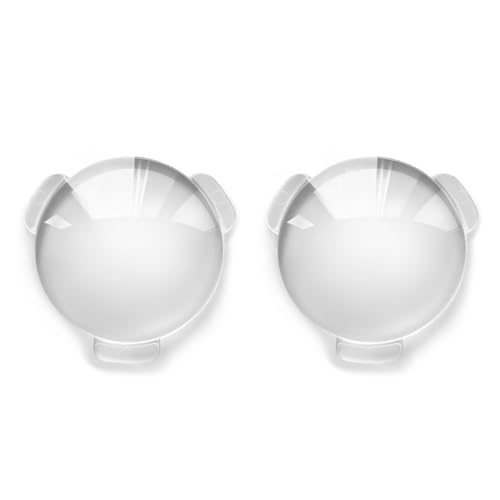
- Pair of 34mm biconvex lenses
- Roughly 45mm focal length
- Fits Google Cardboard V2 projects
Best For: DIY cardboard VR viewers and optical experiments
Best Budget Headset Protection

- Three silicone ring thicknesses
- Fits several older Oculus/Meta headsets
- Not compatible with Quest 3
Best For: Eyeglass wearers needing adjustable headset lens clearance
Best DIY Option

- 20 clear acrylic lenses per pack
- 45mm focal length for DIY viewers
- Designed for makers and STEM projects
Best For: Custom viewer builders and classroom optics projects
Best Storage Protection

- Fits Quest 3, Quest 2, and many others
- Blocks dust, scratches, sunlight, and UV
- Washable and reusable soft cover
Best For: Protecting headset lenses during storage and travel
Single-Lens Budget Pick – Amavasion Quest 3S/2 Insert
For shoppers comparing budget VR prescription lens inserts, this Amavasion option combines a frame with a single spherical myopia lens for Quest 3S or Quest 2. It is available in powers from -1.00 to -6.00 and uses a no-glare coating for VR gaming.
Best For: Quest 3S or Quest 2 users who need an affordable, single-eye lens insert.
Pros:
- Designed for Quest 3S/2 and shaped for the headset’s curved design.
- Offers multiple fixed spherical powers from -1.00 to -6.00.
- No-glare coating and an easy-install frame support comfortable VR use.
Cons:
- The package contains only one lens.
- Left and right lenses may need to be purchased separately, including different powers for each eye.
This is a practical low-cost route when you want to match each eye individually, but confirm your headset model and buy two lenses if needed.
Quest 2 Repair Option – GFTVRCE Fresnel Replacement
Although it is not a prescription insert, this Quest 2 replacement lens may suit shoppers researching budget VR prescription lens inserts because it addresses a damaged or worn headset lens instead. It is an OEM-style Fresnel replacement designed for Quest 2.
Best For: Quest 2 owners repairing a damaged lens rather than adding prescription correction.
Pros:
- Specifically designed for the Oculus Quest 2.
- Uses a Fresnel lens design with fixed focus.
- Intended for straightforward replacement and original-equipment-like performance.
Cons:
- It is a replacement headset lens, not a prescription lens insert.
- Compatibility is listed for Quest 2 only.
Choose this only if lens repair is your goal; prescription users will need a separate corrective solution.
Glasses Protection Pick – AMVR Quest 2 Lens Guard
AMVR Resilient VR Facial Vent Soft Interface + AMVR Lens Anti-Scratch Ring Protecting Myopia Glasses
Check Price On AmazonThis AMVR kit is an accessory for glasses wearers comparing budget VR prescription lens inserts. It does not provide prescription correction, but its lens protection frames and silicone rings help reduce contact between eyeglasses and VR lenses on supported headsets.
Best For: Quest 2 users who wear glasses and want lens-scratch protection plus a ventilated facial interface.
Pros:
- Includes two lens protection frames and 12 silicone rings.
- Three ring thicknesses—4 mm, 5 mm, and 7 mm—allow fit adjustment.
- Ventilation holes help exhaust air without light leakage, according to the listing.
- PU leather and sponge foam facial padding is designed to be soft and sweat-resistant.
Cons:
- Does not include prescription lenses.
- Headset and glasses are not included.
- Compatibility is focused on Oculus/Meta Quest-family and related supported platforms rather than Quest 3 prescription inserts.
This is best viewed as a glasses-protection companion, not a substitute for prescription inserts.
Magnetic Quest 3 Pick – ReaLegend Right-Eye Lens
For Quest 3 owners seeking budget VR prescription lens inserts, this ReaLegend lens uses a magnetic ABS frame for quick installation. The listed version is for the right eye with a -3.0 prescription, and each package contains one monocular lens.
Best For: Quest 3 users who need a right-eye -3.0 lens and prefer magnetic installation.
Pros:
- Designed specifically for Meta Quest 3.
- Magnetic frame supports quick attachment and removal.
- ABS frame is described as durable without adding excessive weight.
- Resin lenses are described as helping block UV rays and blue-light stimulation.
Cons:
- Only one side is included; the other eye must be purchased separately.
- The listed model is specifically the right-side -3.0 lens.
- Prescription increments are set in 0.50 steps, so buyers should verify each eye’s exact diopter.
This is a convenient Quest 3 option if the listed right-eye correction matches your prescription; verify both eye powers before ordering.
Bulk DIY Value – 50-Pack VR Convex Lens Replacements
For shoppers seeking budget VR prescription lens inserts for a DIY headset project, this bulk pack provides 50 round convex lenses with a listed 45mm focal length. They are intended as replacement or project components rather than ready-made prescription inserts.
Best For: DIY VR glasses, smartphone viewers, and buyers who need many replacement lenses.
Pros:
- Includes 50 transparent lenses for replacement or experimentation.
- Listed 25mm diameter and 45mm focal length.
- Designed for use with smartphones, tablets, gaming consoles, and computers.
- Lightweight design intended for extended use.
Cons:
- These are convex project lenses, not finished prescription inserts.
- No warranty is listed.
This is the most practical option for low-cost DIY builds or bulk replacements, but prescription users will need a separate optical solution and a compatible mounting method.
Prescription-Ready Choice – IOOIOO Quest 3 Magnetic Lens
IOOIOO one Lens for L or R Eye for Meta Quest 3 Oculus VR Headset, (nearsighted SPH:-5.75)
Check Price On AmazonAmong budget VR prescription lens inserts, this IOOIOO option is designed for one eye of a Meta Quest 3 and is supplied for a specific nearsighted prescription: SPH -5.75. Its magnetic frame makes installation and removal straightforward.
Best For: Meta Quest 3 users who need a single left- or right-eye insert matching the listed prescription.
Pros:
- Made specifically for the Meta Quest 3.
- Magnetic, removable frame is easy to clean and share.
- Uses a 1.60 Hi-Index lens with an easy-clean coating.
- Lightweight design is intended to remain secure during motion gaming.
Cons:
- Only one lens for the left or right eye is included.
- The listed version is for SPH -5.75, so other prescriptions require a different option.
- Installation guidance is provided through the product video rather than an additional printed manual.
This is the strongest match for a prescription user with a Quest 3 and the specified spherical power. Confirm each eye’s prescription and whether you need one or two lenses before ordering.
Cardboard Project Pick – Biconvex VR Lens Pair
This biconvex lens pair is a low-cost starting point for DIY builders comparing budget VR prescription lens inserts and homemade viewers. The lenses have a roughly 45mm focal length and are intended for Google Cardboard-style projects, not prescription correction.
Best For: Google Cardboard V2 builds, VR goggles, and simple optical experiments.
Pros:
- Includes one pair of biconvex lenses.
- Listed 34mm diameter and roughly 45mm focal length.
- Designed to fit Google Cardboard V2 projects.
- Clear plastic construction supports lightweight DIY assemblies.
Cons:
- Not prescription lenses or finished headset inserts.
- Lenses do not include tabs, so they must be held between cardboard layers.
- Fit and alignment depend on the builder’s project design.
Choose this pair when you want an inexpensive optical component for a cardboard VR build. It is less suitable for users who need a ready-to-install corrective insert.
Best Budget Headset Protection – AMVR Glasses Spacer
For shoppers seeking budget VR prescription lens inserts, the AMVR Glasses Spacer is a practical alternative for reducing contact between eyeglasses and the headset lenses. Its soft silicone rings and protective frame are designed for Quest 3S, Quest 2, Rift S, Quest 1, and Go, but not Quest 3.
Best For: Eyeglass wearers using compatible Oculus or Meta headsets who want adjustable scratch protection.
Pros:
- Includes three ring thicknesses—4mm, 5mm, and 7mm—for a more flexible fit.
- Protective frame and silicone rings are designed to stay connected during use.
- Includes six pairs of rings in black and red/blue color options.
- Offers simple installation and a 12-month warranty.
Cons:
- Not compatible with Meta Quest 3.
- This is a spacer and lens protector, not prescription lenses.
If you already wear glasses and use one of the supported headsets, this low-cost spacer provides adaptable clearance and basic lens protection. Verify your headset model before ordering.
Best DIY Option – Biconvex VR Lenses
These biconvex lenses are a low-cost DIY route for makers exploring budget VR prescription lens inserts, although they are not prescription-corrected inserts for an existing headset. The 20-pack uses clear acrylic lenses with a 45mm focal length for homemade smartphone viewers and optical projects.
Best For: Makers, educators, and hobbyists building custom VR viewers or conducting classroom optics projects.
Pros:
- 20 lenses provide ample parts for multiple projects or classroom use.
- Flanged winged edges are designed to fit securely into compatible DIY viewer slots.
- Lightweight acrylic construction avoids the breakage risk associated with glass.
- Can also be used for projectors, miniature cameras, and other magnification projects.
Cons:
- Does not provide individualized prescription correction.
- Requires a compatible DIY viewer or custom mounting solution.
This set makes sense only if you are comfortable designing or assembling your own viewer. It is a bulk optical component pack rather than a ready-to-install prescription insert.
Best Storage Protection – KIWI design VR Lens Cover
The KIWI design VR Lens Protector Cover complements budget VR prescription lens inserts by protecting the headset optics when they are stored or transported. It is a washable, reusable sleeve rather than a corrective lens insert, and it supports a broad range of headsets including Quest 3, Quest 2, Vision Pro, Rift S, Valve Index, Pico 4, and HP Reverb G2.
Best For: VR users who want to shield headset lenses from dust, scratches, sunlight, and UV exposure between sessions.
Pros:
- Compatible with many popular VR headsets, including Quest 3 and Quest 2.
- Helps block sunlight and UV exposure that can damage VR lenses.
- Soft foam and breathable stretch fabric are designed to be gentle on lenses.
- Washable, reusable, lightweight, and designed to stay in place.
Cons:
- It protects lenses but does not add prescription correction.
- It is intended for storage and transport, not active headset use.
For shoppers pairing budget VR prescription lens inserts with a simple storage safeguard, this cover is a useful accessory. Its main value is keeping optics cleaner and safer when the headset is not in use.
How We Picked These Budget VR Prescription Lens Inserts
We selected products across the most common budget approaches: headset-specific prescription inserts, single replacement lenses, magnetic frames, glasses spacers, lens protectors, and DIY optical components. Compatibility was a primary consideration, especially for Meta Quest 2, Quest 3, and Quest 3S users. We also considered installation style, material, eye coverage, scratch protection, and whether the product is intended for everyday viewing or experimentation.
Because prescription needs vary, a low price does not automatically make an insert a good value. Buyers should verify the exact SPH, CYL, AXIS, and PD requirements where applicable and confirm whether the listing includes one lens, a pair, or only a frame or accessory.
Quick Comparison
| Type | Best For | What to Check |
|---|---|---|
| Prescription insert | Direct, glasses-free VR use | Prescription range and headset model |
| Magnetic lens frame | Frequent installation and removal | Magnet alignment and included lenses |
| Glasses spacer or anti-scratch ring | Using a headset with glasses | Fit, comfort, and lens clearance |
| Replacement optic | Repairing or modifying a headset | Diameter, focal length, and optical quality |
| DIY biconvex lens | Cardboard viewers and projects | Lens dimensions and viewer design |
Key Buying Factors for Budget VR Prescription Lens Inserts
Headset Compatibility
Quest 2, Quest 3, and Quest 3S accessories are not always interchangeable. Check the exact headset generation, lens housing shape, and installation method before ordering. A product labeled for a generic VR viewer may not fit a modern standalone headset.
Prescription and Lens Coverage
Some products are made for a specific spherical prescription, while others require complete prescription details. Confirm whether the listing is for the left eye, right eye, or both eyes. Single-lens products can be useful for replacement, but they are easy to mistake for a complete pair.
Optical Quality and Comfort
Look for secure mounting, clear optics, smooth edges, and a design that does not interfere with the headset’s eye relief or field of view. Magnetic inserts are convenient, while fixed frames may be more stable during active use. Spacers can be preferable if you need to keep wearing glasses.
Protection and Maintenance
Anti-scratch rings, covers, and lens protectors do not correct vision, but they can help protect expensive headset optics from glasses, dust, and storage damage. Use a clean microfiber cloth and avoid harsh cleaners or excessive pressure on insert surfaces.
Who Should Buy Which Budget VR Prescription Lens Inserts?
Choose a headset-specific prescription insert if you want the clearest glasses-free setup and already know your prescription. A magnetic model is a practical choice for shared headsets or users who switch between glasses and inserts. If you only need clearance for ordinary eyeglasses, a spacer or protective ring may be the most affordable solution.
DIY biconvex and replacement lenses are better suited to hobbyists, educational projects, cardboard viewers, or repairs where exact optical alignment can be tested. They are not a substitute for a professionally specified prescription insert. For the safest purchase, match the headset first, confirm the complete prescription details, and check the package contents before comparing price.
