
Choosing a network video recorder does not have to mean overspending. The best budget network video recorders combine dependable recording, straightforward camera connections, and enough storage for your security needs.
This roundup compares 10 affordable NVR options, from compact four-channel systems to expandable 36-channel models, with attention to PoE ports, resolution support, storage, AI detection, and camera compatibility.
Best 10 Budget Network Video Recorders Picks for 2026
Expandable PoE Value

- 8 built-in PoE ports
- Expands to 16 channels
- HDD sold separately
Best For: Hiseeu-focused systems needing expansion
Simple Brand-Matched Setup
- Supports 8 cameras
- Internal and eSATA storage
- Reolink-focused compatibility
Best For: Reolink PoE camera systems
Large-System Capacity

- Supports up to 32 cameras
- Four SATA bays up to 32TB
- AI human and vehicle detection
Best For: Large home or commercial surveillance systems
Ready-to-Record Starter

- Includes a 1TB hard drive
- Four built-in PoE ports
- Supports ONVIF cameras
Best For: Small properties needing an easy starter system
Best Expandable Option
LongPlus NP08E 12MP 8CH PoE NVR

- Eight built-in PoE ports simplify installation
- Supports up to 12MP recording and 320Mbps bandwidth
- Dual SATA slots provide expandable local storage
Best For: Eight-camera systems needing flexible storage expansion
Best Bundled Storage
Anpviz 12MP 8CH NVR with 2TB Drive

- Includes a 2TB hard drive
- Supports eight cameras up to 12MP
- Offers H.265+ compression and no-fee remote access
Best For: Anpviz camera systems needing included storage
Best for Reolink Systems

- Supports 24/7 local recording with a compatible HDD
- Includes local AI video search
- Plug-and-play PoE works with Reolink cameras
Best For: Compact Reolink systems requiring subscription-free recording
ANNKE Value Pick

- 12MP recording with H.265+ compression
- Eight built-in PoE ports
- ANNKE-focused compatibility; no HDD included
Best For: ANNKE camera systems needing simple PoE setup
SECULINK Plug-and-Play Pick
- Supports 8MP/4K recording
- Eight-port built-in PoE switch
- ONVIF compatible; no HDD included
Best For: Small mixed-camera systems needing easy PoE installation
Reolink Expansion Pick

- Supports up to 36 Reolink cameras
- Three bays with up to 48TB total capacity
- Requires separate PoE switches; no HDD included
Best For: Large Reolink systems designed for future expansion
Expandable PoE Value – Hiseeu 8-Port 4K NVR
For shoppers comparing budget network video recorders, the Hiseeu offers eight built-in PoE ports and expansion to 16 channels with an additional PoE switch. It supports cameras up to 8MP and uses H.265+ compression to help reduce storage requirements, but the lack of an included hard drive and limited third-party compatibility are important considerations.
Best For: Users building a primarily Hiseeu-based system who need room to expand beyond eight PoE cameras.
Pros:
- Eight built-in PoE ports power cameras over Ethernet.
- Can expand to up to 16 channels with a PoE switch.
- Supports remote viewing without a monthly fee.
- H.265+ compression can save storage space.
Cons:
- Hard drive is not included, so recording requires a separately purchased HDD.
- Third-party cameras are not fully plug-and-play and require network configuration.
- Expansion requires a separate PoE switch.
This is a practical choice when built-in PoE capacity and future expansion matter more than broad out-of-box camera compatibility. Budget for a hard drive and some setup time.
Simple Brand-Matched Setup – Reolink RLN8-410 NVR
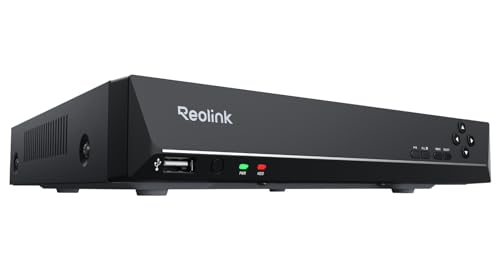
The Reolink RLN8-410 is one of the more straightforward budget network video recorders for a Reolink camera system. It supports eight simultaneous cameras, one internal HDD up to 8TB, and an external eSATA drive up to 8TB, with one-cable PoE installation and free remote access through Reolink apps.
Best For: Home users who want an independently running, plug-and-play recorder for compatible Reolink PoE cameras.
Pros:
- Supports up to eight cameras recording simultaneously.
- PoE carries power and data over one Ethernet cable.
- Supports internal and external storage options.
- Includes free local and remote viewing apps with no monthly fee.
Cons:
- Hard drive is not included.
- Compatibility is focused on Reolink cameras and excludes 4G LTE models.
- Firmware updates may be needed before use.
The RLN8-410 makes the most sense when you are committed to Reolink cameras. Its setup and app experience are appealing, but shoppers seeking broad third-party compatibility should look elsewhere.
Large-System Capacity – ANNKE 32-Channel NVR
For larger installations, this ANNKE is a high-capacity option among budget network video recorders, supporting up to 32 IP cameras and four SATA drives with up to 32TB total capacity. It has no built-in PoE ports, so cameras require separate PoE switches, and ANNKE recommends using its own cameras for compatibility.
Best For: Commercial or property-wide surveillance setups that need many channels, multiple drives, and AI-based motion events.
Pros:
- Supports up to 32 channels and 12MP camera streams.
- Four SATA interfaces allow up to 32TB total storage.
- AI detection identifies humans and vehicles.
- Includes line-crossing and intrusion detection features.
Cons:
- No PoE ports are built in; separate PoE switches are required.
- Hard drives are not included.
- ANNKE cameras are recommended to reduce compatibility issues.
This recorder offers substantial capacity for the price, but the full system cost includes PoE switching, cameras, and storage. It is better suited to planned installations than quick, small-scale setups.
Ready-to-Record Starter – 4-Channel 4K PoE NVR
This four-channel recorder is a convenient pick among budget network video recorders because it includes a 1TB surveillance hard drive. Its four built-in PoE ports simplify installation, while support for up to 8MP cameras, H.265+ compression, remote viewing, and ONVIF compatibility cover the needs of many small properties.
Best For: Homes, small offices, shops, and garages needing a compact system with storage included.
Pros:
- Includes a pre-installed 1TB hard drive.
- Four PoE ports provide one-cable camera installation.
- Supports up to 8MP 4K cameras and 24/7 recording.
- ONVIF support helps it work with many third-party IP cameras.
Cons:
- Four-channel capacity limits future camera expansion.
- The included 1TB drive may provide less retention than larger systems.
- Additional storage may be needed for extended recording.
With storage included and a simple PoE layout, this is the most ready-to-use choice in the group. Its main limitation is capacity: it suits smaller deployments rather than growing multi-camera installations.
Best Expandable Option – LongPlus NP08E 12MP 8CH PoE NVR
For shoppers comparing budget network video recorders, the LongPlus NP08E is a flexible choice when you need eight camera inputs, high-resolution recording, and room to expand local storage. Its built-in PoE ports simplify installation by carrying power and data over Ethernet.
Best For: Home or small-business systems using up to eight compatible IP cameras and needing expandable HDD storage.
Pros:
- Supports recording resolutions up to 12MP and 320Mbps incoming bandwidth.
- Eight built-in 100M PoE ports enable plug-and-play camera connections without a separate PoE switch.
- Dual SATA slots support larger local storage capacity, and ONVIF compatibility helps with supported third-party cameras.
- Includes two-way audio support and a Gigabit LAN port.
Cons:
- Hard drives are not included.
- Camera compatibility should be verified, particularly for third-party equipment.
- The supplied details list the built-in media as 5MP NVR despite the stated support for resolutions up to 12MP.
The NP08E stands out among budget network video recorders for its dual-drive design and eight integrated PoE connections. It is most attractive if you already have compatible cameras and want a scalable recorder rather than a bundled storage solution.
Best Bundled Storage – Anpviz 12MP 8CH NVR with 2TB Drive
The Anpviz 8-channel recorder is a practical pick among budget network video recorders because it includes a 2TB hard drive instead of requiring an immediate storage purchase. It also combines 12MP support, H.265+ compression, remote access, and selected AI-related camera features.
Best For: Buyers building an Anpviz-based eight-camera system who want included storage and app-based remote playback.
Pros:
- Includes a 2TB hard drive and supports storage expansion up to 8TB.
- Supports up to eight cameras with resolutions up to 12MP, including 4K and 8MP models.
- H.265+ compression can save up to 75% of storage space compared with H.264.
- Provides remote access through the Anpviz Viewer app without monthly fees.
Cons:
- Plug-and-play operation is limited to Anpviz IP PoE cameras.
- Third-party camera setup may require consulting the manual.
- The NVR itself does not have built-in AI functions; supported AI features depend on compatible cameras.
With a hard drive included, this Anpviz model can reduce the upfront cost and setup work for a matching camera system. Its main limitation is the narrower plug-and-play ecosystem, so confirm camera compatibility before buying.
Best for Reolink Systems – REOLINK RLN4E 4CH PoE NVR
For a smaller Reolink installation, the RLN4E is one of the more focused budget network video recorders. It supports continuous local recording, plug-and-play PoE connections, and local AI video search, but it is designed specifically for Reolink cameras and does not include a hard drive.
Best For: Reolink PoE camera owners who need dependable local recording for a compact system.
Pros:
- Supports 24/7 recording with a compatible internal surveillance-grade HDD.
- PoE carries power and data over one Ethernet cable for simpler setup.
- Local AI search can help find people, vehicles, or events without manually reviewing the entire timeline.
- Supports up to 8TB of internal HDD storage and remote multi-device viewing.
Cons:
- Works only with Reolink IP cameras.
- HDD and microSD card are not included.
- The recorder is centered on a four-channel PoE setup, with the listed configuration supporting up to six cameras when two additional Wi-Fi or battery cameras are used.
The RLN4E makes sense when stability, local storage, and Reolink-specific features matter more than broad camera compatibility. Its subscription-free operation and offline-capable local recording are useful advantages for a compact security setup.
ANNKE Value Pick – 12MP 8-Channel PoE NVR
For shoppers comparing budget network video recorders, the ANNKE 12MP 8-channel NVR offers a straightforward foundation for an ANNKE-focused camera system. It supports up to 12MP recording, H.265+ compression, 24/7 recording, and one-cable PoE connections, but it does not include a hard drive.
Best For: Home or small-business users building an ANNKE PoE camera system with compatible AI cameras.
Pros:
- Supports up to 12MP cameras and H.265+ video compression.
- Eight PoE ports provide power and data through one Ethernet cable per camera.
- Remote viewing is available through the ANNKE Vision app without monthly fees.
- Supports 2.5- and 3.5-inch hard drives for flexible storage installation.
Cons:
- Works primarily with ANNKE IP cameras; third-party compatibility should be confirmed with support.
- No hard drive is included.
- The NVR itself has no built-in AI functions; AI features depend on compatible ANNKE cameras.
This is a practical budget option when you already use ANNKE cameras or want an ANNKE-centered system. The built-in PoE ports simplify installation, while the missing hard drive and brand-focused compatibility should be considered before buying.
SECULINK Plug-and-Play Pick – 4K 8-Channel PoE NVR
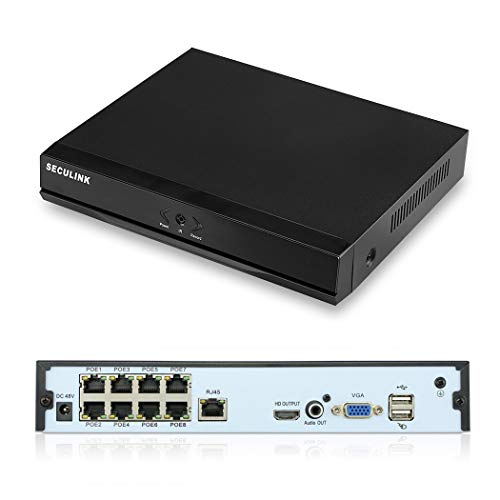
This SECULINK recorder is one of the more flexible budget network video recorders for an 8-camera setup. It supports up to 8MP, or 4K, recording, includes an eight-port PoE switch, and works with ONVIF-compatible IP cameras, making it useful for assembling a mixed-camera system.
Best For: Homes, offices, stores, farms, and small businesses seeking an affordable ONVIF-compatible 4K PoE recorder.
Pros:
- Records up to 8MP, or 4K, video across all eight channels.
- Built-in eight-port PoE switch simplifies installation with one cable for power and data.
- ONVIF compatibility supports a range of IP cameras, including 5MP, 4MP, and 1080p models.
- XMEYE remote access supports live viewing, playback, and system management on iOS and Android.
Cons:
- No hard drive is included.
- Storage capacity and recording duration depend on the separately installed drive.
- Motion alerts and detection require configuration for the desired areas and notifications.
With 4K support, built-in PoE, and ONVIF compatibility, this model offers a balanced starting point for buyers who do not want to stay within one camera brand. Plan for a separate hard drive before installation.
Reolink Expansion Pick – 36-Channel RLN36 NVR
The Reolink RLN36 is designed for buyers whose surveillance needs exceed a typical eight-camera recorder. Among budget network video recorders, it stands out for supporting up to 36 Reolink IP cameras and three hard-drive bays, although it has no built-in PoE ports and requires separate PoE switches.
Best For: Larger Reolink camera systems, businesses, and users planning substantial expansion.
Pros:
- Manages up to 36 Reolink IP cameras.
- Three hard-drive bays support up to 16TB per drive, for 48TB total storage capacity.
- USB 3.0 supports faster backups to a portable hard drive.
- Integrates compatible Reolink camera features such as human and vehicle detection during playback.
Cons:
- No PoE ports are built in, so separate Reolink PoE switches are required.
- Works with Reolink IP cameras rather than serving as a general-purpose recorder.
- No hard drives are included.
This is a strong expansion-oriented choice, but its total system cost is higher than a basic PoE NVR because switches and storage must be added separately. Choose it when 36-camera capacity and multi-drive storage matter more than all-in-one installation.
How We Picked the Best Budget Network Video Recorders
We evaluated these NVRs against the features that matter most in a practical surveillance setup: channel count, supported camera resolution, built-in PoE ports, storage configuration, playback tools, remote access, and compatibility with common IP-camera standards such as ONVIF. We also considered whether each recorder suits a small home installation, a growing property, or a larger multi-camera system.
Price alone is not a useful measure of value. A lower-cost recorder can become expensive if it requires additional switches, a hard drive, adapters, or replacement hardware. Models with included storage may offer a simpler starting point, while no-HDD units can be better for buyers who want to select their own surveillance-grade drive.
Quick Comparison
| Best For | Recommended Capacity | Features to Prioritize |
|---|---|---|
| Small apartment or entryway setup | 4 channels | Built-in PoE, simple remote viewing, included storage |
| Typical home security system | 8 channels | 4K or higher support, expandable storage, smart playback |
| Larger home or small business | 16–32 channels | Extra PoE capacity, AI alerts, strong storage support |
| Large installation | 36 channels | Network flexibility, centralized management, high-capacity storage |
Key Buying Factors for Budget Network Video Recorders
Channel Count and Expansion
Choose more channels than you currently need if you expect to add cameras. A four-channel NVR is efficient for a small installation, while an eight-channel model gives most homes useful flexibility. Larger systems are worthwhile only when you need many cameras or centralized recording.
PoE Ports and Installation
Built-in Power over Ethernet ports can carry power and video over one cable, reducing setup complexity. Check both the number of PoE ports and the recorder’s total network capacity. An NVR may support more cameras than it can power directly, requiring a separate PoE switch.
Resolution, Storage, and Recording Time
Higher-resolution cameras produce clearer images but consume more storage and bandwidth. Confirm that the recorder supports your cameras’ resolution and compression format. Included 1TB or 2TB drives are convenient, but calculate retention time based on camera count, frame rate, motion recording, and audio use.
Compatibility and Smart Features
For mixed-brand systems, look for ONVIF support and verify specific camera functions before buying. AI motion detection, person or vehicle filtering, two-way audio, and smart playback can reduce the time spent reviewing footage, but feature support may vary by camera and firmware.
Who Should Buy Which Budget Network Video Recorders?
Buy a four-channel NVR for a compact system with a few cameras and no immediate expansion plans. An eight-channel recorder is the best all-around choice for many homeowners. Choose a 16-channel or larger model if you are securing multiple buildings, entrances, or outdoor areas. A high-capacity 36-channel unit is better suited to businesses or large properties that need centralized management.
Before ordering, confirm camera compatibility, drive requirements, network layout, and local recording regulations. The right budget NVR is the one that matches your current camera plan while leaving enough capacity for the next stage of your security system.
