
Understanding where your electricity goes can make it easier to cut waste, verify solar production, and spot unusually high usage. The best budget home energy monitors provide useful real-time data without requiring a premium energy-management system.
This roundup compares 10 options by circuit coverage, sensor capacity, connectivity, automation support, and privacy features so you can choose a monitor that fits your panel and goals.
Best 10 Budget Home Energy Monitors Picks for 2026
Best Certified Whole-Home Monitor

- UL and CE listed with ±2% specified accuracy
- Whole-home, solar, and net-metering support
- Expandable to 16 branch-circuit sensors
Best For: Whole-home and solar energy tracking
Best Budget Circuit Monitor
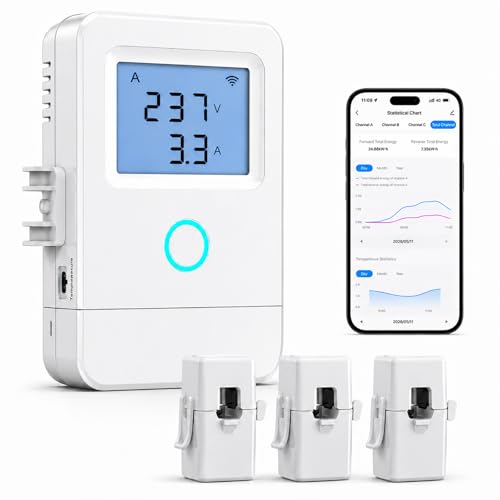
- Three included 80A CT clamps
- Tracks selected circuits in Smart Life or Tuya
- Adds temperature alerts and limited relay control
Best For: Monitoring up to three high-power circuits
Best for Smart Home Automation

- Covers two main and 16 branch circuits
- Home Assistant and local-data support
- Solar surplus detection with smart alerts
Best For: Detailed monitoring and local home automation
Best for Private Smart Homes
Refoss EM16P Local Energy Monitor

- Local Web UI, API, MQTT, and Home Assistant support
- Monitors two main and 16 branch circuits
- Five-year daily data storage with no subscription
Best For: Privacy-focused households and solar-home automation
Best for App-Based Monitoring
Emporia Vue 3 Home Energy Monitor

- UL and CE listed with clamp-on sensors
- Monitors whole-home, solar, and net-metering data
- App supports time-of-use and peak-demand management
Best For: Cloud-connected energy tracking across phone and web apps
Best for Detailed Circuit Audits
Refoss 18-Circuit Energy Monitor
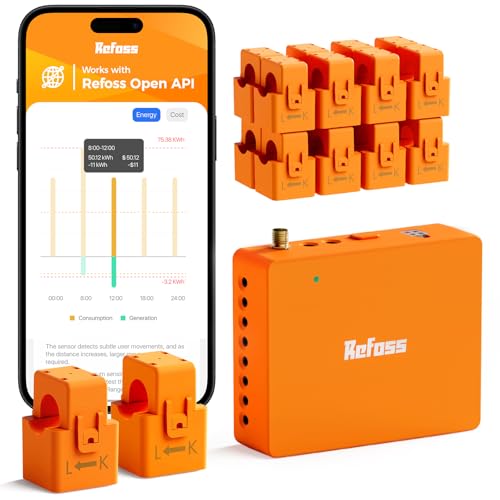
- Covers two main and 16 branch circuits
- Local control with API, MQTT, WebSocket, and Home Assistant
- Five-year daily records with CSV export
Best For: Granular energy audits and subscription-free automation
Best Overall
Meross Smart Home Energy Monitor
- Monitors two mains and up to 16 branch circuits
- Stores five years of data with exports and alerts
- Local data, Home Assistant support, and no subscription
Best For: Detailed circuit-level monitoring and solar-focused automation
Best Simple Whole-Home Pick

- Uses two 200A sensors for whole-home or solar monitoring
- Connects by 2.4GHz Wi-Fi or Ethernet
- MyEyedro cloud access has no subscription
Best For: Simple grid, solar, or net-metering visibility
Best for Circuit Management

- Measures mains and up to 16 branch circuits
- Offers app-based real-time and historical tracking
- Adds peak-demand, solar, and load-shedding functions
Best For: U.S. and Canadian homes needing detailed circuit management
Best Certified Whole-Home Monitor – Emporia Vue 3
For shoppers comparing budget home energy monitors, the Emporia Vue 3 is a strong whole-home option with UL certification, real-time app data, and support for solar and net metering. It installs in the electrical panel with clamp-on sensors, though panel work should be approached carefully.
Best For: Homeowners who want whole-home usage tracking, solar monitoring, and optional appliance-level monitoring.
Pros:
- UL and CE listed, with accuracy specified at ±2%.
- Tracks whole-home electricity use and supports solar/net metering.
- App supports time-of-use settings, alerts, automation, and cost reporting.
- Can add up to 16 branch sensors for appliance monitoring.
Cons:
- Requires 2.4 GHz Wi-Fi and an internet connection.
- Additional branch sensors are sold separately.
- Some electrical system configurations require an additional 200A sensor.
The Vue 3 offers broad functionality for the price, especially if you want to monitor a full electrical service and expand into individual appliances later. Its one-year warranty and required panel installation are worth considering before purchase.
Best Budget Circuit Monitor – WiFi Home Energy Monitor
This WiFi monitor is a practical pick among budget home energy monitors when you only need to watch selected circuits rather than the entire panel. Its three included CT clamps let you compare major loads such as HVAC, water heating, laundry, or solar-related circuits through the Smart Life or Tuya app.
Best For: Users who want affordable monitoring for up to three high-power circuits.
Pros:
- Includes three 80A CT clamps for simultaneous circuit monitoring.
- Displays voltage, current, power, and energy use in the app.
- Provides historical usage data for trend comparisons.
- Includes temperature alerts and remote control for one connected circuit.
Cons:
- Designed for selected circuits, not whole-home monitoring.
- Requires 2.4 GHz Wi-Fi and electrical-panel wiring.
- Remote relay control is limited to 15A.
With three clamps included, this model gives budget-conscious buyers a focused way to identify which large circuits consume the most energy. It is best suited to targeted monitoring, and installation by a qualified electrician is recommended if panel wiring is unfamiliar.
Best for Smart Home Automation – Meross 18-Circuit Monitor
The Meross EM16 stands out among budget home energy monitors for extensive circuit coverage and local smart-home integration. It monitors two main circuits plus up to 16 branch circuits, while Home Assistant support enables automation without subscriptions or cloud-dependent data storage.
Best For: Smart-home users who need detailed circuit monitoring, local data, and solar surplus automation.
Pros:
- Monitors two 200A main circuits and up to 16 branch circuits.
- Works with Home Assistant, Open API, and Web Control.
- Stores up to five years of data and supports hourly report exports.
- Offers smart alerts, solar surplus detection, and ±2% specified accuracy.
Cons:
- Its advanced features may be more than basic users need.
- Installation still involves working at the electrical panel.
- Solar automation depends on a compatible Home Assistant setup.
The EM16 is a particularly capable choice if you want granular circuit data and privacy-focused local control. Its two-year warranty adds value, while the larger feature set makes it better suited to an enthusiast or automation-oriented installation.
Best for Solar Export Tracking – Blindsmart WiFi Monitor
For budget home energy monitors aimed at solar or battery systems, the Blindsmart model offers two 120A CTs and bi-directional tracking. It can measure household consumption and electricity exported to the grid, with Smart Life app access and support for home energy management features.
Best For: Single-phase homes with solar or battery storage that need import and export monitoring.
Pros:
- Includes two 120A split-core CTs for single-phase 3-wire systems.
- Measures both household consumption and grid export.
- Supports alerts, automation scenes, and Smart Life app analysis.
- Includes HEMS, dynamic load balancing, and zero-grid-export support.
Cons:
- Its listed compatibility is focused on single-phase 3-wire systems.
- Smart features require app and Wi-Fi connectivity.
- Battery-powered operation may require attention to battery maintenance.
This monitor is a focused choice for solar and storage users who need to distinguish energy consumed from energy sent to the grid. Its compact split-core CTs and pluggable terminals may simplify setup, but confirm system compatibility before buying.
Best for Private Smart Homes – Refoss EM16P Local Energy Monitor
For shoppers comparing budget home energy monitors, the Refoss EM16P stands out for local access and broad circuit coverage. Its built-in Web UI, Open API, MQTT support, and native Home Assistant integration let you review and automate energy data without relying on cloud services or subscriptions.
Best For: Privacy-conscious households, Home Assistant users, and solar homes seeking circuit-level monitoring.
Pros:
- Local Web UI, Open API, MQTT, and native Home Assistant support.
- Supports two main sensors and up to 16 branch sensors.
- Provides up to five years of daily data, exportable without subscription fees.
- ETL certified, with clamp-on installation and a two-year warranty.
Cons:
- Installation requires access to the home circuit panel.
- Low-current readings are rated at ±2% rather than ±1%.
The EM16P is a strong budget-minded choice when privacy and smart-home flexibility matter more than a cloud-first experience. Its solar automation features add value for homes with excess midday generation.
Best for App-Based Monitoring – Emporia Vue 3 Home Energy Monitor
The Emporia Vue 3 is a practical option among budget home energy monitors for shoppers who want app-based tracking and utility-management tools. It monitors whole-home usage, solar, and net metering through the Emporia app, with clamp-on sensors for compatible electrical systems.
Best For: Users who want UL-listed hardware, live app reporting, and cloud-based energy history.
Pros:
- UL and CE listed for added safety assurance.
- Supports whole-home monitoring with eight circuit sensors.
- Tracks solar, net metering, time-of-use, peak demand, and excess-solar opportunities.
- Works with iPhone, Android, and web apps.
Cons:
- Requires 2.4 GHz Wi-Fi and an internet connection.
- One-second data is available only while the app is open and retained for three hours.
- Some electrical configurations require an additional 200A sensor.
The Vue 3 makes sense for buyers comfortable with cloud-connected monitoring and app-based controls. Its safety certifications and utility-focused features are appealing, though its data access is less local than the Refoss alternatives.
Best for Detailed Circuit Audits – Refoss 18-Circuit Energy Monitor
For a budget home energy monitor aimed at detailed audits, this Refoss system combines 18-circuit coverage with local control. It is designed to identify high-consuming appliances, retain long-term usage records, and support solar and time-of-use automation without subscription fees.
Best For: Households that want granular circuit analysis, exportable records, and local smart-home control.
Pros:
- Monitors two main circuits and 16 branch circuits with professional ±1% precision.
- Offers local Web UI, Open API, MQTT, WebSocket, and Home Assistant integration.
- Stores daily data for five years and supports CSV export without a subscription.
- Supports single-phase, split-phase, and 3-phase 4-wire Wye systems.
Cons:
- Panel installation may require qualified electrical assistance.
- Its many sensors and integrations may be more than casual users need.
This model is the better fit for shoppers who want to audit individual circuits rather than simply view a whole-home total. The external antenna and sensor-direction correction also make setup more forgiving, while the local architecture keeps ongoing costs down.
Best Overall – Meross Smart Home Energy Monitor
For shoppers comparing budget home energy monitors, the Meross EM16 stands out for broad panel compatibility and detailed circuit-level tracking. Its clamp-on installation, real-time readings, custom alerts, and local-data features make it a practical choice for households that want actionable energy information without subscription fees.
Best For: Homeowners who want whole-home and branch-circuit monitoring, privacy-focused local data, or solar automation through Home Assistant.
Pros:
- Supports two main circuits plus up to 16 branch circuits.
- Tracks power, voltage, current, and power factor with stated accuracy of ±1%.
- Offers up to five years of stored data, report exports, alerts, and no subscription fees.
- Includes ETL certification, UL 61010 compliance, and a two-year warranty.
Cons:
- Installation is intended for compatible electrical systems and involves the panel.
- Its broad feature set may be more than needed for simple whole-home monitoring.
- Home Assistant solar automation requires setup with the compatible platform.
The Meross is one of the more capable budget home energy monitors for users who want granular data and future automation. Verify your electrical-system compatibility and installation requirements before buying.
Best Simple Whole-Home Pick – Eyedro Smart Energy Monitor
The Eyedro Home is a straightforward option among budget home energy monitors for tracking whole-home electricity use or solar production. It provides real-time readings through Wi-Fi or Ethernet and displays consumption in dollars, watts, amps, and volts through the MyEyedro cloud without a subscription.
Best For: Homeowners, DIY users, solar users, and off-grid households seeking simple whole-home or single-purpose energy tracking.
Pros:
- Includes two 200A directional sensors for whole-home or solar monitoring.
- Works over 2.4GHz Wi-Fi or wired Ethernet.
- Tracks usage in real time and supports grid, solar, or net-metering applications.
- Includes MyEyedro cloud access with no subscription.
Cons:
- A single unit monitors grid energy, solar, or net metering—not all simultaneously.
- Separate grid-versus-solar tracking requires two EYEDRO-HOME meters.
- It does not offer the supplied circuit-level sensor capacity of the other listed monitors.
Choose the Eyedro when dependable, accessible whole-home data matters more than extensive branch-circuit monitoring. Solar owners should account for the additional meter requirement if they want separate grid and generation measurements.
Best for Circuit Management – Siemens Inhab Energy Monitor
The Siemens Inhab is a strong choice for shoppers seeking budget home energy monitors with direct panel and circuit-level measurement. Its mobile app provides real-time and historical data, while customizable notifications and advanced functions support more active energy-management strategies.
Best For: U.S. and Canadian homeowners who want whole-home monitoring plus measurements for up to 16 individual branch circuits.
Pros:
- Measures usage at the mains and up to 16 branch circuits.
- Provides 24/7 real-time and historical monitoring through a mobile app.
- Supports alerts for abnormal behavior, such as an oven left on.
- Includes time-of-use, peak-demand, excess-solar, net-metering, and load-shedding functions.
Cons:
- The mobile app is specified for use in the USA and Canada only.
- Panel installation may require appropriate electrical expertise.
- Its advanced energy-management functions may be unnecessary for basic monitoring.
The Inhab is best suited to households that want monitoring to support broader energy controls, not just a usage display. Confirm regional availability and plan for professional installation where appropriate.
How We Picked the Best Budget Home Energy Monitors
We focused on monitors that offer meaningful electricity data at a comparatively accessible price. Our evaluation considers the number and rating of included current transformers (CTs), whether the system supports whole-home or circuit-level monitoring, connectivity options, app usability, solar and net-metering capabilities, and compatibility with smart-home platforms.
Installation requirements also matter. Some systems are designed for main-panel monitoring, while others support multiple branch circuits. Because panel layouts, electrical ratings, and local codes vary, buyers should confirm compatibility and use a qualified electrician when installation involves exposed service wiring.
Quick Comparison
| What to Compare | Why It Matters |
|---|---|
| Whole-home CT rating | Determines whether the monitor can safely measure your service capacity. |
| Number of circuit sensors | Shows how many appliances or branches can be tracked separately. |
| Connectivity | Wi-Fi, Ethernet, and local APIs affect reliability and integration. |
| Solar support | Useful for measuring generation, consumption, and surplus power. |
| Cloud versus local control | Cloud services add convenience; local access can improve privacy and resilience. |
Key Buying Factors for Budget Home Energy Monitors
Panel and Sensor Compatibility
Check your main service rating, available panel space, wire arrangement, and the CT clamp size before buying. A monitor with more sensors is not automatically better if the sensors cannot fit or its amperage range does not match your installation.
Data Detail and Accuracy
Whole-home monitoring is enough for tracking overall consumption, but circuit-level data can reveal which appliances drive costs. Look for clear historical graphs, energy-cost estimates, exportable data, and a sampling rate suited to your goals.
Smart-Home and Privacy Features
Home Assistant support, open APIs, or local control can be valuable for custom dashboards and automations. If internet outages or data privacy are concerns, prioritize products that continue recording locally or provide a no-cloud operating mode.
Solar and Billing Support
Solar households should verify that the monitor can distinguish production from consumption and support bidirectional or net-metering measurements. Cost tracking is most useful when rates, time-of-use pricing, and export credits can be configured accurately.
Who Should Buy Which Budget Home Energy Monitors?
Choose a basic whole-home Wi-Fi monitor if you mainly want to see current usage and establish a household energy baseline. Select a multi-circuit model if you want to track HVAC equipment, water heaters, EV chargers, or other major loads individually. Solar owners should prioritize bidirectional measurement and dedicated production tracking.
For smart-home enthusiasts, models with Home Assistant compatibility or an open API offer more flexibility than app-only systems. Buyers who value privacy and reliability should consider local-control options, while those who want the simplest experience may prefer a polished cloud app. In every case, verify electrical compatibility and installation requirements before placing an order.
