
Finding the best budget camera crane means balancing reach, payload, portability, and mounting stability—not simply choosing the longest arm.
This roundup compares compact overhead mounts, desk-friendly magic arms, mini jibs, and full-size crane systems so you can match the setup to your camera and shooting style.
Best 10 Budget Camera Cranes Picks for 2026
Lightweight Overhead Pick
K&F Concept 76 in Overhead Camera Tripod

- Removable boom arm rotates 360 degrees horizontally
- Folds to 15.3 inches and weighs 3.63 pounds
- Supports up to 17.6 pounds
Best For: Portable overhead, panorama, and travel shooting
Compact Jib Value

- Four-foot CNC aluminum jib for DSLR video cameras
- Supports up to 8 kilograms or 17 pounds
- Designed for pan-tilt heads and 3-axis gimbals
Best For: Compact studio and outdoor jib setups
Versatile Tripod Crane Alternative
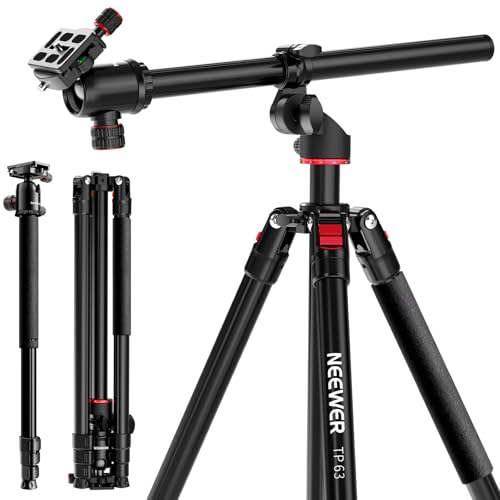
- Reaches 90.6 inches with the center column raised
- Horizontal column tilts 120 degrees and rotates 360 degrees
- Converts to a monopod and supports up to 22 pounds
Best For: High-angle, overhead, event, and travel shooting
Long-Reach Production Crane
Proaim 14ft Camera Crane Jib Arm

- Configures at 14 or 10 feet for extended reach
- Supports camera rigs up to 8 kilograms
- Offers 270-degree platform tilt and bearing-supported movement
Best For: Film, event, and large-set crane shots
Best Budget Desk Crane
Adjustable Overhead Camera Stand

- Desk-mounted C-clamp design
- 12–22.4-inch adjustable height
- Supports cameras up to 4.4 lb
Best For: Tabletop overhead filming and livestreaming
Best Heavy-Duty Budget Camera Crane

- 5.2–7.2-foot telescoping reach
- Supports up to 33 lb
- Folds to 2.5 feet for transport
Best For: Heavy cameras, gimbals, and production jib shots
Best Compact Budget Camera Crane
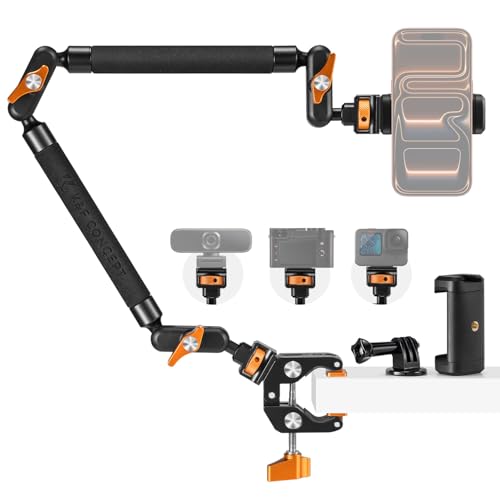
- Three 360-degree ball heads
- Clamp fits flat and cylindrical surfaces
- Supports up to 2.2 lb
Best For: Static overhead phone and action-camera setups
Complete Production Crane

- Complete jib, tripod, and dolly system
- 6–10ft telescopic arm
- Supports up to 25kg
Best For: Production teams needing a full-size crane support package
Compact Overhead Mount

- 56cm articulating overhead arm
- Clamp and phone holder included
- 600g recommended load
Best For: Desk-based overhead video, streaming, and lightweight gear
Carbon-Fiber Mini Jib

- 85in extendable reach
- 33lb maximum load
- Foldable carbon-fiber design
Best For: Portable camera movement with professional mounting flexibility
Lightweight Overhead Pick – K&F Concept 76 in Overhead Camera Tripod
For budget camera cranes, the K&F Concept is a portable tripod-based option for overhead angles, panoramas, and flexible camera positioning. Its removable boom arm rotates horizontally and swings from 0 to 180 degrees, while the tripod folds down to 15.3 inches and weighs 3.63 pounds with the included head and arm kit.
Best For: Travel photographers, vloggers, and creators who want overhead or panoramic positioning without carrying a full-size jib.
Pros:
- Removable extension boom supports overhead and panoramic shooting.
- 360-degree ball head and panning dial allow precise angle adjustments.
- Adjusts from 17.3 to 76.7 inches and supports up to 17.6 pounds.
- Includes a carrying bag and uses quick flip leg locks.
Cons:
- It is a tripod with an extension arm rather than a dedicated long-reach jib.
- The aluminum design is not water resistant.
This is a practical budget camera crane alternative when portability matters more than maximum reach. Its 8-kilogram capacity and broad compatibility suit cameras, smartphones, projectors, and telescopes, but larger crane-style moves may require a dedicated jib.
Compact Jib Value – PROAIM 4' Vega Jib Crane
Among budget camera cranes, the PROAIM Vega 4′ focuses on compact jib movement for DSLR video cameras in studios or outdoor locations. Its CNC aluminum construction supports up to 8 kilograms and is designed to work with pan-tilt heads and 3-axis gimbals.
Best For: Film crews and independent creators who need a manageable four-foot jib for compact production setups.
Pros:
- Supports payloads up to 8 kilograms or 17 pounds.
- Compatible with pan-tilt heads and 3-axis gimbals.
- Compact four-foot design suits confined studios and mobile shoots.
- Central fork is designed to reduce unwanted vibration during moves.
Cons:
- A tripod stand or jib stand with a junior baby pin is required.
- Four-foot reach is more limited than larger crane arms.
- The listed item weight is 5.6 kilograms, so it is not an especially light setup.
The Vega 4′ is a straightforward choice when you want genuine jib movement without committing to a full-size crane. Its payload is useful for rigged DSLR setups, but the required support stand should be included in the overall budget.
Versatile Tripod Crane Alternative – NEEWER TP63 Overhead Tripod
The NEEWER TP63 is a flexible option for shoppers comparing budget camera cranes with overhead tripods. Its center column can rise to 90.6 inches, shift horizontally for 360-degree rotation and 120-degree tilt, and convert into a monopod for tighter shooting spaces.
Best For: Content creators, event photographers, and videographers who need high-angle positioning, travel flexibility, and multiple shooting configurations.
Pros:
- Reaches 90.6 inches with its liftable center column.
- Horizontal column supports 360-degree rotation and 120-degree vertical tilt.
- Converts into a monopod reaching up to 94.5 inches.
- Metal build supports up to 22 pounds and includes a sandbag hook.
Cons:
- The sandbag needed for added stability is not included.
- It provides overhead tripod positioning rather than the sweeping reach of a dedicated jib.
- Its folded 21-inch size is less compact than smaller travel tripods.
The TP63 offers more configuration flexibility than a basic tripod and can handle a relatively heavy setup. It is a strong budget camera crane alternative for elevated or overhead compositions, especially when monopod use is also valuable.
Long-Reach Production Crane – Proaim 14ft Camera Crane Jib Arm
For buyers who need true crane movement, the Proaim P-14 is the long-reach choice among these budget camera cranes. Its modular jib can be configured at 14 or 10 feet, carries up to 8 kilograms, and provides a 270-degree camera-platform tilt range for sweeping or overhead shots.
Best For: Film productions, event coverage, and creators who need extended reach over crowds, obstacles, or large sets.
Pros:
- 14-foot arm can reach approximately 15 feet high with a five-foot stand.
- Supports DSLR rigs, gimbals, pan-tilt heads, and fluid heads up to 8 kilograms.
- Modular 14-foot and 10-foot configurations adapt to different spaces.
- Two-arm construction and thrust roller bearings are designed for smoother, more stable movement.
Cons:
- The 16-kilogram arm is substantially heavier than tripod-based alternatives.
- A suitable stand is needed to achieve the stated ground-to-height reach.
- Its large setup is less convenient for casual travel or small rooms.
The P-14 is the best fit when reach and cinematic movement matter more than minimal equipment. Its modular design, monitor mount, storage bags, and broad tilt range add production value, but the weight and support requirements make it a more involved purchase.
Best Budget Desk Crane – Adjustable Overhead Camera Stand
For creators comparing budget camera cranes, this desk-mounted option provides adjustable overhead positioning without requiring a full floor-standing jib. Its 12- to 22.4-inch height range, 14.5-inch arm, and 360-degree ball head suit tabletop filming, product photography, and livestreaming.
Best For: Overhead desk shooting with cameras, lights, phones, or other lightweight gear.
Pros:
- C-clamp mounting helps save desk space and adds stability.
- Adjustable height and arm angles support multiple shooting positions.
- Includes a 1/4-inch ball head and phone holder with cold shoe mount.
- Supports up to 4.4 pounds for the two-section camera stand.
Cons:
- The phone overhead arm has a lower 1.1- to 2.2-pound capacity depending on its angle.
- The clamp fits tabletops from 10 to 50 mm, limiting compatibility with thicker surfaces.
- Users must hold attached equipment while adjusting the arm.
This is a practical budget camera crane for a fixed tabletop setup, especially when compact storage and flexible overhead angles matter more than long reach or heavy-camera support.
Best Heavy-Duty Budget Camera Crane – Proaim Wave Fold Jib
Among budget camera cranes, the Proaim Wave Fold is the choice for users who need substantially more reach and payload capacity than a desk arm. Its telescoping jib extends from 5.2 to 7.2 feet, supports up to 33 pounds on a 100mm bowl, and folds to 2.5 feet for transport.
Best For: Production setups using heavier cameras or gimbals and requiring elevated, low-angle, or sweeping movements.
Pros:
- 15 kg/33 lb capacity accommodates cameras and gimbals on a 100mm mount.
- Telescoping reach adjusts from 5.2 to 7.2 feet.
- Quick dovetail mechanism switches between overslung and underslung configurations.
- Separate pan and tilt locks support controlled movement, while the arm folds for transport.
Cons:
- At 53 pounds, it is considerably heavier than compact desk-mounted alternatives.
- The system requires a suitable 100mm bowl support.
- Its production-oriented design may be excessive for simple tabletop or lightweight-camera work.
The Wave Fold is a strong value when “budget” still needs to include professional-level payload capacity and location flexibility. It is less convenient for casual creators but better suited to demanding jib shots.
Best Compact Budget Camera Crane – K&F 22-Inch Magic Arm
For simple overhead setups, this 22-inch magic arm offers a compact alternative to larger budget camera cranes. Three 360-degree ball heads, a super clamp, and included phone and action-camera adapters make it useful for static desk-based shooting with lightweight equipment.
Best For: Static overhead filming with phones, action cameras, lights, or microphones.
Pros:
- Three 360-degree ball heads allow flexible angle adjustment.
- Clamp grips flat surfaces up to 50 mm and cylindrical objects from 20 to 60 mm.
- Includes phone and action-camera adapters plus 1/4- and 3/8-inch accessory threads.
- All-metal construction and anti-twist features improve connection security.
Cons:
- Maximum supported load is 1 kg/2.2 pounds.
- Designed for static scenes and should not be used for dynamic outdoor activities.
- Its 22-inch arm offers less reach than a full-size jib crane.
This K&F kit is a sensible low-cost pick for compact creator stations and product demonstrations. Its broad clamp compatibility is useful, but the 1 kg limit makes it unsuitable for heavier DSLR or cinema-camera rigs.
Complete Production Crane – Proaim Wave-2 Plus 10ft Jib
For buyers seeking budget camera cranes without giving up a full support setup, the Proaim Wave-2 Plus is a ready-to-use system with a telescopic arm, heavy-duty tripod, and portable dolly. Its 6- to 10-foot adjustment and 25kg payload suit larger professional camera packages.
Best For: Film crews, broadcasters, studios, and creators who need a complete crane-and-support system for sweeping or overhead shots.
Pros:
- Includes the jib, 100mm two-stage tripod, and portable tripod dolly.
- Adjusts from 6 to 10 feet for different shooting environments.
- Supports up to 25kg, including cameras, gimbals, and accessories.
- Provides a stable foundation for production use.
Cons:
- At 99.2 pounds, it is substantially heavier than compact jib options.
- Its professional support system may be more equipment than casual shooters need.
The Wave-2 Plus stands out when “budget” means maximizing included production hardware rather than minimizing size. It is a strong choice for teams that value payload capacity and a complete setup.
Compact Overhead Mount – SMALLRIG 22in Magic Arm
If you are comparing budget camera cranes for tabletop work, the SMALLRIG 22-inch Magic Arm is a compact alternative for overhead and POV shooting. It combines an articulating arm, crab clamp, phone holder, and adapters, but its recommended load is limited to 600g.
Best For: Vloggers, streamers, remote workers, and creators mounting phones, webcams, lights, or lightweight cameras over a desk or tube.
Pros:
- The 56cm arm offers flexible overhead positioning.
- Double-ball joints allow independent angle adjustments.
- Clamp opens to 63.5mm and includes anti-slip, anti-scratch padding.
- Includes phone holder, 1/4-inch screws, and a 1/4-to-3/8-inch adapter.
Cons:
- The recommended load capacity is only 600g, requiring careful positioning with heavier phones or cameras.
- It is a mounting arm rather than a full jib crane with a tripod base.
This kit is best viewed as a low-cost overhead camera mount, not a substitute for a full production jib. Its small footprint and included accessories make it practical for desktop content creation.
Carbon-Fiber Mini Jib – IFOOTAGE M1 III 85in Crane
The IFOOTAGE M1 III is a practical middle ground among budget camera cranes, offering an 85-inch reach in a foldable carbon-fiber design. It supports up to 33 pounds and adds tilt, pan, quick-release, and low-angle mounting options for more varied camera movement.
Best For: Filmmakers and videographers who want a portable mini jib for smooth vertical, horizontal, low-angle, and upside-down shots.
Pros:
- 20-layer carbon-fiber square tubing provides rigidity while keeping the jib at 13.2 pounds.
- Extends to 85 inches and supports up to 33 pounds.
- Integrated pan head and adjustable platform support varied camera movements.
- Includes quick-release options compatible with 60mm and 75mm fluid ball heads and multiple cameras.
Cons:
- A tripod or suitable support head is not identified as included in the supplied notes.
- Its 85-inch reach is shorter than a full-size 10-foot crane.
With its carbon-fiber construction, folding format, and broad mounting options, the M1 III is well suited to creators who prioritize portability without dropping to lightweight phone-only capacity.
How We Picked the Best Budget Camera Cranes
We evaluated these Budget Camera Cranes by looking at the factors that most affect real-world shooting: maximum payload, arm length, mounting method, adjustment range, portability, and compatibility with cameras, gimbals, pan-tilt heads, and accessories. We also considered whether each design suits a desk, tripod, dolly, or dedicated production rig.
Compact overhead arms are often the most practical choice for product videos, tutorials, streaming, and tabletop photography. Larger jibs make more sense when you need sweeping movement, additional clearance, or support for a heavier camera package.
Quick Comparison
- Best for compact overhead work: K&F Concept 76 in Overhead Camera Tripod and NEEWER TP63.
- Best for desk and tabletop setups: K&F Concept 22-inch Magic Arm Clamp Kit and SMALLRIG 22-inch Magic Arm Clamp.
- Best for larger camera rigs: PROAIM Vega, Proaim 14ft Camera Crane, and Proaim Wave-2.
- Best lightweight mini jib: IFOOTAGE M1 III Carbon Fiber Mini Jib Crane.
- Best for flexible production setups: Proaim Wave Fold Jib Crane.
Key Buying Factors for Budget Camera Cranes
Payload and Balance
Check the crane’s rated payload against your complete setup, including the camera, lens, battery, cage, monitor, microphone, and fluid or pan-tilt head. A crane that barely meets the load limit may be difficult to balance and less stable during movement.
Reach and Clearance
Longer arms provide wider overhead moves but require more room, stronger support, and greater counterbalancing. Measure your shooting area before choosing a 10- or 14-foot jib. Shorter arms are easier to control in studios and on desks.
Mounting and Stability
Desk clamps are convenient for lightweight cameras and phones, but they depend on a solid tabletop and careful tightening. Tripod-mounted and dolly-supported jibs are better for heavier equipment and repeatable camera moves. Confirm the required mounting thread and whether a tripod or counterweights are included.
Portability and Setup
Folding jibs and carbon-fiber designs are easier to transport, while larger aluminum systems may offer more capacity and rigidity. Consider how often you will break down the crane, how much storage space you have, and whether one person can assemble it safely.
Who Should Buy Which Budget Camera Cranes?
Choose a clamp-style magic arm if you primarily film overhead tutorials, unboxings, crafts, or desk-based content with a phone or lightweight camera. Pick an adjustable overhead tripod when you need more height and framing flexibility without committing to a full jib system.
For DSLR or mirrorless cameras with heavier lenses, a mini jib or compact crane with a proper tripod offers better control. If you operate a production setup with a gimbal, pan-tilt head, or larger cinema camera, prioritize payload capacity, counterbalance options, and a sturdy base over the lowest price. Buyers who need traveling versatility should favor folding or carbon-fiber models, while studio users can benefit from the extra reach of a full-size jib and dolly system.
